Feeds:
Posts
Comments

Posts Tagged ‘Wonderopolis’

Please use this button on your site for DigiLit Sunday posts

Please use this button on your site for DigiLit Sunday posts

When my student Vannisa wanted to write a fall poem, she looked to the skies. She wrote this poem including the science of meteor showers that occur in fall.

As We Fall

As we fall into winter,
the weather chills
and the leaves come down.
They fill the ground with
a fiery red
and blazing orange.

As we fall into winter,
we can no longer watch fireworks
like 4th of July,
but we can watch
the shooting stars of
Orionids and Leonids
and watch the days get shorter
until Spring comes back again.
–Vannisa

She had a blog comment on her poem asking her more about the Orionids. When she was looking for something to research for her Wonder of the Week, I suggested the meteor shower. Each week I have my students use Wonderopolis to read nonfiction and respond by writing about what they learned. They then have the option to create a class presentation using technology.

Vannisa had to expand her research beyond Wonderopolis and this was my intent all along, that some little spark would send my students into real, authentic research.
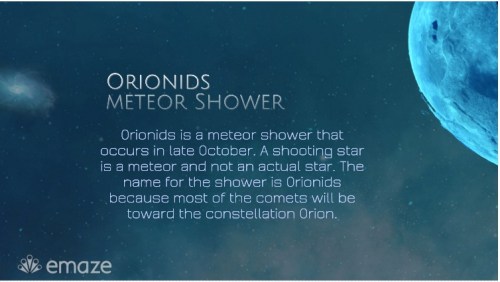
Click the image to view the Emaze.

Click the image to view the Emaze.

Know: Orionids is a meteor shower that occurs in late October. A shooting star is a meteor and not an actual star. The name for the shower is Orionids because most of the comets will be toward the constellation Orion.

Wonder: What Causes a Shooting Star?, Where Is the Big Dipper?, How Many Stars Are In The Sky?

Learned: A meteor is formed from rock that burns up in Earth’s atmosphere, causing it to look like a streak of light in the sky. A piece of a meteor is called a meteorite. The Big Dipper is mostly referred to as a constellation, but it’s actually an asterism. Our galaxy has about 200 billion to 400 billion star. Scientist predict that there are 100 billion to 200 billion galaxies in the universe. Based on the latest estimates, astronomers guess that there are 300 sextillion stars in the universe which is 300,000,000,000,000,000,000,000. That is 1 billion times 1 billion times 3!

Burning Question: How did they find out how many stars there are?
https://www.emaze.com/@AICIROTW/orionids

Days when learning and creativity come together I realize the true joy of discovery. I strive to give my students the open door that will lead them on their own journey of learning, not down a path I have designed, but one they have chosen. It doesn’t happen every day. But with Vannisa and her spark of interest in meteor showers, these two paths converged and made meaningful learning. Through blogging, she was able to share it with others. Win. Win.

Add your own Digital Literacy posts here:

Read Full Post »

Please use this button on your site for DigiLit Sunday posts

Please use this button on your site for DigiLit Sunday posts

This year I am trying out a new weekly assignment, Wonder Wednesdays. My students are required to choose their own wonder from Wonderopolis, read the information, and write a paragraph or two about their topic. I thought this would give them practice in nonfiction reading along with practice in writing informational paragraphs. I also wanted the element of choice involved. The students have been getting so excited about what they are learning that they can’t help but want to share. So I told them they could do a Wonder Presentation once each grading period.

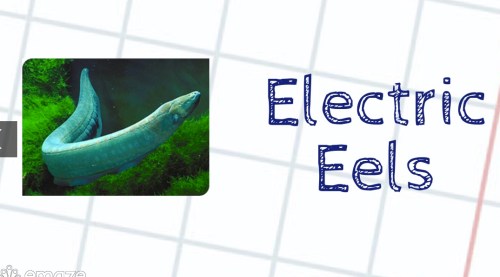
Emily was the first to present this week. She became interested in electric eels. This proves how important choice is. I would never have thought she would be interested in eels, of all things, but her family went to the Aquarium this summer, and she saw a live one. When she discovered from Wonderopolis that electric eels are not actually eels, she wanted to “trick” the class. Not only that, she created a quiz and kept up with points making the whole presentation totally engaging.

electric eels

https://app.emaze.com/@AIRTFIRQ/are-electric-eelsPowered by emaze

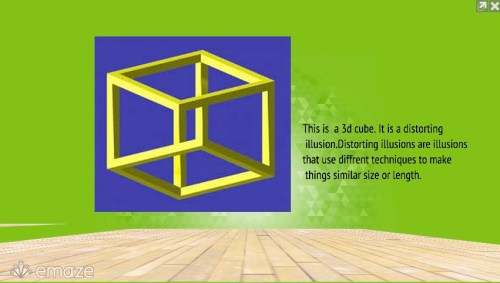
Andrew, 3rd grade, researched optical illusions. I had no idea there were different types. I encouraged him to try Emaze as a format for presenting his topic. Andrew is a gamer who is no stranger to technology. He created this presentation with ease. I love that this is a format that even my youngest students can use. Click on the image to see his presentation.

optical illusion

I am pleased that Wonder research has materialized into a student-led classroom. I value learning that is student-driven, when I can stand on the sidelines coaching, troubleshooting, and cheering them on.

Link up your digital literacy posts.

Read Full Post »

Please use this button on your site for DigiLit Sunday posts

Please use this button on your site for DigiLit Sunday posts

wonderopolis logo

Wonderopolis is a wonderful site for nonfiction reading. Last year I used the site once a week with my students. I picked out the “Wonder,” and created a Wonder worksheet for the week that included other language activities. While this method worked well for me as a teacher, it wasn’t so great for my students. They enjoyed the site, but they hated the other activities. And why not, they were teacher-created. They became a burden to them rather than a learning tool.

This summer I was thinking about how to change this plan and still take advantage of the Wonderopolis site. I read this post by Tara Smith. She talked about choice. She gave her students a form to fill in with a Wonder of their own choice. What a great idea!

Last week I started classes with my gifted students. I introduced the idea of Wonder Wednesday and choosing their own Wonders. For my birthday (on Tuesday), Lani had given me a small rubik’s cube. One of my boys, Tobie, couldn’t stop playing with it. He decided his Wonder would be about how to do a rubik’s cube. He found the question on Wonderopolis! Then he watched a video. He got other students excited about learning. (I could say he distracted others with his enthusiasm.)

cube-427897_640

After watching the excitement spread, I decided to give my students the option to present their Wonder learning using technology. I will present different tools in the coming weeks: Piktochart, Canva, Emaze, Powtoon, Animoto. One presentation each nine weeks will be required.

Teaching a variety of grade levels has its challenges. Wonderopolis has given me a way to differentiate nonfiction reading, empower students through presentation, and generate enthusiasm for learning. Here is a link to my student form.

Please join the DigiLit Sunday Round-up with your link.

Read Full Post »


Dig poetry


My friend who doesn’t write sent me the joke poem above.  My response was “You understand me. I dig deep.”  I have committed myself to write everyday this month about poetry.  I am not promising an original poem each day (but who knows?). To share our poetry activities this month, we are using #digipoetry.  Leigh Anne (@teachr4) made this button for our blog posts.  Feel free to use it, too.


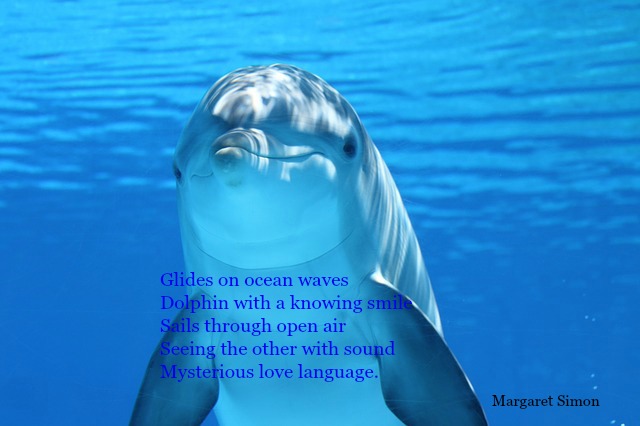
DigiPoetry buttonWednesday is a good day to wonder.  I wandered over to Wonderopolis and found a wonderful article about dolphins and echo-location.  To think about writing a poem, I collected words and phrases from the article.  After many false starts (rough drafts), I read about Nikki Grimes’ tanka contest.    Nikki Grimes’ contest for kids in grades 3-6: Tanka writing

Sometimes when writing doesn’t come easily, a form gives you the structure you need to create.  A tanka is similar to a haiku. There is no rhyme and a syllable count of 5, 7, 5, 7, 7.   Nikki Grimes has a book coming out in May, Poems in the Attic, which includes tanka.  (Click the link for more information.)

I used PicMonkey to create this image poem.

dolphin-203875_640


Read Full Post »

Join the roundup with Cathy at Merely Day by Day

Join the roundup with Cathy at Merely Day by Day

This was a week all about magic. We started the week with a visit from Magic Mike, not the one you are thinking of, but a magician from New Orleans. I knew him when he was a teenager performing at birthday parties, and now he is on his way to an international magician competition this summer. One of my students is obsessed passionate about magic. It was amazing to watch the two of them go back and forth showing tricks and slights of hand.

Then on Wonder Wednesday, we looked at optical illusions on Wonderopolis. So today when we used an image writing prompt, the National Geographic image of two penguins in Antarctica, our minds were on illusion.

Jacob is a first grade gifted student fairly new to my class. He often needs more prodding and questioning during writing time so that I have to give up my own writing to help him. Not so today. At the end of our quick write, he announced that he had a poem to share. Five minutes or so earlier he didn’t even have a word written for the word list pre-writing activity. I gave permission for him to “steal” any of the words other writers had shared. I was moved to tears when I heard his poem because I knew it signified a turning point. Jacob is now a writer!

Two Penguins

Two penguins walking in fields of popcorn.
Their love is black and white.
Sliding their bellies on the icy snow.
–Jacob, 1st grade

See image here.

My poem reflects the mood of the class, magic, illusions, and a little bit of Valentine’s Day love. Matthew created a card trick to go with my poem. He turned an ace of spades into an ace of hearts.

Spade to Hearts: A Magic Trick or Illusion?

I see a black spade
on Antarctic ice.
Mountains majestic, jagged, and tall
protect this frigid land
where two penguins
frozen in time
become a symbol
of love.
–Margaret Simon

Read Full Post »

Join the roundup over at These 4 Corners with Paul.

Join the roundup over at These 4 Corners with Paul.

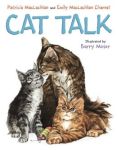
Cat Talk

Have you ever wondered why a cat lands on all fours or why its tongue is rough or if he really has nine lives? These are some Wonders you can explore on Wonderopolis.
I am a cat owner. I’ve had many cats in my life from my first cat Tommy to the meanest cat ever, Mimi. Years ago I picked up this beautiful poetry collection by Patricia MacLachlan and her daughter, Emily. The illustrations were done by one of my favorite artists, Barry Moser. I could spend time petting his cats. I love the poems because they do not rhyme. I am not a rhyming poet, and more and more, I embrace this fact of my poet-life. These poems captured the personalities of each cat from Tough Tom who climbs through the window to Peony who under all her fur is little.

I asked my students to notice the literary elements. We talked about many: personification, onomatopoeia, metaphor, simile, imagery, and alliteration. When writing our own poems, let’s try to use at least one of these elements.

Reed wrote while I read the poems. He was thinking about what Shakespeare said about the nine lives of a cat, “For three he plays, for three he strays and for the last three he stays.” – See more at: Wonderopolis

Bad Kitty

For three, he plays and plays with me.
Why, is it a sight to see.
The way he’ll twirl and whirl looking like a squirrel,
I start to wonder is he a boy or a girl.

Next three he stays in the allies on the streets.
Many people who look may think he’s sweet.
Trust me he’s not. I’m not sure he loves me.

The last he will stay and curl up with me
as I know I must let him free
onto heaven with a cat trinity.
–Reed

Tyler has experience with cats, too. His poem reflects found lines from Maclachlan’s poems.

A Cat’s Needs

The black shadows of the night,
Stalking their prey so silently,
Quietly licking your ankles,
and lying on your face
not wanting to move.
They have many things that
they like to do.
–Tyler

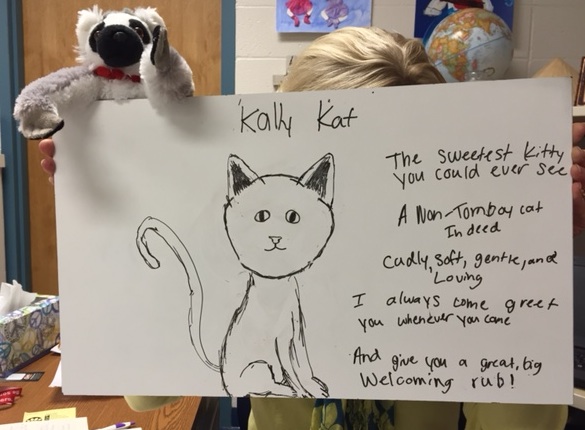
Emily illustrated her poem and took a picture of me and Jack (the lemur) holding it up.

Emily illustrated her poem and took a picture of me and Jack (the lemur) holding it up.

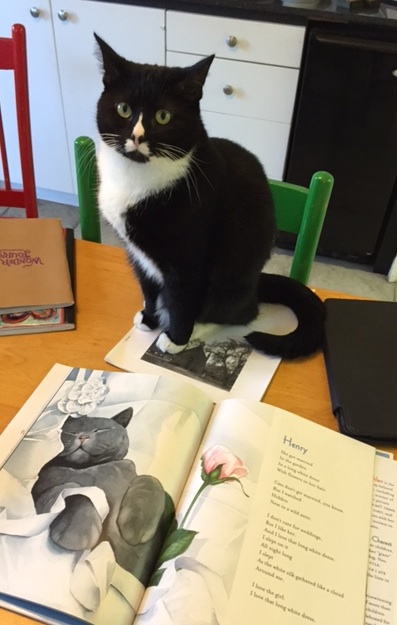
Mimi has no interest in poetry or Henry.

Mimi has no interest in poetry or Henry.

Read Full Post »

Find more Poetry Friday at Tabatha's blog, The Opposite of Indifference.

Find more Poetry Friday at Tabatha’s blog, The Opposite of Indifference.

Do you know what a bandicoot is? I didn’t. Neither did my students. We looked at bandicoots for the Wonder of the Week. After we read the page, watched the video, talked about the words, my new little first grader announced, “Now we write a POEM!” After only a few months he knows how my teaching flows. So, of course we did.

One of my colleagues found the poem Benjamin Bandicoot by A.B. “Banjo” Paterson.

If you walk in the bush at night,
In the wonderful silence deep,
By the flickering lantern light
When the birds are all asleep
You may catch a sight of old Skinny-go-root,
Otherwise Benjamin Bandicoot. (Read complete poem here.)

I asked my students to use alliteration in their titles and use at least 3 facts in their poems. I wrote, too, and settled for the acrostic form. It took me all day to write. Acrostics are not as easy as they look.

Busy
Australian marsupial
Nesting in a pile of leaves
Darkness cloaks
Insects are a delectable snack.
Creature with a ratty tail
Outback wanderer
Over land forager
Terrified of a bush fire,
Busy Bandicoot skedaddles.

Kielan worked more than a day on her poem and even created an Animoto video with it. I love her title, Banjo Boomsnicker Bandicoot.

Read Full Post »

Join the Poetry Friday Round-up.

Join the Poetry Friday Round-up.

My favorite librarian, Jone, has the round up today at Check it Out. Go check it out!

Inspired by a post from Linda Baie (who blogs at Teacher Dance) about using Eve Merriam’s poem Thumbprint at the beginning of the school year, I designed this week’s Wonder around fingerprints. We read this article on Wonderopolis. I asked students to select four vocabulary words from the Wonder Words. Then we watched this Prezi about annotating Eve Merriam’s Thumbprint. Then using the chosen words, we wrote our own poems. I also passes around an ink pad so my students could place their thumbprint on the journal page. I taught this lesson twice during the day to two groups of students, so I had the added advantage of writing two poems. Here’s mine.

Fingerprint

I own
a God-given design,
uniquely mine,
a painting of swirls
and whorls
imprinting me
on this page.
I own
an invisible touch,
a latent path
left on a note
from me to you,
this fingerkiss.

–Margaret Simon, all rights reserved

Read Full Post »

Join the Poetry Friday Round-up at Life on the Deckle Edge with Robyn Hood Black.

Join the Poetry Friday Round-up at Life on the Deckle Edge with Robyn Hood Black.


Due to Robyn’s shoulder injury (Get well quick, Robyn.), Irene Latham has taken on the roundup today at Live your Poem.

Cicada molting animated-2.gif
Cicada molting animated-2” by T. Nathan Mundhenk – Edited version of File:Cicada molting animated.gif. Licensed under CC BY 2.5 via Wikimedia Commons.

Taken by T. Nathan Mundhenk, in Centerville, Ohio USA July 30 2007. Each frame taken at 1 minute intervals. 30 minute gap in middle while cicada rested. The Cicada takes about 2 hours to complete the process.

This week was my first week back with my students. We read about bioluminescence of fireflies on Wonderopolis. This got me thinking about another insect, one that is loud at this time of year, the cicada. We read together two poems from The Poetry Friday Anthology of Science, Cicada Magic by Heidi Mordhorst and Cicada by Guadalupe Garcia McCall. We discussed the literary elements of imagery, rhyme, and personification. Then we wrote our own Cicada poems. Mine came out as an ode. One student’s response, “You’ve gotta love an ode!”

Ode to the Cicada

Your buzzy song rises
with the temperature.
Heat fans your wings
that saw the air
with sound.
You shed your exoskeleton
like a chrysalis
emerging larger and uglier
leaving behind a prize,
an ornament hanging on a tree,
a bronze clasp pen for my lapel.
Oh, cicada,
the memory of happy summer days
waiting, wondering,
whispering in wind’s ear
your creaky violin.
–Margaret Simon, all rigths reserved

This video is a quick look at the clouds outside with cicadas singing.

Read Full Post »

Please use this button on your site for DigiLit Sunday posts

Welcome to DigiLit Sunday. Please consider joining in the roundup by posting a Digital Literacy post and linking up with Mr. Linky.

I am working on framing my daily language lessons for my gifted students in grades 5 and 6 using WONDER. Here is a form for creating your own Wonder lesson. Wonder template for ELA (2) This framework will lead my students to explore Wonderopolis, an amazing educational site, as well as help them respond to real-world content. These frames are aligned to the Common Core Standards and use pre-AP skills.

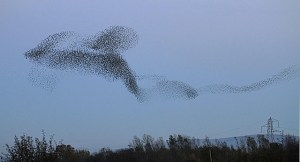
I worked on the Thinglink Teacher Challenge this summer. I wanted to put my Wonder framework into a Thinglink image. I used Starling Murmurations as the Wonder for this experiment. I also tried PollDaddy to embed two polls, one for a definition and one for a question. I put in links with each of the Wonder activities. These activities include

  • W- Exploring the wonder
  • O- What is your opinion?
  • N- Notes, find words of awe and wonder
  • D- Define phenomenon
  • E- On Tapestry, rewrite phrases to create a logical sentence.
  • R- Response to reading: Summarize and article.

Here is the link to Thinglink: 

Have you ever wondered about Starling Murmurations?

Have you ever wondered about Starling Murmurations?

I wonder if Thinglink will make the work of Wonder more motivating or more time-consuming.  Will Thinglink be a useful tool in my classroom or not worth the time it takes me to create one?  All this remains to be seen as I begin working with my students this year.  All in all, trying new applications is challenging and fun, so I hope my excitement translates to the children.

What new technology will you try this year?  Don’t forget to link up.

Read Full Post »

« Newer Posts - Older Posts »