Welcome to Wednesday This Photo Wants to Be a Poem Day. While you are here, take a moment to be in/ with the featured photograph. When you feel moved to write, write a small poem inspired by the photo. Leave some or all of your creation in a comment. Respond to other writers with positive feedback.
Today’s photo was taken by Molly Hogan. She is a teacher-poet-photographer friend in Maine. When I first saw and saved this photo, I hadn’t seen the full reflection in the water. I’m not sure where this photo was located, but I want to be there today. Don’t you?
God encircles us rainbow stretched over water glows endless hope
Thank you to Two Writing Teachers for creating an amazing community of writers and a safe, welcoming space to write and share.
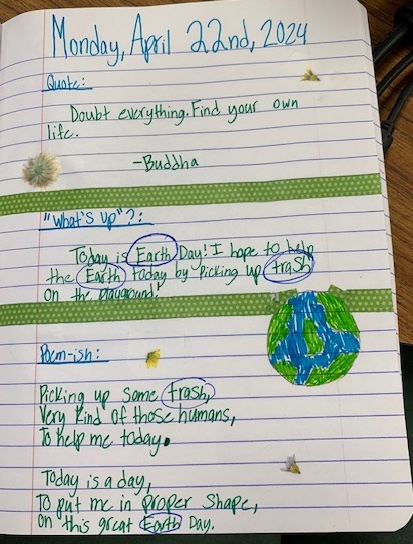
Monday was Earth Day and the weather could not have been more perfect. A cool front came through, so our temps were in the 60’s. I took each group of students outside for writing time. I opened the Merlin app and we talked about the birds’ songs we heard. It was a good day for listening, teaching, and writing. State testing starts Wednesday, so I was happy for the opportunity to sit outside and forget our worries.
Kailyn’s notebook page
Earth Day is also my father’s death day. He loved double numbers; his birthday was 11/11/33. He passed away on 4/22/22. Ethical ELA’s prompt gave me the space I needed to write about him and his love of trees.
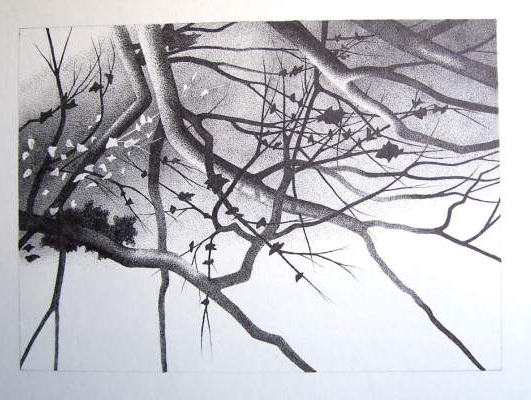
Dark Clouds by John Gibson
Earth Day Dedication
My father’s compass pointed to the trees, how the branches bent and blocked light shadows dotting landscape.
Once he told me trees grounded him in the present, reliable– long standing safety for Mother Earth’s children.
Yesterday I heard the “kow-kow-kow” of a yellow-billed cuckoo stopping in our tree from its journey across the Gulf.
The journey of life, as the cuckoo calls, is hard and easy. Some days you find rest, take a breath, sigh for Mother Earth and sing loud. (Margaret Simon, draft)
Kidlit Progressive Poem is moving along with apprehension and worry for our two refugees. See the latest line at Opposite of Indifference with Tabatha Yeats.
Thank you to Two Writing Teachers for creating an amazing community of writers and a safe, welcoming space to write and share.
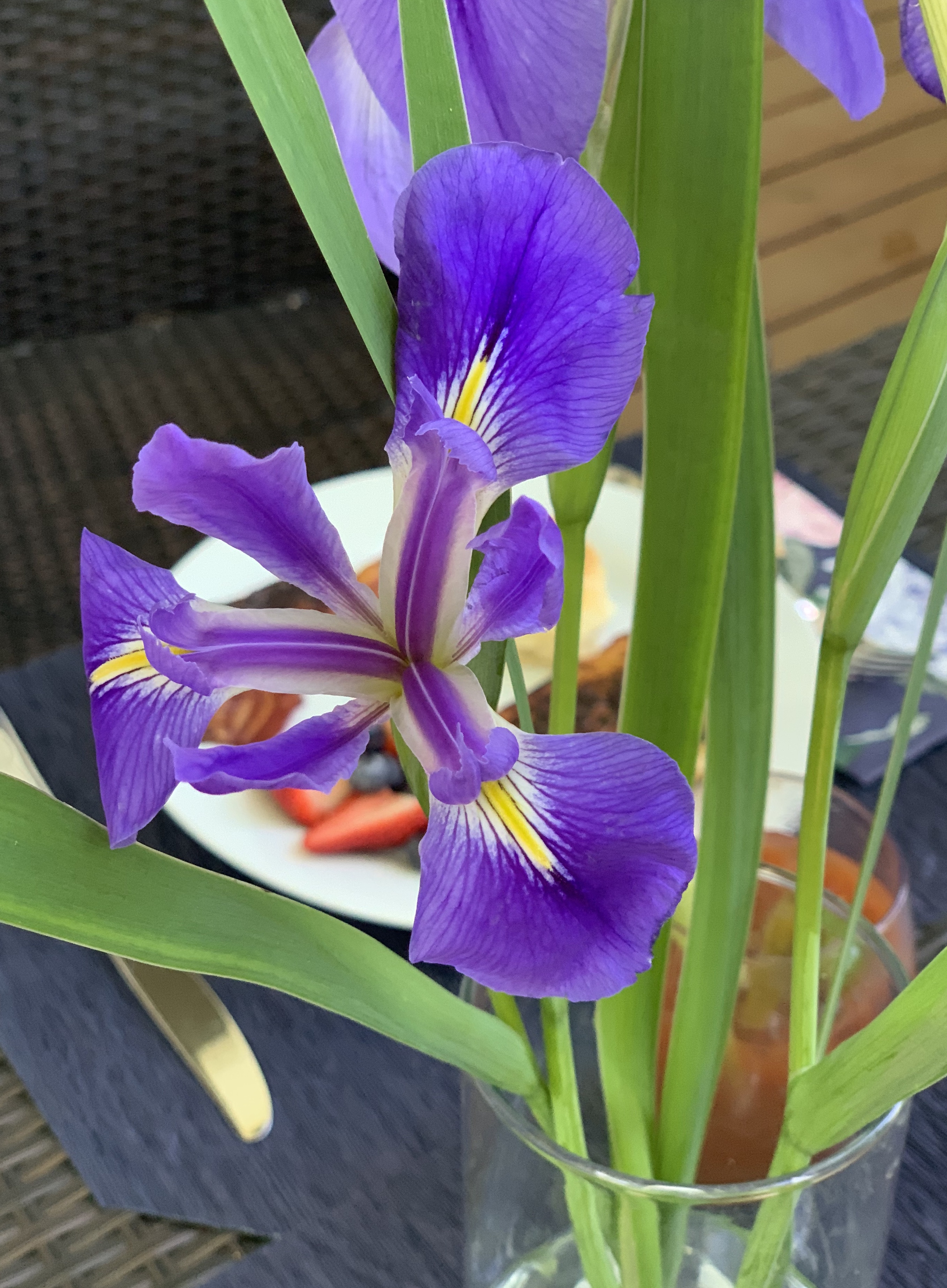
What an amazing month for flowers! They are everywhere. Knockout roses, wild purple salvia, native Louisiana iris. I even say a few poppies in a neutral ground. Jasmine is blooming sending fragrance through the windows. I am finding hope and poetry in the flowers this month. Today I want to offer two poems about flowers. I hope you are watching flowers blooming in your part of the world. Small daily miracles.
Louisiana iris clipped from our bog.
Iris in a Glass Vase
If you want to know hope as the deepest thing, look at each flower blossom. The iris yellow eyes like little candlelight wrapped in a purple gown. Nature plants seeds for us to notice new life to believe that God wants us to rise up and wink at the sun, to hear the sounds of birds as they shout out loud, We are here! We are here! We are here!
Margaret Simon, draft written to my own prompt on Ethical ELA
This next one is after Clint Smith as prompted on Ethical ELA. Pop over to see many wonderful poems.
Today I will write a poem about a small white flower opening overnight to burst into fragrant song–
Jasmine climbs boldly over a picket fence persisting to be here in a place where no one cries, innocently hidden from view.
The scent of it opens over spring breeze announcing its place in the family of things.*
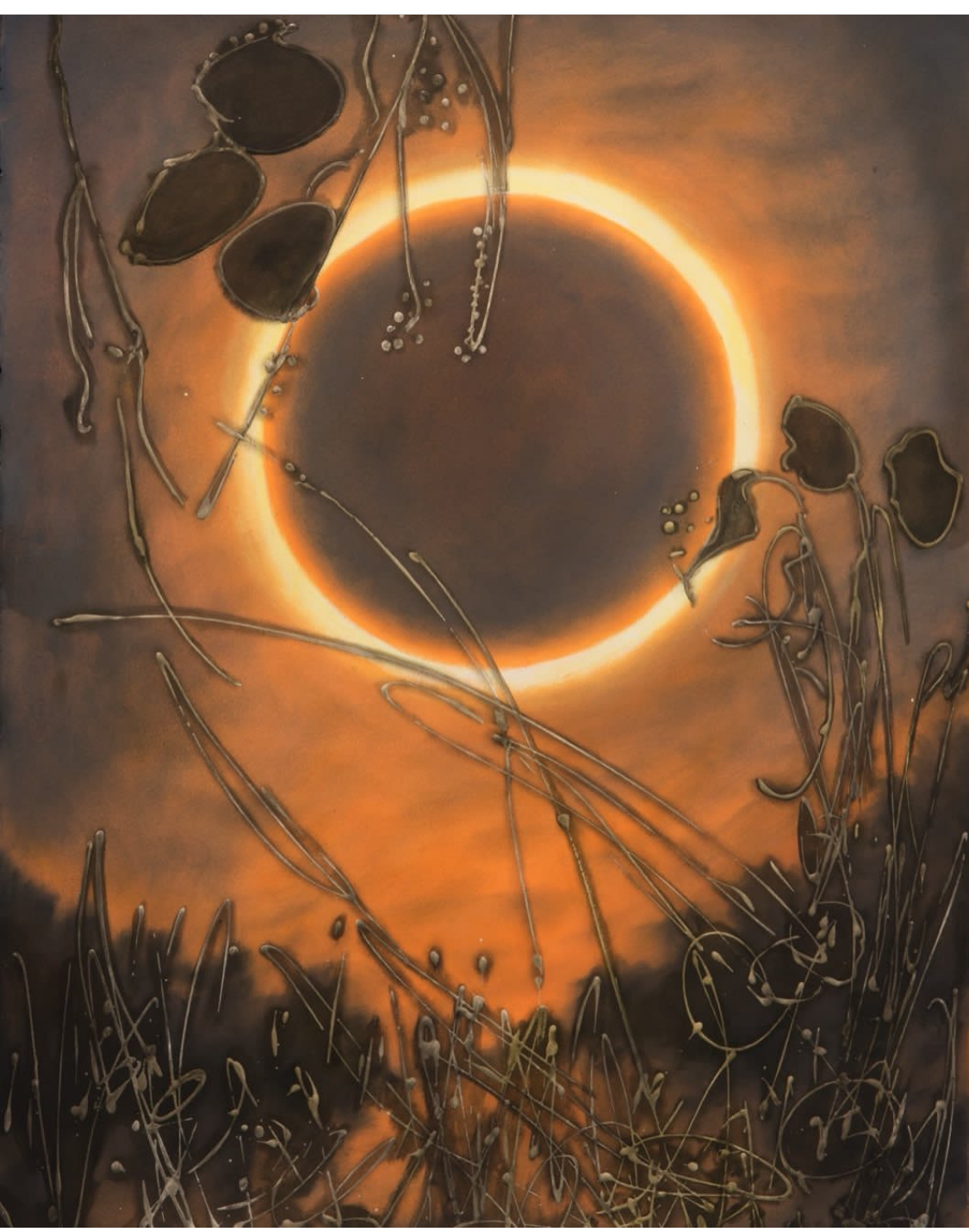
This painting by my friend, artist Melissa Bonin, was exhibited at the Acadian World Congress in 2019 in Moncton, New Brunswick, Canada. When Melissa posted this photo of her art on Instagram, I was inspired to ask permission for our ekphrastic poetry this week.
Did you experience the eclipse? The experience was exciting for everyone. Although there were clouds and rain, a few times the sun peeked out and we were able to view it. My students were fascinated.
Every day we Come closer to Learning our lesson. I stand in awe Pretending to feel Safe on our fragile Earth.
Margaret Simon, draft
Please write a small poem in the comments. Encourage other writers with your responses.
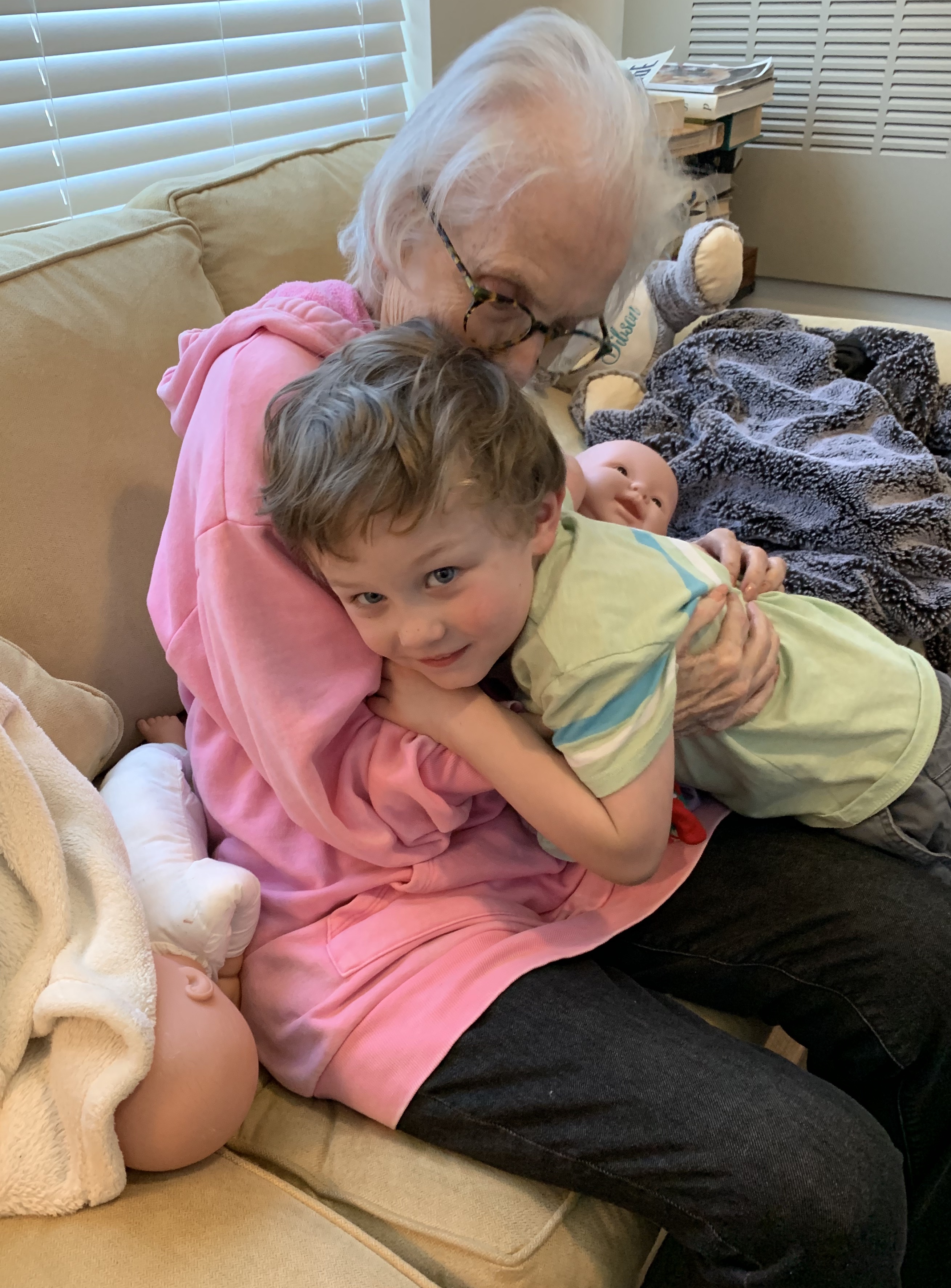
Visits with my mother are hard on me. I don’t live near enough to get used to her Alzheimer’s silence, the confused look in her eyes. I keep thinking one of these days I will accept this. But it seems so unfair. She was such a vibrant and thoughtful person. She is safe and happy and generally in good health, so I convince myself I should feel gratitude. Despair and grief take over. I can’t even look at this photo without tears welling up.
At Ethical ELA, we were prompted by Katrina to write about a photograph. I chose the one above.
We see a child delighted to hug his great grandmother generations of love passed on with a kiss on top of his head.
We don’t see the grief seeping into the moment the loss of a mother whose memories fleet past through empty eyes always questioning.
Robert selected the topic of everyday miracles for this month’s Spiritual Journey posts. Jennifer Jowett led us at Ethical ELA to explore a letter of the alphabet. Combining both prompts, I wrote about the letter M, my first initial that carries the legacy of my grandmother as well as the letter of my grandmother name, Mamère.
M is for miracle, mountain of twin peaks, how mothers are made, become Mamères watching a boy learning to write his name- “up, down, up, down” ride the pen roller-coaster how calligraphic M wears a fancy dress to the letter party. Maybe M moves mountains, makes miracles, but most of all M glows in the heart when your child mutters, “Mom, I missed you.”
Margaret Simon, draft
I continue to find fascinating words to write about. Today’s word lulu means an outstanding example of a particular type of person or thing. Years ago we rescued a greyhound who came with the name Lulu. I had no idea that the name had this meaning. This poem is sometimes called taking a word for a walk.
Lulu is a luxurious word we say with a lulling lilt calling the lazy dog- a lulu of a greyhound- blond furry wind a blur when she ran. She loved lulu weather. We love our Lulu memory.
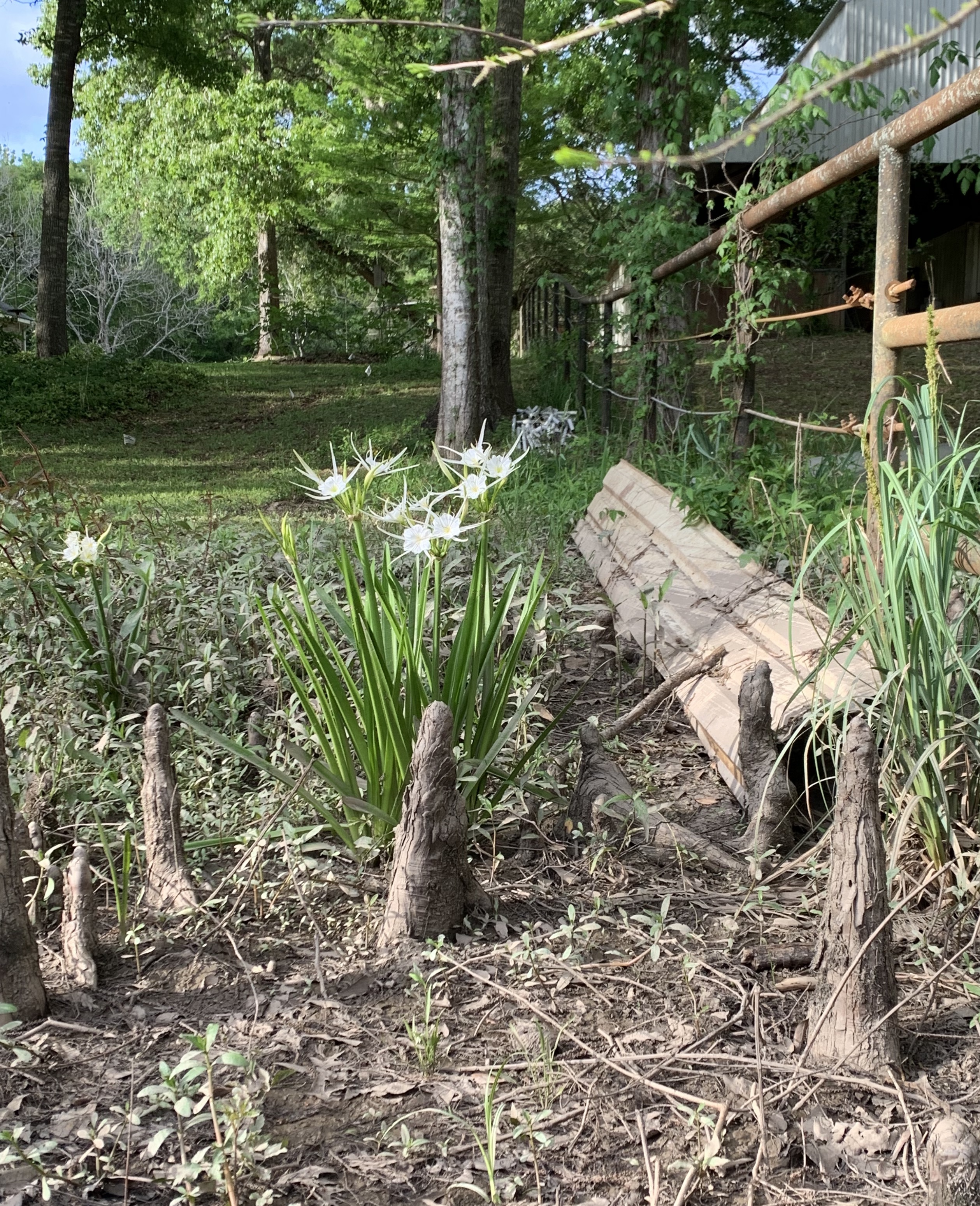
Spider Lily among cypress knees on Bayou Teche, Louisiana
I wanted this swamp lily to be a star lily, but research is telling me it’s a variety of spider lily. On Ethical ELA, the prompt by Wendy Everard asks us to explore the place of a favorite poet. I chose Mary Oliver and a striking line from her poem Fall: “what is spring all that tender/ green stuff”
I’m not sure what heaven is but amazement like spring when all green that was hiding in tender seed fills green bridal bouquets blossoming beautiful stuff.
Margaret Simon, draft
I’m also writing a word poem each day. Today’s word is vernal which means of, in, or appropriate to spring. Today’s form is an acrostic.
Variety of colors eagerly popping- resurrection- nature’s recital. April, I Love you.
Day two of the Kidlit Progressive Poem is with Jone today.
This National Poetry Month, I am writing word poems using random words that come into my life.
I’m taking care of my 4 year old grandson while his mother is on a work trip. Today’s elfchen is playing with the word shambles.
Shambles Elfchen
Shambles of toys on Mamere’s floor a kingdom of pretend Lightstep
Margaret Simon, draft NPM 24
I’m also following Ethical ELA prompts. Today’s prompt “The Magic Box” was an interesting practice in synectics, combining words together that normally would not be connected. The intent was to release some of the insecurity in writing, loosen our muscles so to speak.
Whistle While you Walk
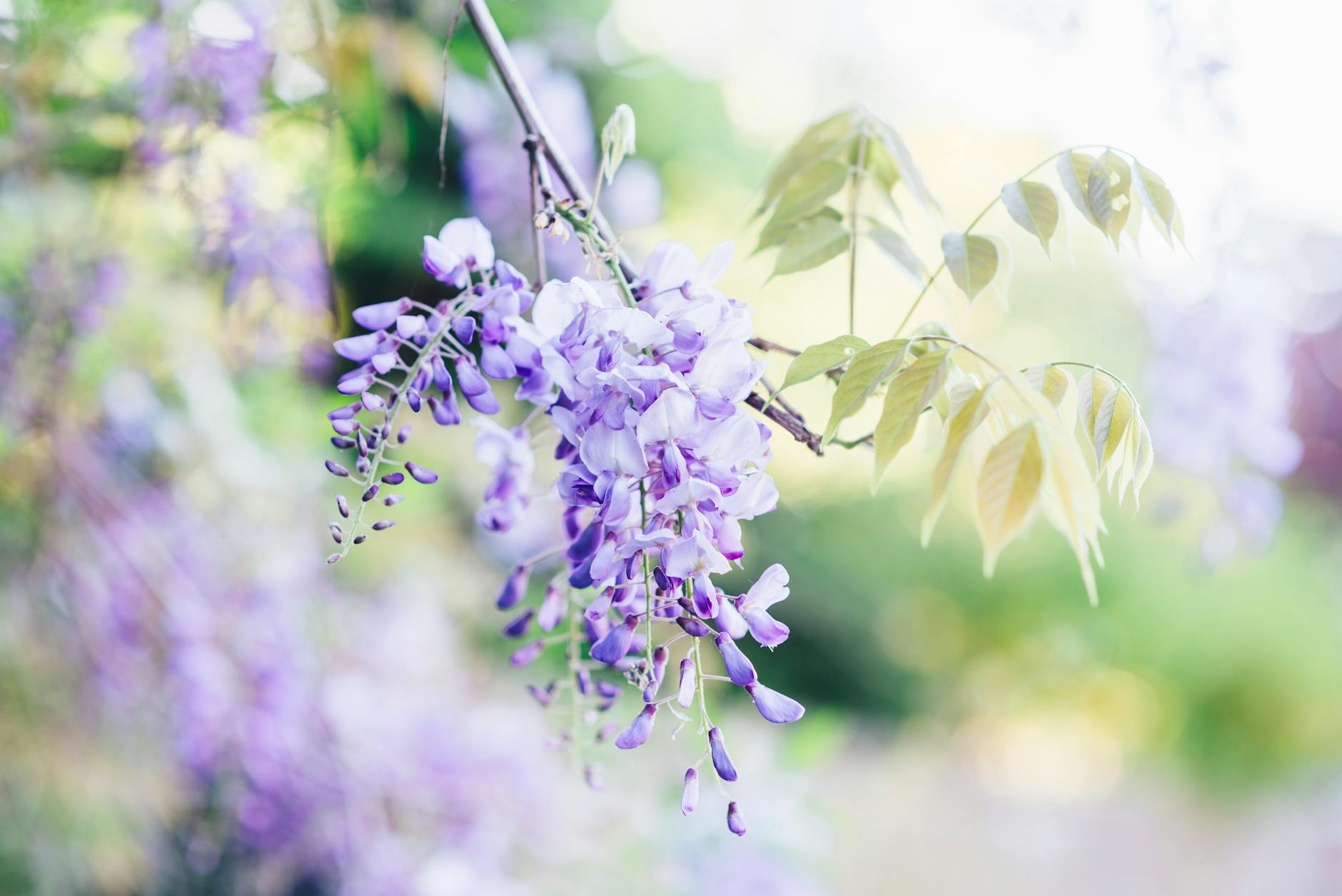
Wisteria hangs like lavender bubbles marching across the dog-ditch. Like a child, blossoms whisper, “I exist to please you.”
We are all monster trucks traveling through construction, a long and dusty road.
Take me on a spring walk, blow a dandelion–a train whistle to the wild world.
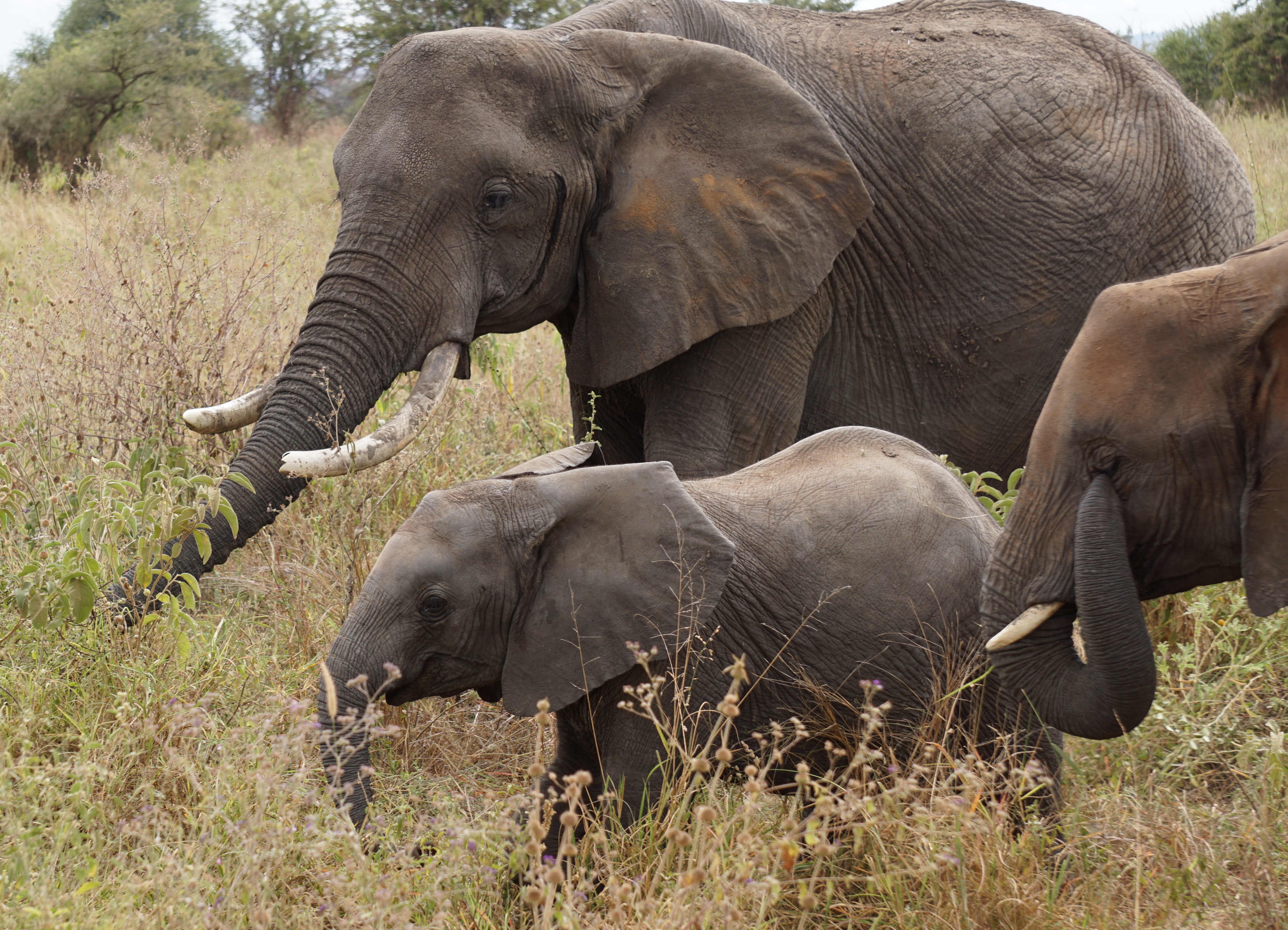
I was inspired by Michelle Kogan who wrote a pantoum for a hippo. I recalled the hippos of my Africa tour in 2016. I’ve been reading Margarita Engle’s verse novel Singing with Elephants. I collected lines from the verse and went to work on the pantoum form. This form is like a puzzle. Michelle fit hers together with rhyme. I didn’t use rhyme. When I googled pantoum, there doesn’t seem to be a rule about rhyme or line length. The rules show that each stanza is four lines with this pattern: (1,2,3,4) (2,5,4,6) (5,7,6,8) (7,3,8,1)
The Poetry Sisters respond to a challenge on the last Friday of the month. This month they are writing animal pantoums. Our host Tricia has more about the form and links to other Poetry Sisters posts.
The beauty of an elephant’s hum-hug, a language as common as buzzing bees, simple as spending time with kindness. Elephants embrace us with their music.
With a language as common as buzzing bees, I can catch good luck as it passes. Simple as spending time with kindness, these animals move like magical mountains.
I catch good luck as it passes: Photo from Africa is a touchstone of memory. These animals move like magical mountains with a touch of heavy gentleness.
My photo from Africa is a touchstone of memory, as simple as spending time with kindness– A touch of heavy gentleness– the beauty of an elephant’s hum-hug.
Margaret Simon, with thanks to Margarita Engle and PÁDRAIG Ó TUAMA.
Margaret Simon lives on the Bayou Teche in New Iberia, Louisiana. She is a retired elementary gifted teacher who writes poetry and children's books. Welcome to a space of peace, poetry, and personal reflection. Walk in kindness.