July is a popular travel month. Heidi challenged the Inklings to write a postcard poem for this first Friday. “Write a short postcard poem with choice details of your vacation/holiday/getaway/escape location and activities. Conclude with “Wish you were here” or some variation!”
Unfortunately, we had to cancel a Europe trip due to my husband’s injury. I have been perusing social media and pondering the travel of my friends. This is not a healthy situation. I’m having bouts of travel envy.
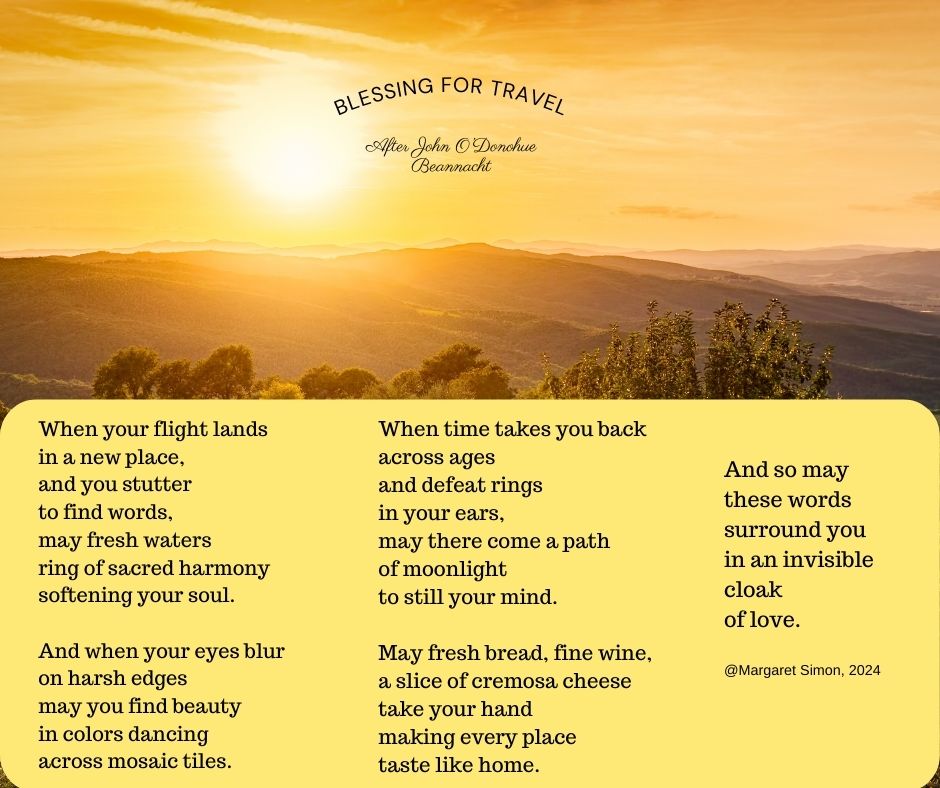
A friend recommended John O’Donohue’s interview on the On Being podcast. O’Donohue died young in 2008. His interview with Krista Tippett was inspiring. I was especially attracted to his poem “Beannacht” found in his final book: To Bless the Space Between Us: A Book of Blessings and used it as a mentor poem for my poem “Blessing for Travel”
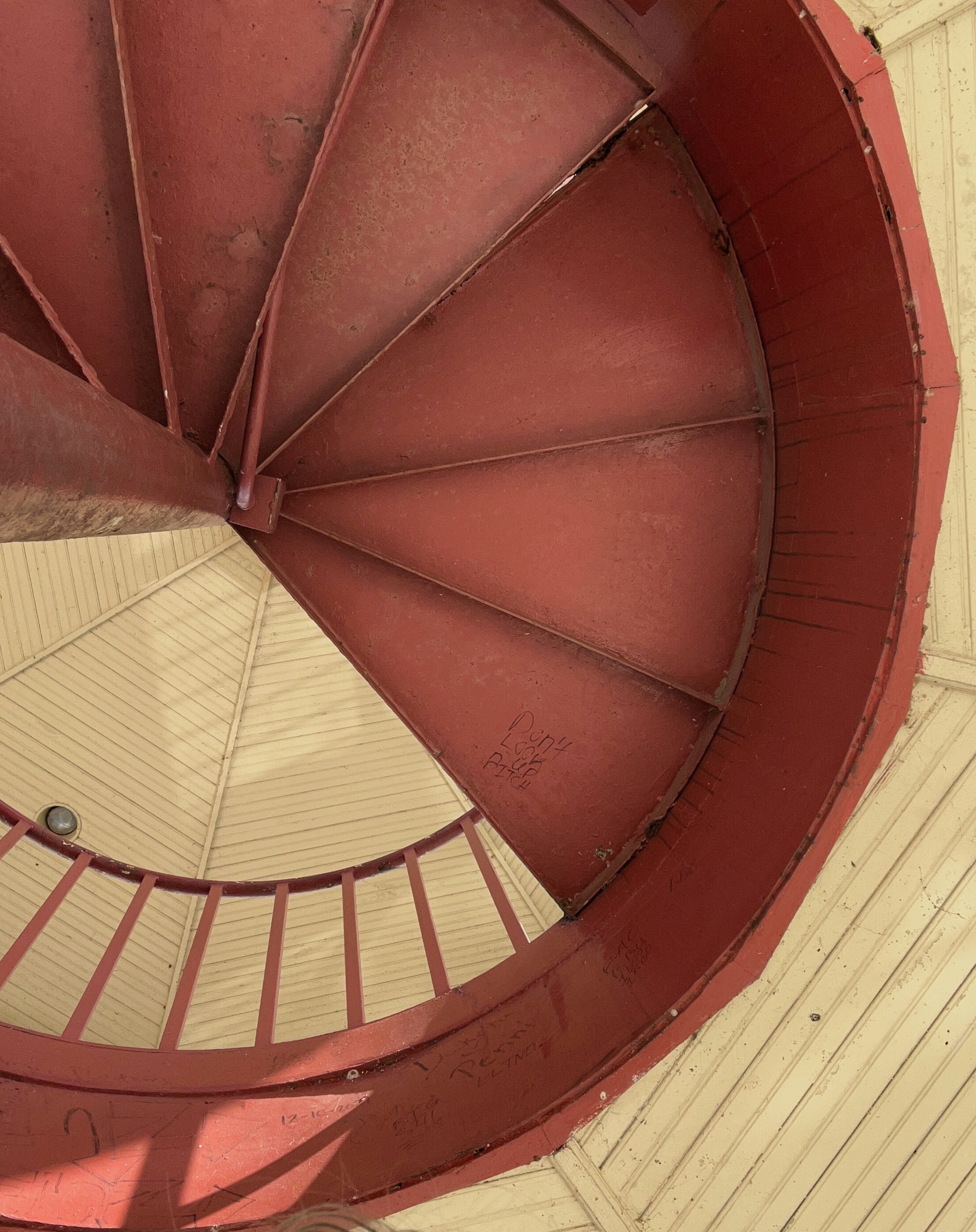
My grandson Thomas “Tuffy” (age 4.5) is visiting. I took him to get ice cream at a shopping center near the bayou. There is a gazebo that has a bayou lookout up a small metal spiral staircase. I was worried about going up and coming down, but Tuffy and I did it. Tuffy did it over and over, coming carefully down by sitting on each stair.
Photo by Thomas
I had my phone out to take pictures. When I gave it to him, he knew exactly what to do. Some of the shots were selfies of his face in different expressions. But one of them missed his head altogether and became an intriguing photo of the spiral stair. This made me think of the Fibonacci sequence (1, 1, 2, 3, 5, 8, 13…) that mathematically makes a spiral. Today I am echoing Langston Hughes’ line “Life is no crystal stair.”
Life can be a spiral stair anchored gracefully to solid ground–imagining a future full of open sky, pathway to purpose. Margaret Simon, draft
Please respond with your own small poem. You can use the Fib form if you choose. Leave encouraging comments to other writers.
The annual Summer Poetry Swap is coordinated by Tabatha Yeatts.
This week I received my first poetry swap poem from Rose Cappelli. Rose sent a dreamy note tablet, a Mary Oliver poem, and a cascade poem about peonies. As Rose explained, in a cascade poem, each line from the first stanza repeats as the final line of each subsequent stanza. Rose does this seamlessly.
Thank you, Rose, for the lovely cascade poem.
My mind has been on the flowers, prompted by Mary Oliver, Rose, and Maggie Smith. I subscribe to Maggie Smith’s Substack newsletter. This week she wrote about naming things.
“I love when I can accurately identify things when I see (or hear) them: a bird, a tree, a flower, a constellation, a kind of nest. (As the poet Pattiann Rogers once said in an interview, ‘naming is a form of honoring something.’)”
Maggie also writes about not knowing the name of something and how that can lead to wonder and discovery. I found a flower in my mother-in-law’s collection of pots that she nor I could identify. We could tell it was a type of hibiscus. I began by writing a list of metaphors. I am still playing with how to insert the not knowing, but wanted to share the small poem that I wrote in my notebook.
Hibiscus Moment
You are Love’s red lace, blooming beet-red bow on a woman’s flowing gown.
You open only for a day flirting like a spool of yarn to a kitten, taunting us
to feel unhinged with marvel. So much bravery in your fleeting face. (Margaret Simon, draft)
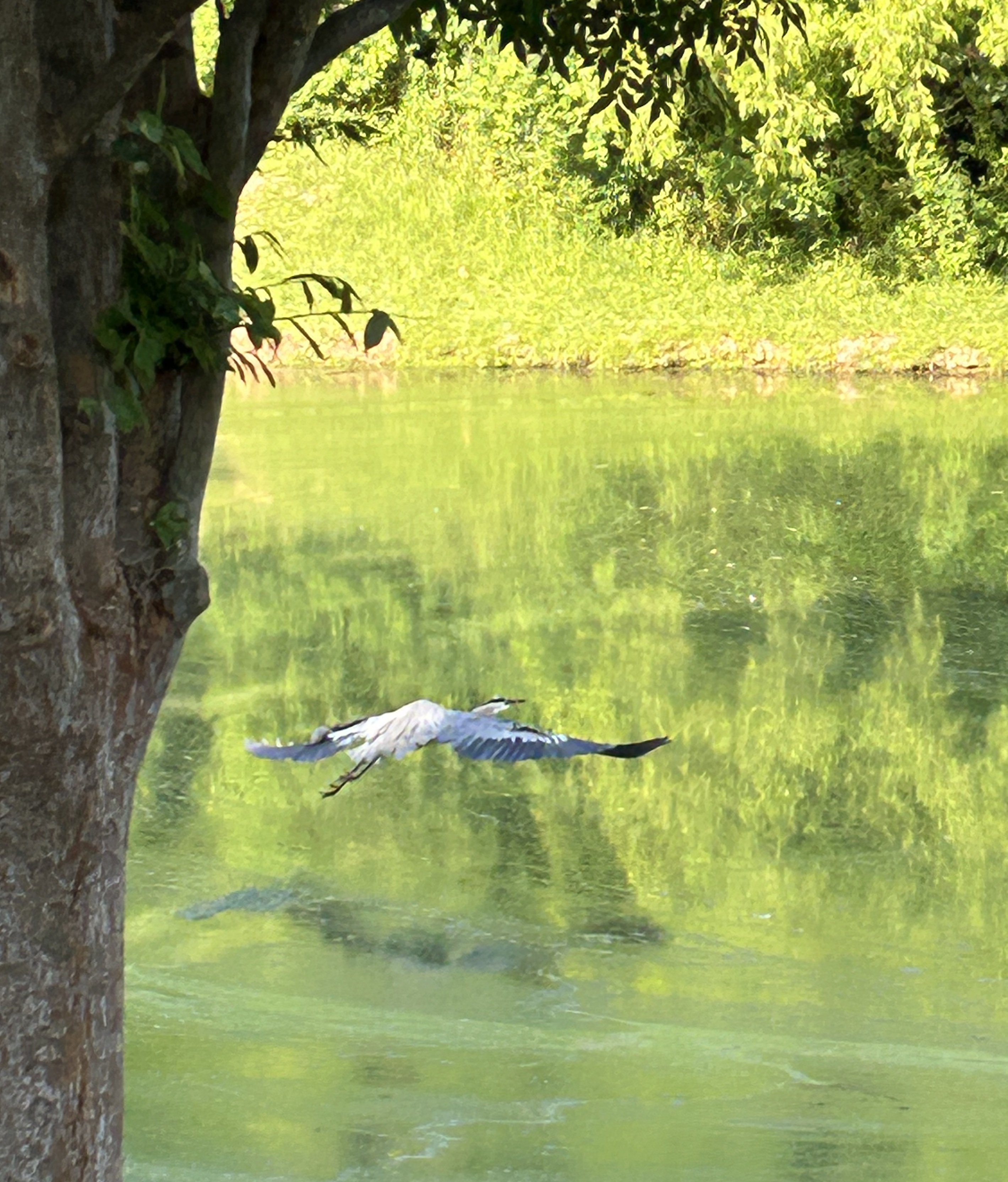
Great Blue Heron on Purple Creek, Ridgeland, Ms. by Margaret Simon
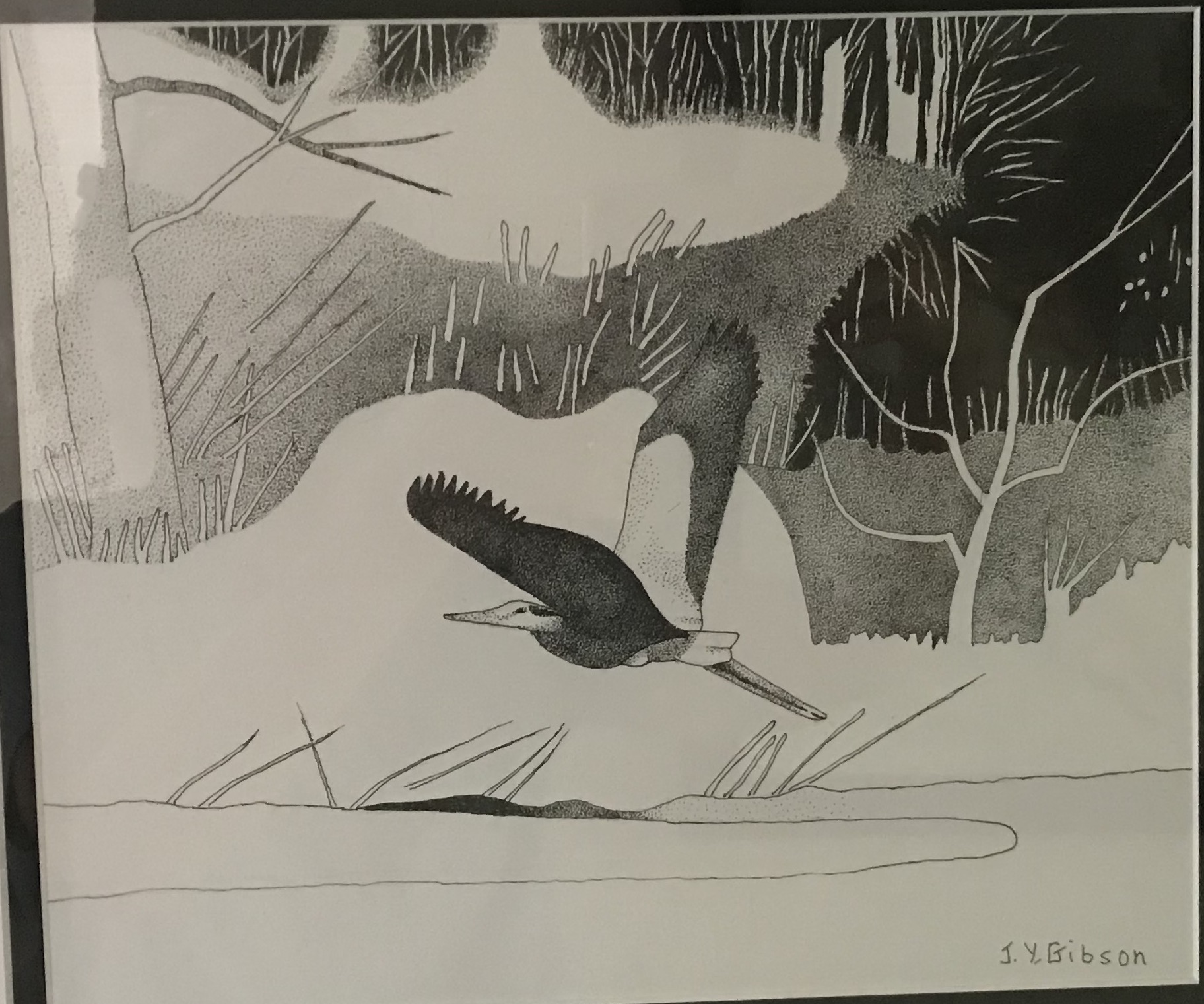
On a recent visit to Mississippi, I caught this flight of a great blue heron on my phone camera. The wingspan of these birds amazes me. They fly low across the water and perch near the water’s edge to forage for minnows and other small aquatics. This photo reminds me of a drawing my father did of a heron over the water.
Heron in Flight by John Gibson
I invite you to write today using these photos as inspiration. Leave a small poem in the comments and support other writers with your responses.
The Flight of the Great Blue Heron
Poised dawn glider Horizon solitude Regal wave to God
Thank you to Two Writing Teachers for creating an amazing community of writers and a safe, welcoming space to write and share.
On Saturday morning, my husband and I set out on an adventure to buy a puppy. The previous day, Friday, the eggs in our wood duck house began to hatch. This year we did not have a wood duck, though. The sitting mother hen was a black-bellied whistling duck. We have a Ring doorbell camera mounted in the nesting box near the bayou. We’d been watching the comings and goings of this hen for 30+ days.
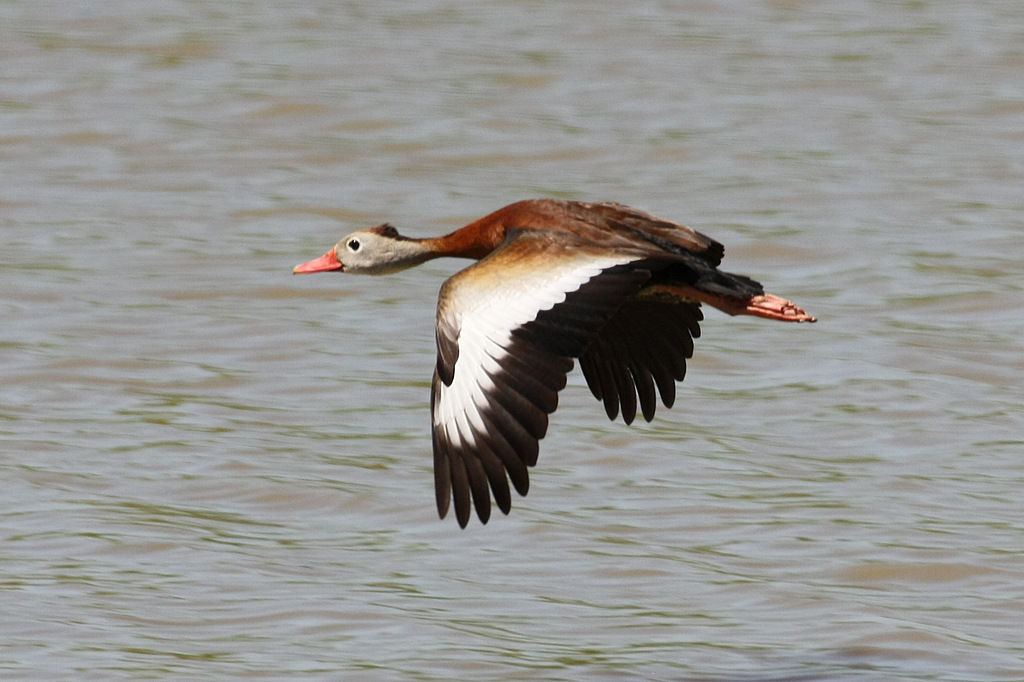
Black-bellied whistling duck from Creative Commons
Wood ducks hatch on one day and jump from the nesting box on the next day, Jump Day. So do whistlers. Because we were on the road, we were watching the jump from my phone. I became distressed when I realized one of the babies had not jumped. He was jumping and flipping, but not toward the metal mesh that serves as a ladder. Time passed, so I was convinced the mother and the other 14 babies were well on their way down the bayou. What should we do?
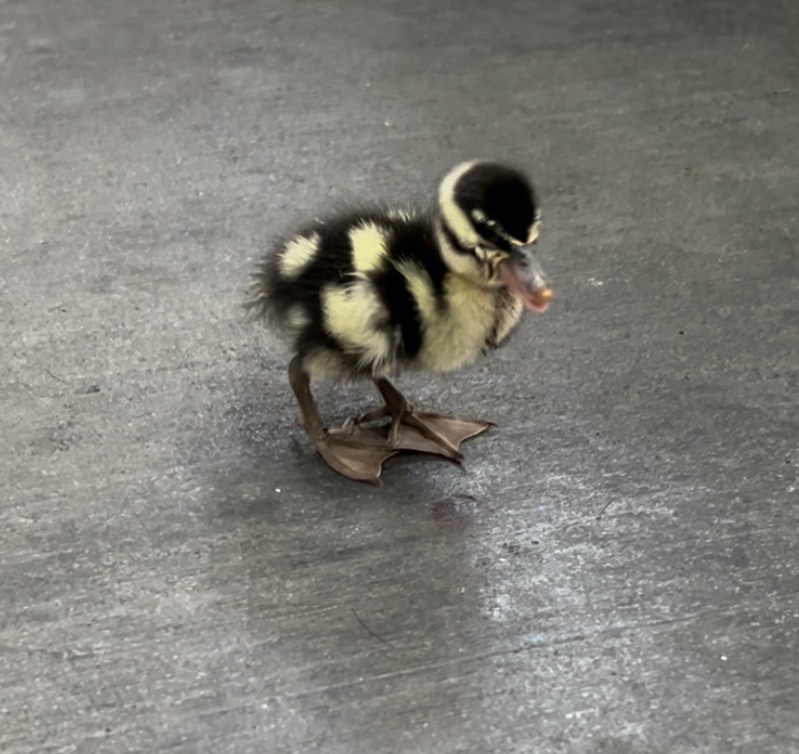
Call Ric, of course. I tried Ric and his wife as well as my neighbor Shirley. All became concerned. And the next time I checked the camera, the baby was gone. At first I assumed he had finally made the leap. Then I got a call from Ric’s wife, Svitlana. She is well known for rescuing animals, cats, dogs, and owls. (Here is a link to the owl story.) She had the baby duck and was researching what to feed it.
On Saturday, we successfully found a new puppy. He is settling in and bringing us joy. We walked over to visit the baby duckling. He is also settling in and bringing joy. His (or her) little life was saved. Ric and Svitlana will keep him safe until he’s big enough to fly. Whistlers are migratory birds, so they have an instinct to leave. The owl has not left the area. He still calls across the bayou every evening to remind us that wild animals can be saved.
“Utochka” Ukranian for little duck. Baby Black-bellied whistling duckling- take a look at those big feet!
I have fallen out of a daily writing practice. I don’t have my students to keep me honest. Summer break has seeped into my psyche and everything feels like a pause. Good news I feel rested. I’m sleeping better, and my daily exercise has leveled up. But I feel guilty about the writing. I really thought I would do more of it.
Ethical ELA helped me out this week with daily prompts for June’s Open Write. On Saturday, Sarah Donovan started us out with a prompt from June Jordan’s poem “These Poems.”
These poems after June Jordan
These poems they are sated with sweet wine.
These lips open for words whispered to wind.
These wishes wander in warm sun hoping to find your heart to hold.
I follow these strokes stem by stem scribbles of ink seeking recognition.
Do you see me?
On Sunday, I led the prompt about writing a duplex poem after Kay Ulanday Barrett who wrote after Jericho Brown. The poem I wrote came to me after my husband’s recent dog bite injury. Everyone we talked to wanted to know all the details. He is doing better, but he is wearing a wound vac that is a gismo that continually pumps the bad stuff out of his wound. We are hoping this method works toward faster healing. (Thanks for all of your thoughts and prayers.)
the poem what it wants me to hear today. What thread runs through the details?
Everyone wants to know the details. What happened at the corner lot?
What happened at the corner turned his life, his legs inside out.
Turned his life, his legs inside out, details that thread the woven story.
They tell details to thread the woven story. Shout for justice for the finish line.
Say justice is truth; shatters the plan, pulls the thread on the whole thing.
Pull a thread, the whole thing changes to what the poem wants me to know.
Monday’s prompt was from Susan Ahlbrand. She shared clips from Gilmore Girls to prompt us to write about graduation day. I took a quote from Lorelei who said, “I’m not crying.”
On the final day, I was taking care of two of my grandchildren, so I put together a quick book spine poem, prompted by Jessica, from my daughter’s son’s shelf. This week revived my soul and hopefully put me back on a path of daily writing.
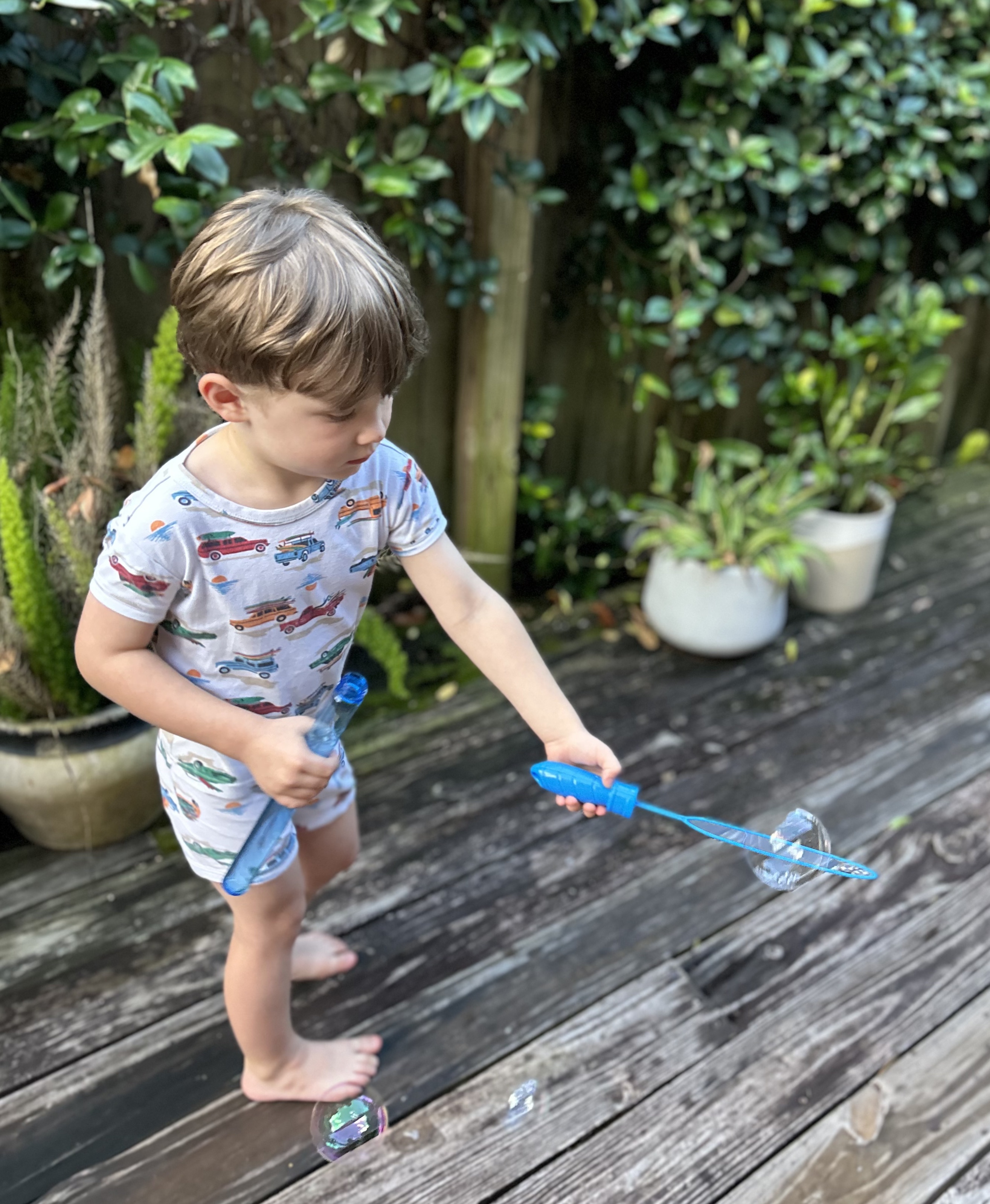
This morning I am waking up with Thomas. His mother is on a work trip, so I am being Mamére. Thomas is fascinated by bubbles. He has a bubble blower and a collection of bubble wands. Early in the morning, this is his outside play time in between bites of cereal.
I wrote 3 poems for Two Truths and a Fib, an anthology by Bridget Magee. In that book, I have a bubble metaphor poem, acrostic, and Fibonacci poem. Since another fascination of Thomas’s is numbers, I decided to write another Fib poem. The syllable count follows the sequence, 1, 1, 2, 3, 5, 8 (and so on, if you choose).
Bubbles
Trapped Air circles in the wind caught in a rainbow– A fascinating wonderland.
Margaret Simon, draft
I invite you to write a small poem today. Please respond to other writers with kind encouragement. Thanks for stopping by.
Last Friday as I read different Poetry Friday posts, I noticed the trinet form. Rose Cappelli wrote one about peonies. I have not tried this form yet, so I decided to offer it today. The form is 7 lines, 2 words in lines 1, 2, 5, 6, and 7, 6 words in lines 3 & 4.
I went on a swamp tour yesterday and dragonflies were flitting all around. Then I saw Julie Burchstead’s beautiful Facebook photo of this one, perfectly posed for a picture. Dragonflies are common insects. I found this on a dragonfly website:
“Dragonflies are similar to damselflies, but adults hold their wings away from, and perpendicular to the body when at rest. Their two sets of wings work independently, allowing dragonflies to maneuver through the air effortlessly. Their huge eyes give them incredible vision in almost every directions except directly behind them.” If you want to use some facts in your own poem, go here.
Dragonfly wings aerial lift flittering over stillness in sacred swamp summer days echoing of cicada song daring us to reflect light–shine!
Margaret Simon, draft
Please leave your own poems in the comments and respond to other writers with encouragement. Happy Summer!
Poetry Friday is hosted today by Tracey Kiff-Judson at Tangles & Tails.
Here we are again with a monthly Inkling challenge. This month Molly challenged us with a prompt from Pádraig Ó Tuama who said “A poem is a word-event going in many directions at once. Sometimes the “you” of a poem is a specific person, at other times it’s the poet, or a general audience, and at times there’s no you at all so the poem addresses itself to the world.”
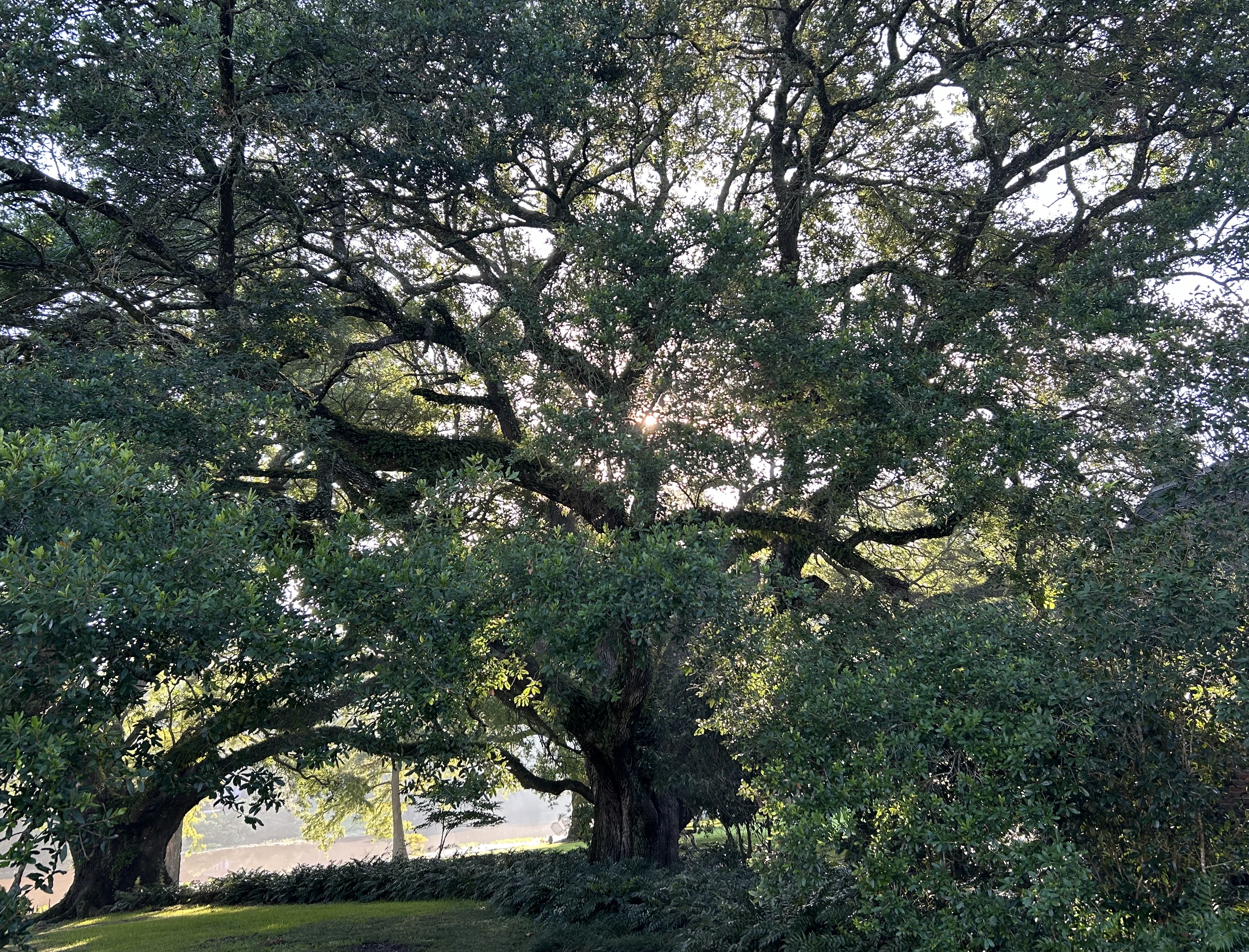
Molly asked us to write a narrative poem that includes observations about the world and explores the craft of address, the you of a poem. On a recent morning walk, I spoke two observations into my notes app. I felt invaded upon when a truck high up on oversized wheels revved its engine at me as it passed. The other observation was not connected at all. I saw oak tree arms leaning on electric wires. We’ve had a number of sudden storms this summer, and each one is frightening. That’s all to say that poetry is a place where I can vent; I can let steam rise and fall. I address this poem to the you of a random monster truck.
Grandmother Oak Sunrise June 6, 2024
You disturb my peace.
You! with your hot wheels rumbling down the road, motor revving, disrupt this peace of mind I’m in writing a poem in my head about birds singing.
Birds sing as you pass, your rolled-up windows beat-boxing, shaking a rhythm
of my walking, heart pumping brow sweating. I’m in this groove you move your hard edge against.
My poem wants to be kind, but I cannot wash away your harsh sound that erases the wind heaving a heavy sigh
like the old oak arms leaning on electric wires holding heavy vibration– a lightning bolt I cry
to be saved from.
Margaret Simon, draft
Take a look at how my Inkling friends approached this challenge:
In these first few weeks of summer, I find myself lingering. Taking my time on my morning walk to stop and take a picture, visit with a neighbor, enjoy the bird songs. I linger over morning coffee. I know this is how it should be, but there’s this little mouse in my brain that thinks I should accomplish things. I sing to myself “It is Well”.
When peace like a river, attendeth my way When sorrows like sea billows roll Whatever my lot, thou hast taught me to say It is well, it is well, with my soul
It is well With my soul It is well, it is well with my soul
Audrey Assad
Peace is my one little word for 2024, so I pay attention. Peace comes to me in songs, in the sounds of the birds, in the slowing down of summer.
When I stopped to take pictures in my neighbor’s garden, she said, “Now write a haiku.” She laughed, but that is what I did. Haiku is a perfect form for peaceful nature noticing.
Canopy of oak arms reaching, tossing tumbling light– peace attends my soul. photo and haiku by Margaret Simon
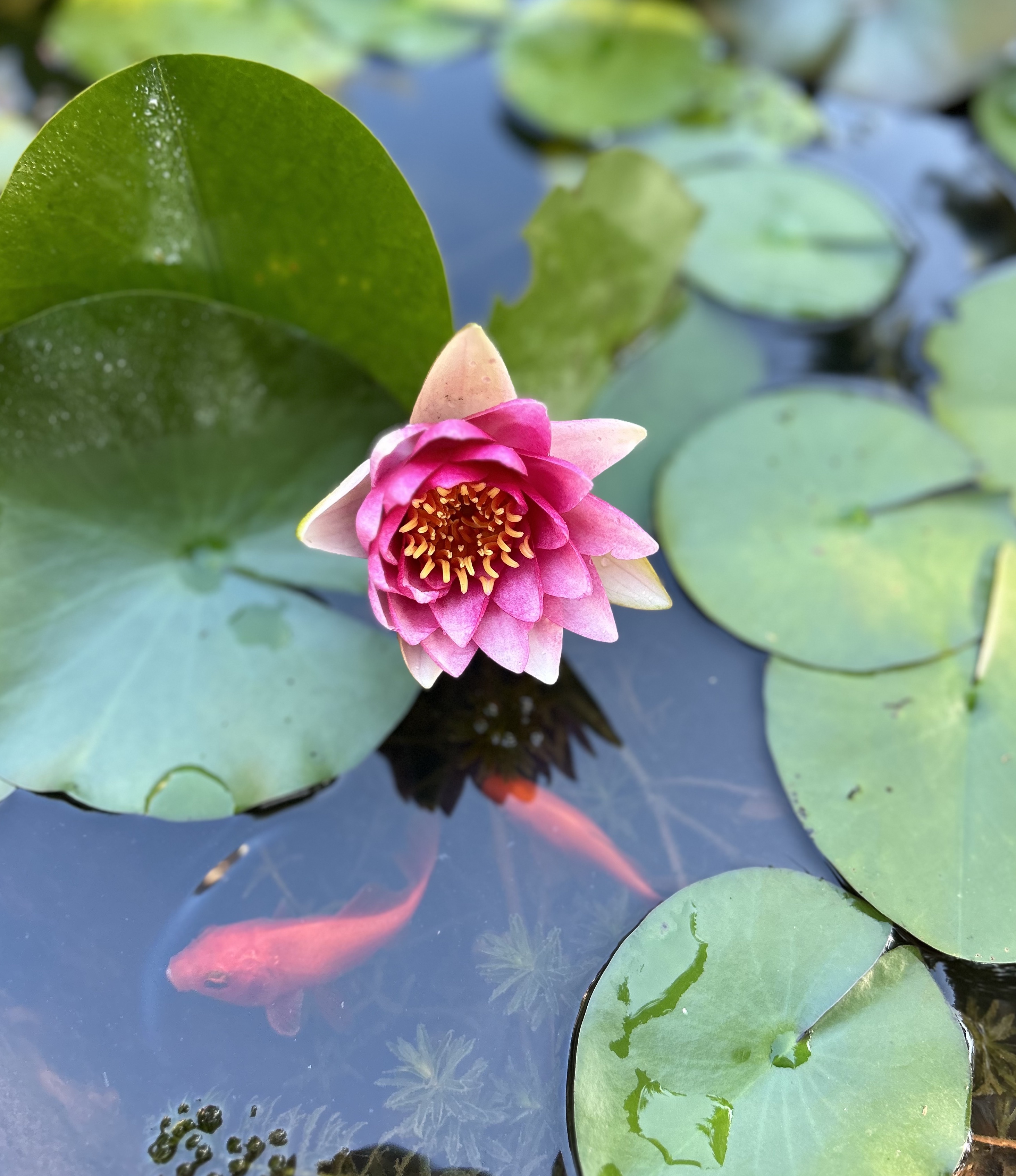
Freckled lily blossom Lonely lighthouse beacon Pool of goldfish beams photo and haiku by Margaret Simon
Margaret Simon lives on the Bayou Teche in New Iberia, Louisiana. She is a retired elementary gifted teacher who writes poetry and children's books. Welcome to a space of peace, poetry, and personal reflection. Walk in kindness.