Feeds:
Posts
Comments

Archive for the ‘Digital Learning’ Category

Please use this button on your site for DigiLit Sunday posts

Welcome to DigiLit Sunday. Please consider joining in the roundup by posting a Digital Literacy post and linking up with Mr. Linky.

I am working on framing my daily language lessons for my gifted students in grades 5 and 6 using WONDER. Here is a form for creating your own Wonder lesson. Wonder template for ELA (2) This framework will lead my students to explore Wonderopolis, an amazing educational site, as well as help them respond to real-world content. These frames are aligned to the Common Core Standards and use pre-AP skills.

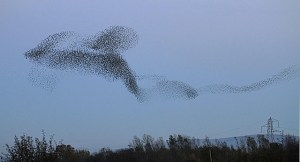
I worked on the Thinglink Teacher Challenge this summer. I wanted to put my Wonder framework into a Thinglink image. I used Starling Murmurations as the Wonder for this experiment. I also tried PollDaddy to embed two polls, one for a definition and one for a question. I put in links with each of the Wonder activities. These activities include

  • W- Exploring the wonder
  • O- What is your opinion?
  • N- Notes, find words of awe and wonder
  • D- Define phenomenon
  • E- On Tapestry, rewrite phrases to create a logical sentence.
  • R- Response to reading: Summarize and article.

Here is the link to Thinglink: 

Have you ever wondered about Starling Murmurations?

Have you ever wondered about Starling Murmurations?

I wonder if Thinglink will make the work of Wonder more motivating or more time-consuming.  Will Thinglink be a useful tool in my classroom or not worth the time it takes me to create one?  All this remains to be seen as I begin working with my students this year.  All in all, trying new applications is challenging and fun, so I hope my excitement translates to the children.

What new technology will you try this year?  Don’t forget to link up.

Read Full Post »

Please use this button on your site for DigiLit Sunday posts

Please use this button on your site for DigiLit Sunday posts

In my thinking and reflecting about digital literacy, I can’t help but mull over the language. I have been teaching my mother-in-law about Facebook. The icons and language are all new to her. Yesterday she sent me a private message, “Is this band along the bottom where I put a comment for your eyes only? Sorry I’m so slow with FB.” I laugh, but this is all a new language for her. It takes us a while to catch on to a new language, and sometimes it intimidates us so much that we resist and don’t learn it. I am proud that she has stuck with it and continues to try to learn the FB jargon.

I have been trying to follow the Connected Learning at Educator Innovator. To start with, the hashtag is clmooc. That is hard to get my head around. It was weeks before I could remember it. I worked hard to get over my intimidation and just did what I could to tag along. Then I got an application for a badge. Oh my, I really want the badge. But I have to prove my worthiness.

This badge is awarded to educators who’ve produced connected learning-based resources, events, curriculum and/or created artifacts that demonstrate Connected Learning principles in action or in theory.
–EducatorInnovator.org

The word Make is all over the Connected Learning assignments challenges. I’m getting used to the term more and more and believe a Make is anything you have created on your own. Makes are not exclusively done with technology. We use the technology to share our Makes.

As I begin to think about how I will incorporate this new learning into my class this year, I am wondering how my discomfort or low level of expertise will affect my use of the vocabulary. Will Makes become a term I use with my students? I feel pretty confident using the social media terms of Tweet, Twitter, Friend, Post, etc. (My children made fun of me for a long time because I didn’t properly use the verb Tweet.)

I’m still hoping for a way to make a Maker Community for our students. We can begin with Sheri Edwards’ site: Connect2Learn. She is till in the brainstorming stage and welcomes our ideas.

What new vocabulary will you be using this year with your students? Does the vocabulary change or heighten the work we do? Let me know your thoughts.

For Kim Douillard’s “In Search of the Unexpected” Photo-a-Day Challenge for August: 1. People 2. Places

A little restaurant in St. Martinville, St. John's, doesn't look like much from the outside, but good food waits on the inside.  The crowds wait for table.

A little restaurant in St. Martinville, St. John’s, doesn’t look like much from the outside, but good food waits on the inside. The crowds wait for table.

Link up your Digital Literacy posts here:

Read Full Post »

Please use this button on your site for DigiLit Sunday posts

Please use this button on your site for DigiLit Sunday posts

I never would have expected that I would be thinking about digital literacy this weekend, but here I am in the front yard of my brother-in-law’s house on Capitol Hill in Seattle, Washington connected to the internet. Next to me is my niece focusing on writing essays for medical school applications. My nephew is shopping for ski bindings. My brother-in-law is working on a grant, and his wife is reading Seattle Times on her phone. We are all connected to the world as we connect to each other.

On the Making Learning Connected site, Kevin Hodgson (who is always thinking about digital literacy) invites us to make 6 image memoirs.

This was harder than I thought it would be. I decided to use Haiku Deck. I perused images and tried to pick out ones that reflect my personal life as well as my professional one. They are so interconnected. When I began blogging three years ago, I did not realize just how appropriate my site name is to the purpose of my writing. Reflections on the Teche does not limit me to only writing about teaching or only posting poetry, but I can do both. My memoir includes my active self (teacher, wife, mother) as well as my reflective self.

It is important in this digital age to encourage our students to not only participate, but to also be reflective and thoughtful about purpose.

Click on the link to view my 6 image memoir on haiku deck:
https://www.haikudeck.com/p/BdTRIF9pjf/6-image-memoir

sunset profile

Link up your digital literacy post or your six image memoir.

Read Full Post »

Please use this button on your site for DigiLit Sunday posts

Please use this button on your site for DigiLit Sunday posts

high water

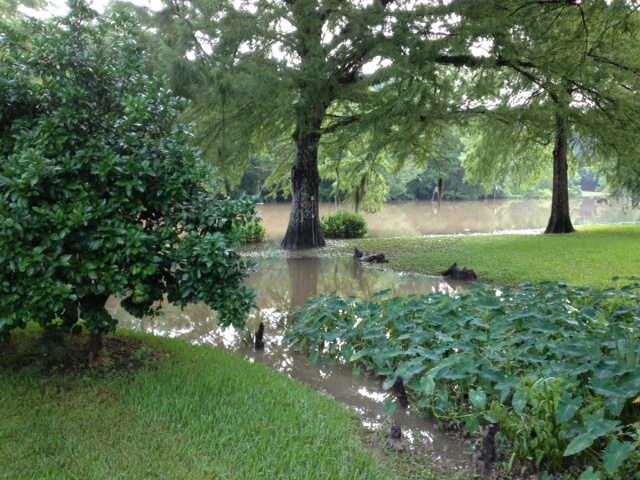
It’s been raining for days. You can hear the grass growing. Everything is lush and green, but at some point the ground gets saturated and overflows. When the rain comes too fast, the water floods the streets. On Friday, businesses closed early so people could make their slow flooded way home.

Sometimes we do this to our students. This week I attended the Rice University AP Institute. My brain went into flood mode. Too much information in, not enough draining out. I learned a valuable lesson about being a student. Finally on Friday, we were given the time to design our own lessons. The room was buzzing. My colleagues and I designed a frame for our teaching this year. We were able to sit and talk and process the water of information. We must give our students this time.

Digital learning can be about gaining knowledge, but mostly it is about processing knowledge. This summer I’ve been flooded with new ways for my students to process information. I’ll need to hand this learning over to them and give them time to find the right application for them. Will it be Prezi, Thinglink, or Haiku Deck? Maybe blogging, Animoto, or Tapestry? The important thing is to control the flood waters, try not to overwhelm them, and give then the time to process and apply.

Let’s continue the conversation about online learning communities for our students. Sheri Edwards has set up an edublog called Connect 2 Learn. Check it out and add your ideas.

The Educator Collaborative is Live! Join the group. Besty Hubbard has a group for Young Writers.

Link up your DigiLit Sunday post:

Read Full Post »

Please use this button on your site for DigiLit Sunday posts

Please use this button on your site for DigiLit Sunday posts

Today for DigiLit Sunday I have something on my mind about this internet PD community. I have tapped into so many teacher challenges this summer I run the risk of being overwhelmed. But instead I am fascinated and wonder what this may mean for my students and for the future of how we educate.

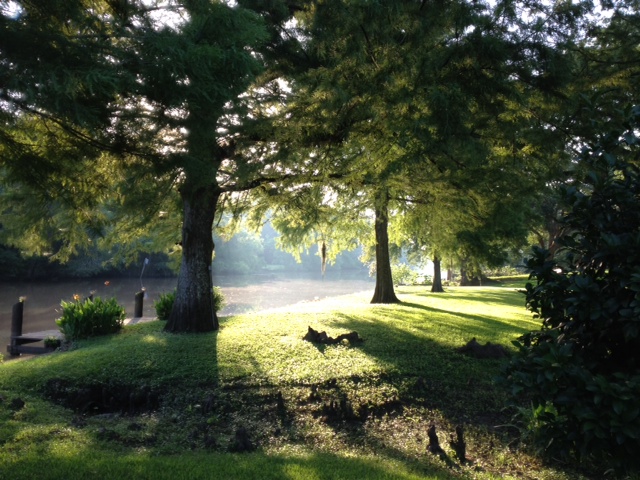
By participating in multiple online learning groups such as the Thinglink Teacher Challenge and Connected Learning (CLMOOC), I connect to other bloggers and find things that pique my interest. For example, Kim Douillard posted a weekly photo challenge in the CLMOOC Facebook group this week. Her blog site is Thinking through my Lens. I have a feeling Kim does not just use her phone for taking pictures, but that’s what I use. This week’s theme was #light. Just after I read her blog post, I took a walk outside to this amazing display of light.

Bayou morning photo by Margaret Simon

Bayou morning photo by Margaret Simon

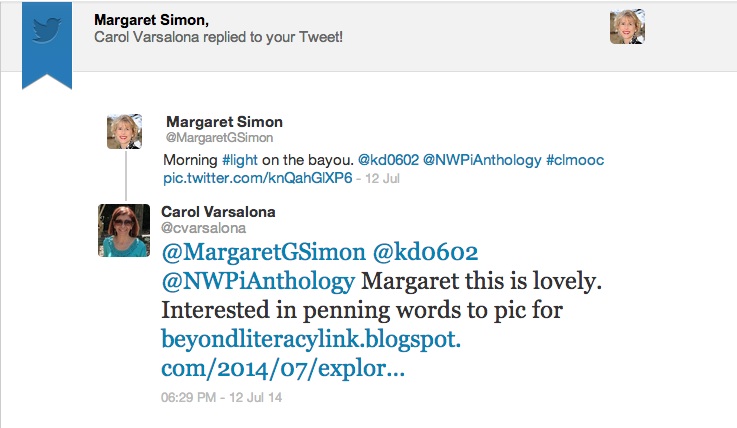
Did you say “Ah!”? Yeah, me too. That’s my world and sometimes I forget to appreciate it. So I uploaded my amazing bayou scene to Twitter and got this response from Carol Varsalona.

Twitter with Carol

I will probably do this because I enjoy a challenge and especially one that makes me write. (Did I mention I am also doing Teachers Write camp with Kate Messner?)

So my Digital Learning question is this: How do we tap into student interests and create online learning environments for them to connect to and learn from? I teach gifted children. They have strong interest areas (obsessions, really). They are much more adept at computer skills than I am. Can we do this for them? Or is this being done and I don’t know about it? I did involve my students in the March Slice of Life Challenge put out by the Two (Six) Writing Teachers. They loved it. And for some, it was a deep learning experience.

Enter this conversation by leaving a comment. Should we have a Twitter chat or Google Hang out? I’ve never led one of those myself, but I’m willing to try.

Leave a link to your digilit post here.

Read Full Post »

clmooc

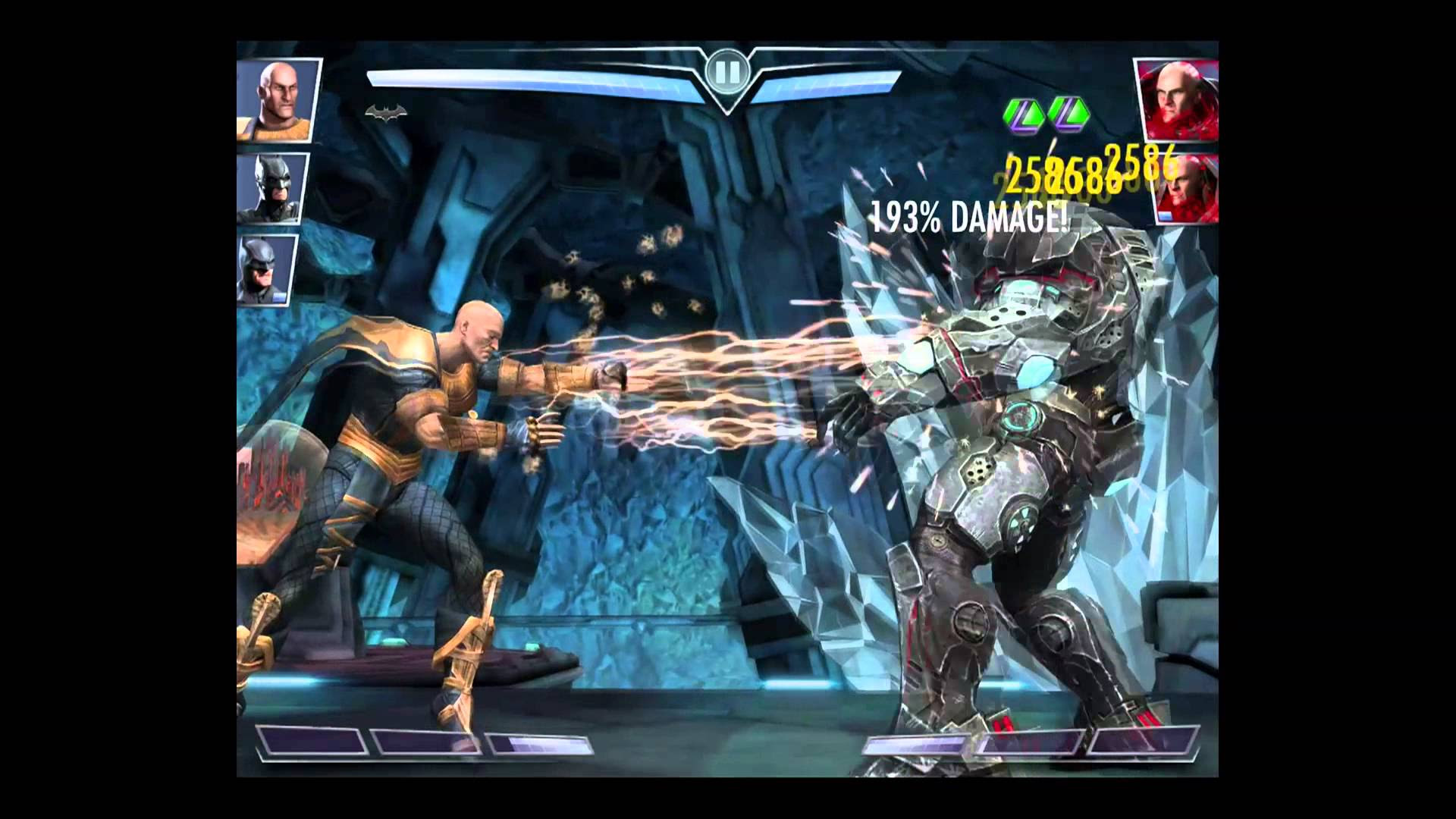
Last week, the Connected Learning challenge sponsored by the National Writing Project and Innovative Education asked us teachers to consider games and learning. I am no expert in the gaming world, so I turned to Jeff Larkin, a visual FX artist at NetherRealm Studios, a division of Warner Brothers Games.
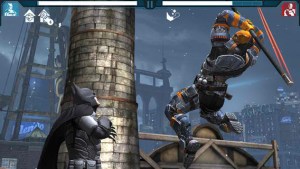
 

Screenshot from Batman: Arkham Origins for iOS and Android.

Screenshot from Batman: Arkham Origins for iOS and Android.

Here is my interview with Jeff:
(Disclaimer: The answers given here in no way reflect NetherRealm Studios nor WB or WB Games and any of their views.)

What is your job?

I am a Visual FX Artist at NetherRealm Studios, a division of WB Games. Basically, just like in animation or film, whenever there’s a magic spell or an explosion or anything like that, I’m the guy they call.

What kind of training do you have?

I have a Bachelors of Fine Arts from the Savannah College of Art & Design (or SCAD). I also have several years experience in the games industry doing VFX and 3D modeling.

What are some advantages, in your opinion, of playing video games?

I think there are a lot of advantages to playing games on many different levels. For me, it’s a stress reliever. Everyone has hobbies and, for a lot of people, it’s video games. For us, it’s the same relaxation, excitement and stimulation as wood working, canoeing, or base jumping might be to different people. Now, there are also a lot of studies that show correlation between playing games and hand-eye coordination, problem solving skills, critical thinking, and recently empathy, just to name a few. Like any activity that is primarily stimulating your brain over your body, I believe video games can be a great source of mental exercise.

A majority of the research focuses on the negative effects of video games, such as increased violence and aggression. What is your opinion of this?

I find over and over again that there is very little to back up claims of increased aggression and violence. Instead there’s a lot of sensationalism that tie video games to mass shootings and terrorist activities; and, unfortunately, the general public seems to favor those stories over empirical research. The facts are people have been violent since the beginning of time, and I don’t believe that any increase or decrease in video games, or other media, are going to affect that in a meaningful way.

As an educator, I am looking for ways to integrate the highly motivating video game with teaching and learning. Any suggestions?

The thing I’ve always loved about games is how, when you take away all of the fancy graphics, sounds, and effects, video games are really all about learning. Raph Koster says it best in his book, “A Theory of Fun,” and I’m going to do my best not to totally ruin his work in paraphrasing. Basically, games introduce a system, with rules, that the player must recognize, understand and then exploit to win. This then hinges on a task/reward system that isn’t too unlike assignments and grades. I apologize for being a little esoteric with all that, but basically treating classes and grades like levels and quests for the student, or player) to complete is something that I think education could really grab on to. In fact, I’ve heard of a few classes in some schools that are functioning completely as a role playing game, where the students do assignments and participate in order to level up (ie, get good grades).

Have you created any strong, self-reliant girl characters?

Though my job at the studio is not to create characters for our games, I always make it a point to push for gender equality and to navigate away from easy gender stereotypes to create genuinely meaningful and interesting characters, both male and female. I find myself actively investing in these sorts of social and political causes, and that of course spills over into my work. There’s been more than one occasions where I’ve butted heads a little with my seniors as I push for less two dimensional women in our games, and I’m happy to say that I’m not alone at my studio, nor in the industry.

Anything else you want to add?

I suppose I would only like to add that, like so many other things that constantly find themselves in the middle of controversy, video games are made by people who are just like you and everyone else. We have families, we walk our dogs and buy groceries, we hopefully remember to vote when the time comes, and we, generally, are good people who want the best for those we love and care about. It’s easy to point fingers at entire industries when something happens in the news, but the fact of the matter is that video games and game developers, like many other things, are not inherently good or evil. We don’t sit at our desks dreaming of ways to destroy society any more than a mechanic tries to build evil robots out of your car when you bring it in for an oil change. We love what we do, as artists, and want to share that with the world in the hopes that you love it too.
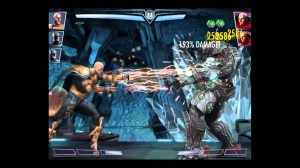
 

From Injustice Gods Among Us: Black Adam on the left electrocuting Lex Luthor on the right with his lightning attack.

From Injustice Gods Among Us: Black Adam on the left electrocuting Lex Luthor on the right with his lightning attack.

Read Full Post »

Please use this button on your site for DigiLit Sunday posts

Please use this button on your site for DigiLit Sunday posts

For DigiLit Sunday, I invited friends to submit flower poems for this Thinglink video. I have been working on Thinglink this summer through their teacher’s challenge. I have also been participating in the National Writing Project and Innovative Educators Making Learning Connected (CLMOOC). Thinglink offered me a preview of their video application. CLMOOC challenged us this week to think about games. Combining the two, we played with flower poems. I want to thank those who took the challenge to write a flower poem and contribute to this video: Sheri Edwards, Diane Mayr, Linda Baie, and Kaylie Bonin. Each flower poem is linked to the video. I used Tapestry to publish the poems.

Use this link to find the video: http://video.thinglink.com/v/132

Click to follow the link to Thinglink video.

Click to follow the link to Thinglink video.

Thinglink is offering to you, my readers, an early access code to Thinglink for video. First sign up for a teacher account on Thinglink. Then login to your account on video.thinglink.com This is your unique access code: tlvideo_for_reflectionsontheteche.

Here is a How to video from Susan Oxnevad.

Link up your DigiLit Sunday post with Mr. Linky:

Read Full Post »

Poetry Friday Round-up

Poetry Friday Round-up


Join the 4th of July Poetry Friday Roundup at My Juicy Little Universe.

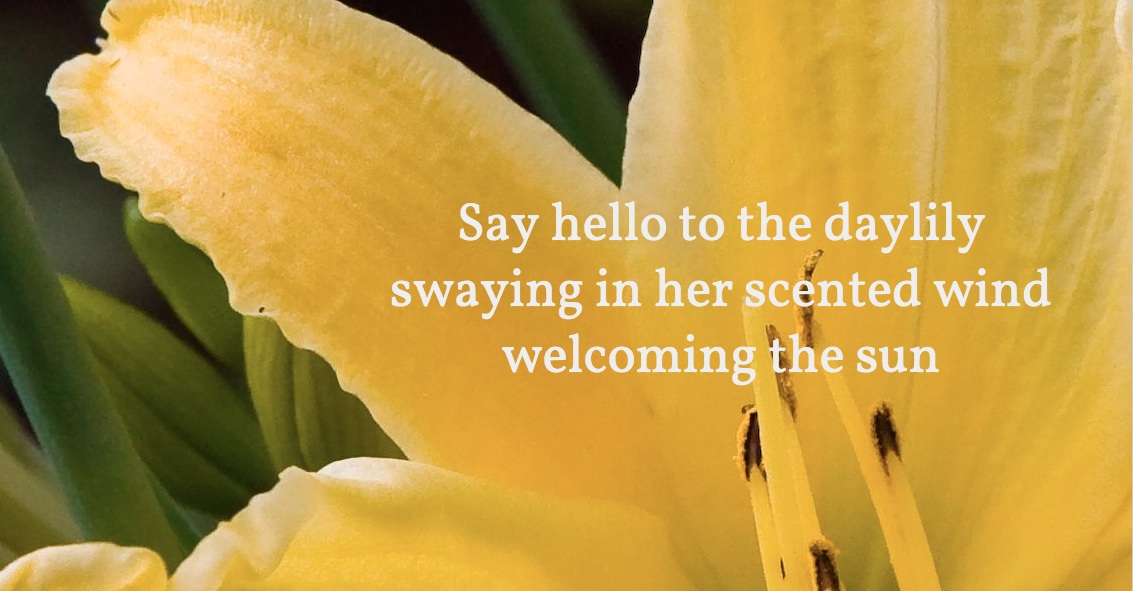
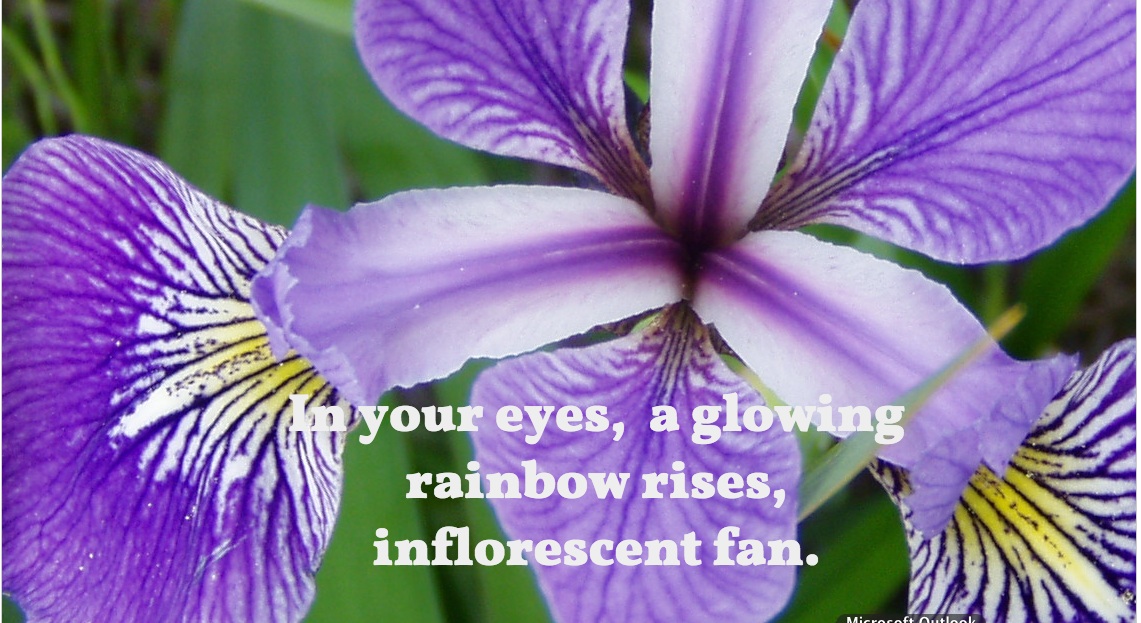
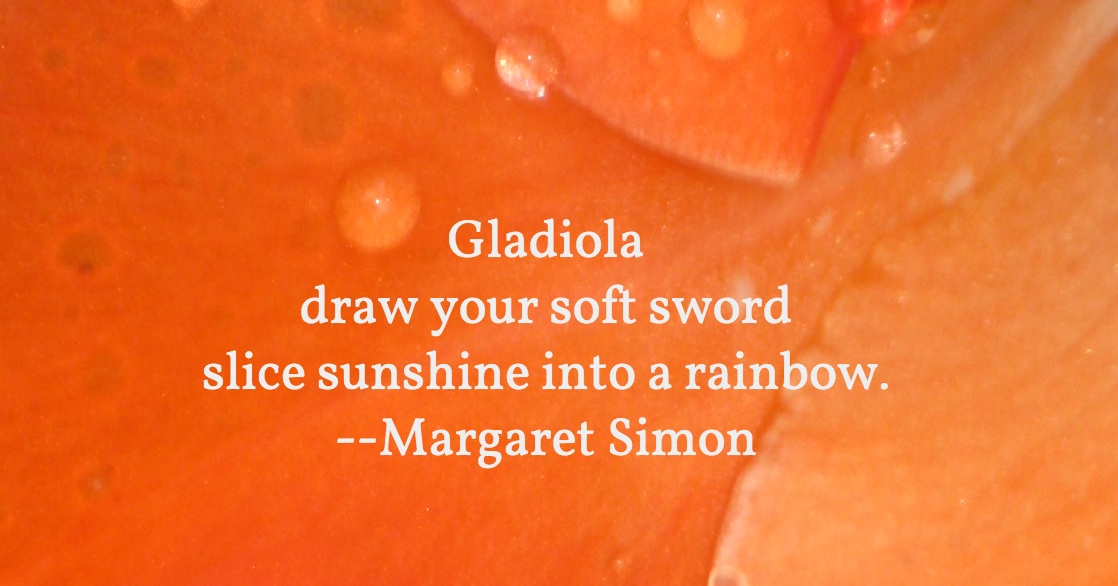
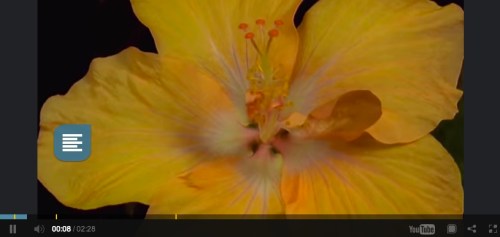
A friend posted a video on Facebook. You may have seen it, too, of the elapsed time photos of flowers blooming. I was inspired to write short poems, haiku-type, about the different flowers. For each one, I googled the flower and used facts in the creation of the poem. For example, a gladiola is also known as a sword lily. Then I found creative commons photos, uploaded to Tapestry, and wrote a poem. I would like to include more poems in my Thinglink video creation, so if you would like to add a poem, please write one in the comments. Or you can do it in Tapestry and send me the link. I’ll post the link for the final video on Sunday on my DigiLit Sunday post. Also, on Sunday I’ll have an offer code from Thinglink for early access to Thinglink for video.

Daylily Sunshine

Iris Rising

Glad Sunshine

Click the image below to watch A Vida Das Flores.

Click to follow the link to Thinglink video.

Click to follow the link to Thinglink video.

Read Full Post »
Please use this button on your site for DigiLit Sunday posts

Please use this button on your site for DigiLit Sunday posts

I am not a grandmother yet, but this week made me feel old. The CLMOOC make cycle #2 was on making memes. High learning curve for me. For one thing, you must be tuned in to popular culture…not! And another, you had to have something clever to say…another not! So I got a little rebellious and decided that memes were just not for me.

Slide1

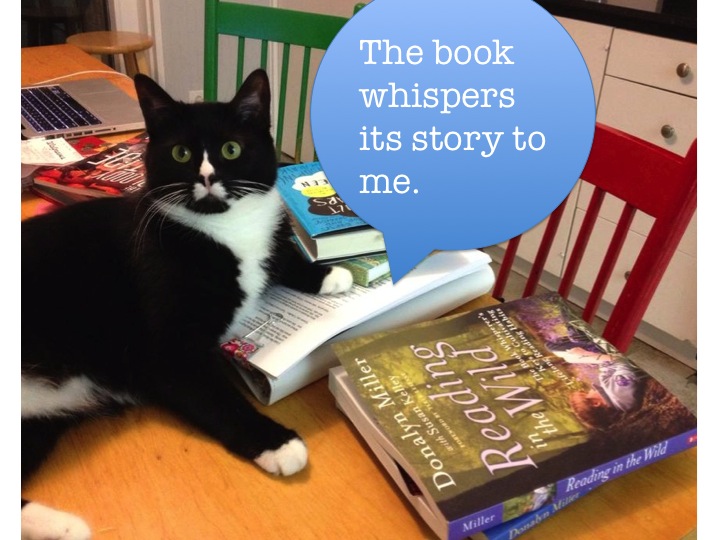
During the week I posted this silly picture of my cat, Mimi. She loves to perch on top of books. This makes her look especially intelligent. My husband made the comment that she was in her literary post. On my Facebook post, Julie Johnson commented that I could make a meme of that. Since Mimi was sitting on top of Donalyn Miller’s books, I created a caption about book whispering. The post only got 5 likes. Needless to say, I don’t think I get this meme thing.

But I do like that I am out there in this digital world taking a dare. Trying to be brave. Trying to be digitally literate. In all honesty, I will not be using memes with my students; they are only elementary age. Then comes this question from the Connected Learning team, “How do we turn the principles of Connected Learning into memes that spread in an educational setting?”

The CLMOOC principles are important for education. See Why Connected Learning. These principles should be spread. Am I responsible for spreading them in my small corner of the universe? As responsible as I am to any principle that I believe in, so whatever I may personally think about memes and my ability to create a clever one, I should find a way to express the principles of Connected Learning.

connected learning tagxedo

Read more about serious memes on Kevin Hodgson’s site and another one from Beth O’Connor.

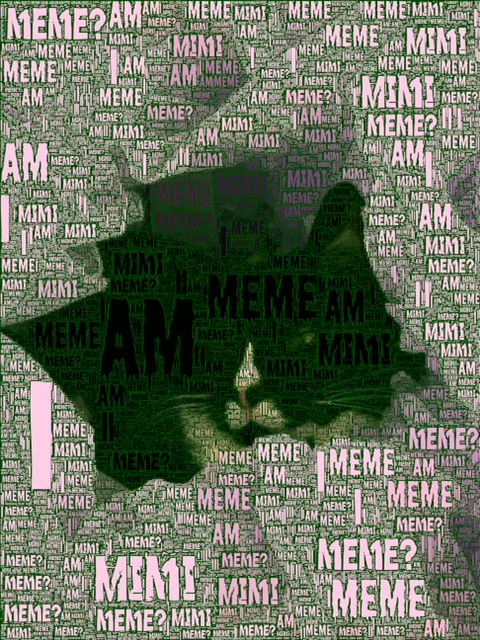
So Mimi begs the question, “Am I a Meme or a Mimi?” Sorry, just had to have a little pun fun.

Made in WordFoto

Made in WordFoto

Link up your DigiLit Sunday post with Mr. Linky.

Read Full Post »
Please use this button on your site for DigiLit Sunday posts

Please use this button on your site for DigiLit Sunday posts


Please join in this meme designed to share our digital learning and challenges. Just as a teacher of writing needs to be a writer, a teacher of digital literacy needs to be a digital learner. Use this button on your blog post and leave a link with Mr. Linky. Please read and comment on other posts. That’s how connectedness and collaboration begin.

Reflection is another means to apply the Connected Learning principles of being Interest-Powered and Production Centered by considering what you’re making and interests are now, and what your orientation is for the immediate future. –Chris Butts, CLMOOC team

clmooc

I have jumped right in to the waters of two digital challenges: The Thinglink Teacher Challenge and National Writing Project’s Making Learning Connected, a.k.a. #clmooc.

summer_challenge8

Yesterday’s email from the CLMOOC team asked us to make a list of three things and to reflect on two questions.

1. What I’ve made so far…

How to pick blueberries: Thinglink
Self avatar: Bitstrip
profile_pic

Digital Self: Thinglink

How to be water: Animoto/YouTube

2. What I’m working on:

Poster about writing in Canva: This is a higher learning curve than other apps I tried this week. I struggled and gave up. But I am determined to try again and conquer this!

3. What I want to work on:

Prezi is a presentation site that I am daunted by. I have seen others do great things with it, and I’m sure my students would love it.

Reflections:

What did you learn from what you’ve already made? I learned to be more confident in my digital self. The Thinglink challenge for this week was to make a digital self. I thought I had to draw something. I started working on my ipad with a new stylus and became quickly annoyed. Then I googled avatar and low and behold, there’s an app for that! I was surprised how easy it was. So many online apps can make you feel stupid, but some, like Bitstrips, made me feel smart.

What do you see as the purpose of making this week? The purpose for me always goes back to my teaching and being able to support my students in their digital learning. However, I also discovered that making was fun, and I was compelled to share (and show off). I want to invite you to take the plunge. Jump in the deep end because there are lots of supportive floatie people out there.

I wanted to make a blog icon for the Connected Learning values, so after writing this post, I tried Canva again. It worked better for this purpose. You should try it.

Connected Learning

Read Full Post »

« Newer Posts - Older Posts »