Welcome to This Photo Wants to be a Poem, a low stress weekly poetic writing prompt. This week’s photo is courtesy of Molly Hogan, who is an amazing photographer/ poet/ teacher in Maine. She has sent me a few photos for this weekly prompt. (If you would like to offer any photos, please send me an email. You will get credit, but the photos will be free for reuse.)
In keeping with Laura Purdie Salas’s 15 Words or Less prompts, I encourage you to write a quick short poem. To help build a supportive community, please comment on three poems with an encouraging response.
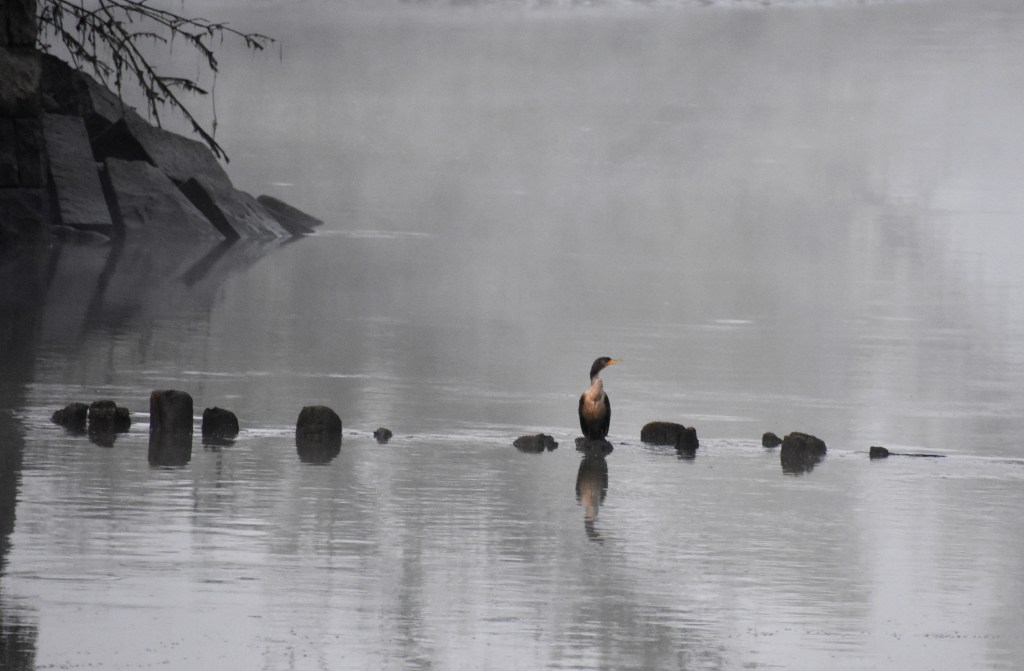
photo by Molly Hogan
A soul in solitary silence seeks a soft whisper of solace.
Margaret Simon, draft
Your turn. Leave your poem draft in the comments. Thanks!
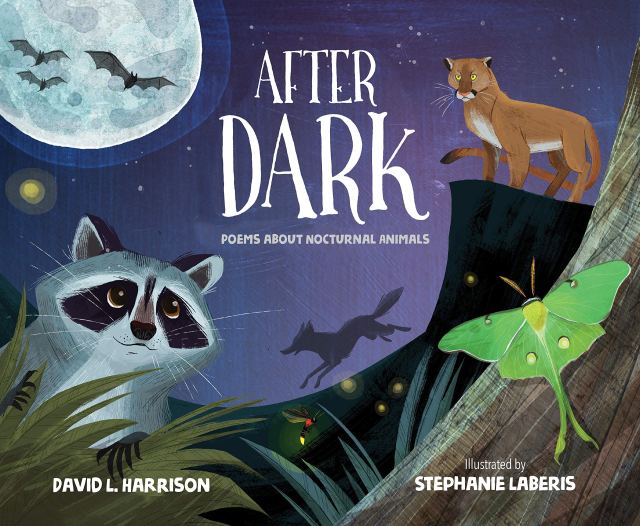
What a pleasure to take part in the After Darkblog tour. After Dark is a picture book of amazing illustrations by Stephanie Laberis and intriguing poems by David Harrison. Publication date is tomorrow, Feb. 25th. Read more about David and his many books here.
David L. Harrison
David’s poems explore the lives of nocturnal animals. In the end pages you can find more information about each animal. With my students, I started with the end pages. I asked them to select two animals they were interested in. We read the facts and then the poem. “Look for ways the poet wove the facts in with poetic language.” We noticed elements like rhyming, slant rhyme, alliteration, repetition, and others.
This reading and talking piqued our interest in finding out more. I gave students the option to select the same animal or another one to research using Wonderopolis.
Breighlynn wanted to learn more about songbirds. Earlier in the week we had discussed allusion and at the beginning of the month, we read about Maya Angelou. I love seeing all of these lessons come together in Breighlynn’s poem.
The song of a songbird the morning alarm. Their vibrant colors just like a rainbow. The smallest of birds make the loudest of songs. Now, I know why the caged bird sings.
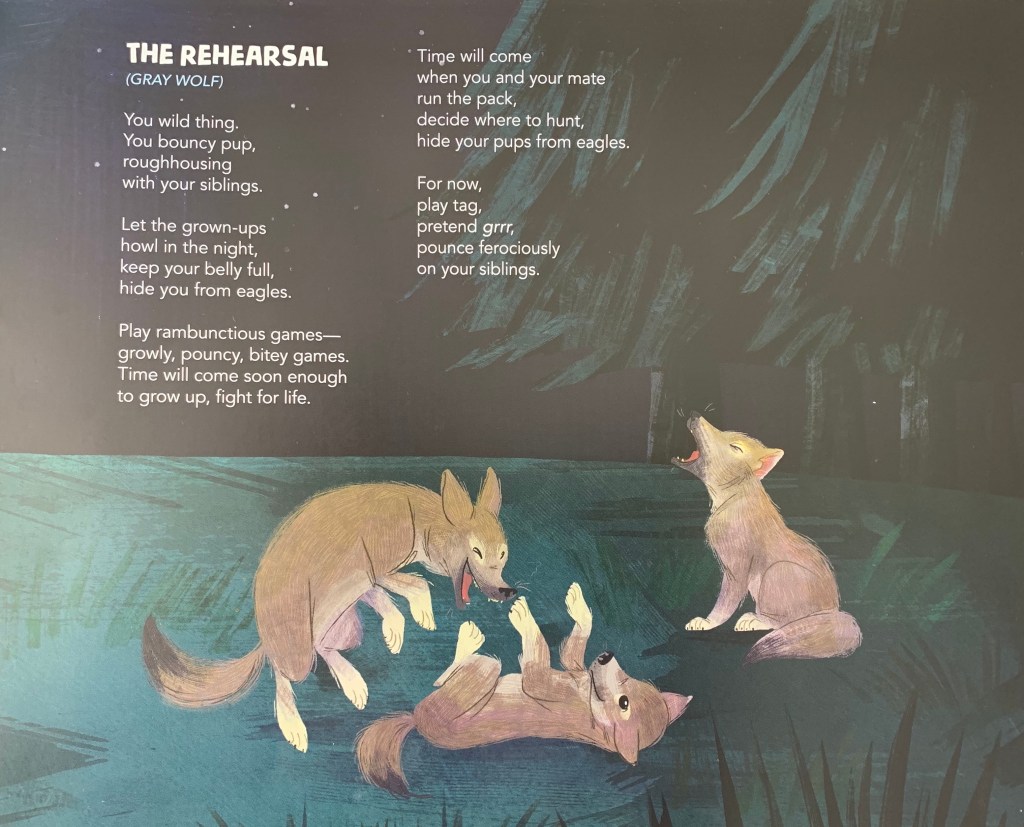
After reading this David Harrison poem about the gray wolf, A.J. wrote a poem contrasting wolves to dogs.
Wolves, never tamed, they can’t be blamed.
Dogs, youngly trained, though restrained.
Wolves, running free, free as can be.
Dogs, fun won’t end, with man’s best friend.
A. J. , 6th grade
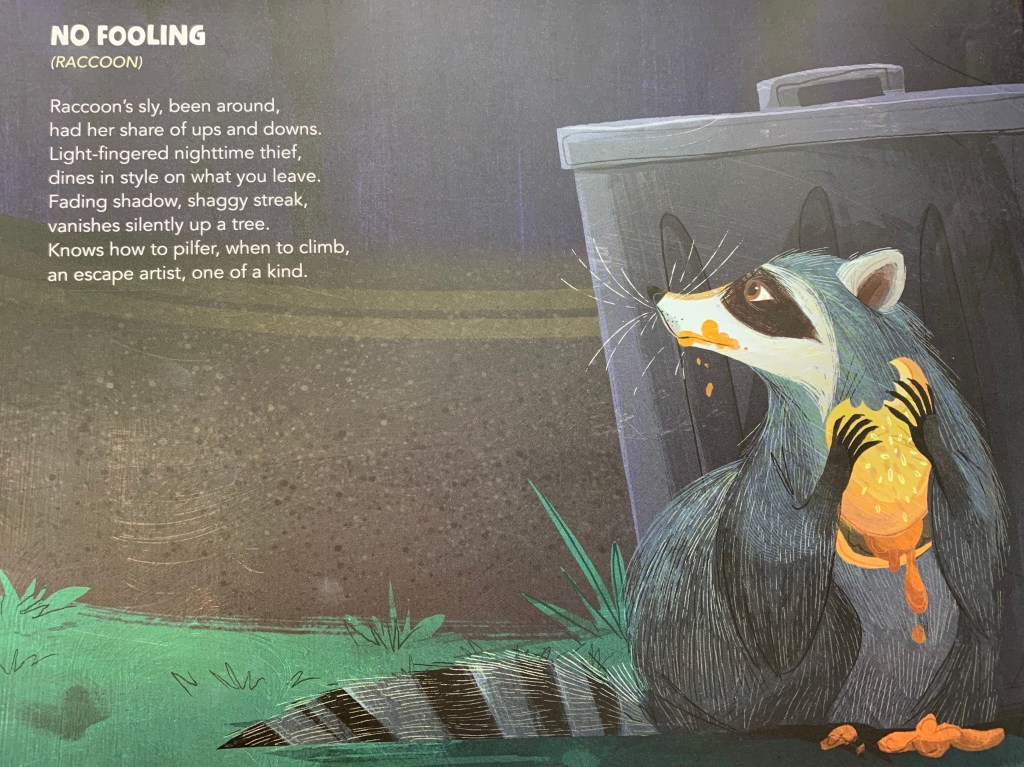
One of my students asked what was the word for animals who are awake during the day. On a Wonderopolis page, we discovered the word diurnal. In the poem, No Fooling (about the raccoon), David uses assonance, creating slant rhyme. I decided to try out this element in my own poem: Where do Birds Go at Night?
Where Do Birds Go at Night?
At first light, I hear their chatter flitting about our courtyard feeder.
But once the air of dawn is gone, I wonder where the birds have flown.
Most birds are diurnal living their life all day, but where do they go once the sun goes down? Only nocturnal birds hang around.
Some birds find a hole big enough to squeeze in. Others, like the heron, want some mud to wade in. Flocks of blackbirds roost in bunches finding their nighttime safety in numbers.
Every time you go to sleep, wonder where the birds may be.
Margaret Simon, draft 2020
This post is part of a blog tour. The publisher has offered a free book for comments on this post. I will draw at random from commenters and post the winner’s name on Friday, Feb. 28th on my Poetry Friday post. Please leave a comment by Thursday, Feb. 27th. Winner must live in the continental U.S.
Check out other posts to hear more about this book.
Poetry Friday round-up is with Cheriee at Library Matters.
An Invitation: With Laura Purdie Salas’s blessing, I’ve started a weekly writing prompt for Thursdays in the spirit of 15 words or less. Pop over to read the poems this week about a pretty pink thistle: This Photo Wants to be a Poem.
This week my students and I read Joyce Sidman’s poem in the December issue of Scope magazine: Song of Bravery. There were a few things to notice in her poem, allusion and irony. When one normally thinks of a song, it’s something positive and praising. Joyce Sidman’s poem stated the opposite.
This one’s not a sure thing. I’m not bound to win. I don’t think I’ll ace it this time. I won’t break a leg, make my own luck, or reach the stars.
Joyce Sidman, Song of Bravery from What the Heart Knows read the whole poem here.
After Joyce, I wrote Song of the Sacred.
I am not a barefoot Buddha. I cannot think and become. I’m not singing rhyming psalms in the present moment.
When I fall on my knees, they hurt. I have no burnt offerings or holy incense to light.
Maybe I pray with open hands or maybe someone prays for me. I’ll never know.
But here I am stretched in savasana humming an Om with my eyes closed tight
Breathing to clear my mind from the shadows of a cloudy day to see the holy sun.
Welcome to a new weekly poetry prompt. Inspired by Laura Purdie Salas who for years posted a weekly photo for participants to write a poem of 15 Word or Less. Because Laura is busy with her day job, writing wonderful children’s books, she has taken a hiatus from this weekly prompt. Here is a link to the archives of those posts.
I contacted Laura, and she was happy to pass the baton. With this new title This Photo Wants to be a Poem, I will post a photo once a week on Wednesday night for you to respond to on Thursday. You can type your poem into the comments. Please be kind and comment on at least 3 other writers’ poems. That’s how we build a supportive community.
Laura limited the poems to 15 words. I see purpose in this practice because (1) it’s quick, (2) word choice matters, and (3) you’ll likely get it done. In all honesty, I will not be counting words. The idea is to simply practice your writing brain.
The photos will credit the photographer but will also be free for you to use if you wish to post on a blog or other social media. If you would like to contribute a photo, send it to me by email.
Let’s get started! This photo was taken by my friend and choir colleague Brenda Lowry on a walk along the Atchafalaya Basin.
Thistle by Brenda Lowry
My first draft:
My spiky stem says Stay Away! But bees are welcome any day. Come. Buzz. Play.
See more posts at Two Writing Teachers Slice of Life
A painted sign in my daughter’s neighborhood. We had to take a picture, but Leo, having been released from the stroller, wanted to get down and walk.
I’ve been participating in Ethical ELA’s monthly 5 day writing challenge. I love this community of friends. On Sunday, the mentor text was a poem “What I Want Is” by C. G. Hanzlicek. The prompt is here.
On Friday night and Saturday morning, we had Leo who is now 14 months and loves to walk. I took him outside in our backyard and next door to swing. My neighbor has 2 grandsons, too, so she has set up baby swings hanging from a tree. I really could not imagine anywhere else I’d rather be. So the prompt led me to this poem.
What I want is what I have
when I’m with him walking hand around finger
down the hill to the bayou
to wave at the canoers even though they don’t
see us swinging from a rope
in the oak tree laughing just because
there are wildflowers too many to count
and a cool breeze to catch our smiles on
a day of only us pointing at birds
flying overhead Bird 1 Bird 2
Margaret Simon after C.G. Hanzlicek
On Monday I combined the Ethical ELA prompt to write a This is Just to Say apology poem with the image posted in Laura Shovan’s February poetry project.
photo by Jone MacCulloch.
This is Just to Say
I missed the turn to school today. My eyes were on the clouds
So soft and floating like giant snowdrifts above me in bouquets of white roses.
Forgive me, I’m late my head in the clouds dancing around in their fluff.
Margaret Simon, draft, after William Carlos Williams
Finding daily prompts in my email inbox help me to pick up the pen and notebook and make something. Creativity feeds my soul. The positive loving feedback is fun, too.
Poetry Friday round-up is with Linda at Teacher Dance.
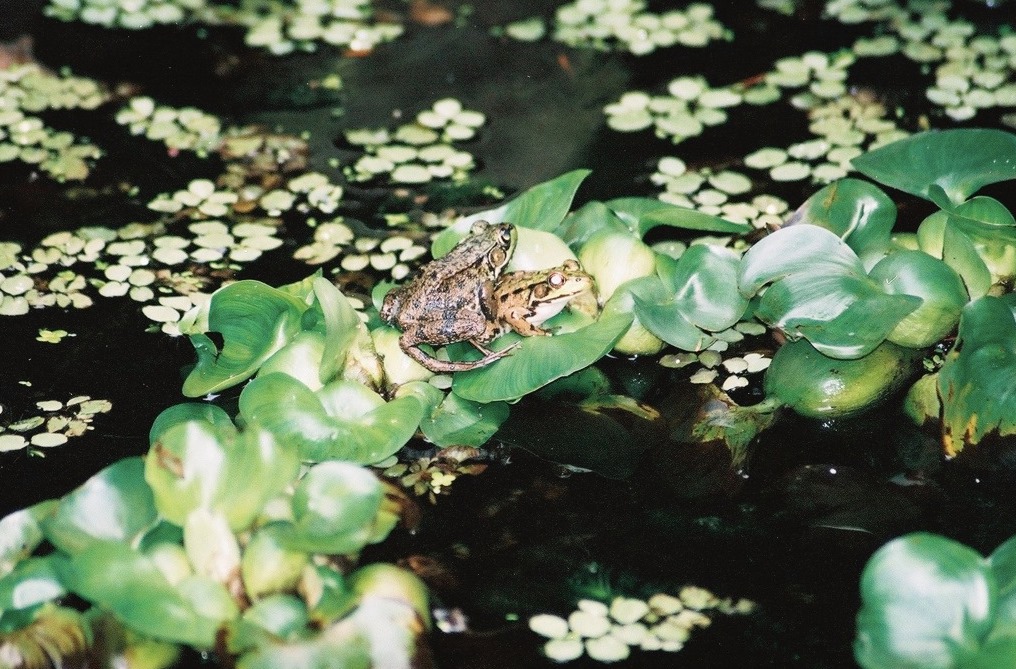
Because it’s Valentine’s Day, I won’t write about the week I’ve had or lost love or about the cold I’ve been fighting. Instead I’ll share a ditty I wrote this week for Laura Shovan’s challenge. Susan Brisson prompted us with frog pictures and a delightful video of her husband and son catching frogs from their pond to take them into the woods, so the little creatures would survive the winter.
Photo by Susan Brisson.
When my youngest daughter was two (she’s now 29), we had a small flower bed that always seemed to be its own pond. She could hear a frog croaking in the flower bed and decided to name it Hans. To this day, we don’t know why, but Hans the frog has become our family’s totem. One Christmas my husband made a huge plywood frog wearing a Santa hat, and we put it up every Christmas.
When watching Susan’s son hopping around gathering frogs into a bucket jogged this memory for me.
Dedicated to my daughter Martha
And here’s a lagniappe poem. Lagniappe is a common term used in Louisiana to mean a little something extra.
See more posts at Two Writing Teachers Slice of Life
Photo by Kay McGriff: “This photo is from one of our favorite activities twice each year–the Friends of the Muscatatuck River Society River Clean up.”
I have been writing a lot of poems lately with my students as we respond daily in our notebooks and with a Facebook group for Laura Shovan’s February Poetry Project.
The picture above was shared by Kay McGriff. She and her family participate in a twice-a-year river clean-up. I haven’t done this yet, but living near the bayou, we see all sorts of things drift by. This picture inspired me to look into this project.
Armed with an article, I decided to create a Bop poem. I was introduced to this form by my friend and critique partner, Linda Mitchell. Here’s a link to the form: https://poets.org/glossary/bop
People are messy. Rivers are easy to access. Everything can be found– shoes, tires, buckets, balls– whatever falls in sinks to a watery grave.
“You wouldn’t believe the stuff we find.”
Someone found a car, an old boat motor, ten feet of rope. It’s all trash pollution and doesn’t belong here buried in our drinking water. Imagine what the fish are thinking. People are crazy! Let’s get out there and clean it up!
“You wouldn’t believe the stuff we find.”
So share in the fun of the Annual Spring River Cleanup. There’s something for everyone to do. Volunteers will collect whatever they find walking the bank or paddling a canoe. Together we can save the river.
Poetry Friday round-up is with Laura at Writing the World for Kids.
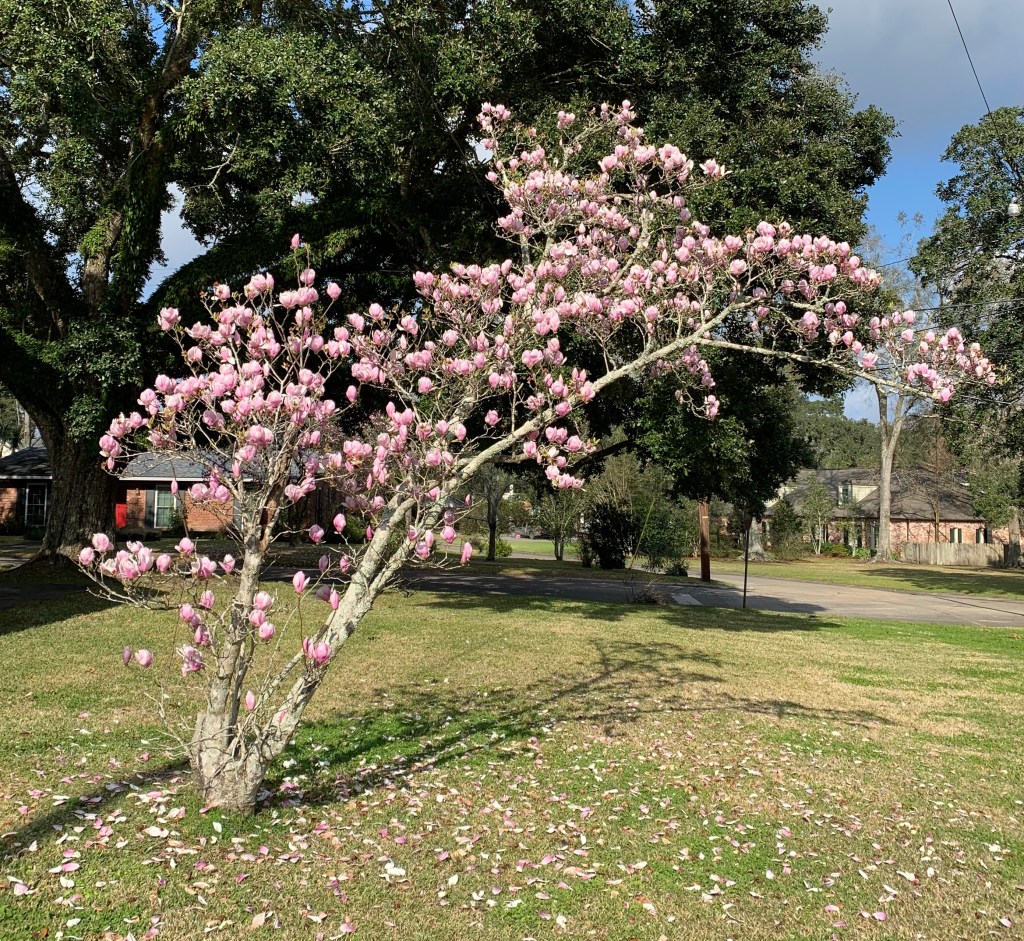
Take a walk with me on this chilly day. The temperature dropped during the day yesterday from a rainy 55 degrees to a frigid 35 degrees with winds close to 20 mph. Bundle up in your winter coat and gloves. Did you bring your wool socks? As we walk past the bayou and along the road, we come to an open field. Watch your step because the ground is uneven here, and you may step in a puddle.
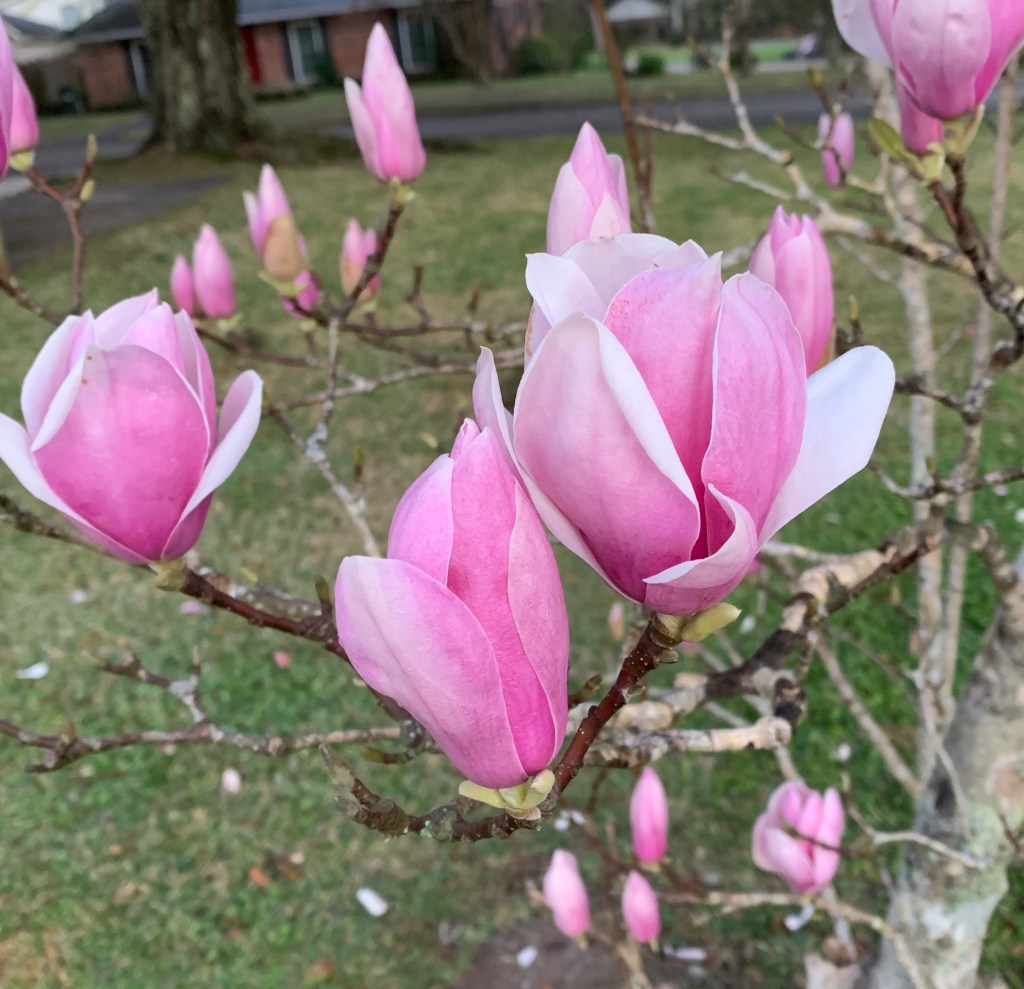
There near the neighboring house is a tree that looks like it may have been struck by lightning. It’s leaning slightly, but oh! It’s bright with pink blossoms. Flowers in winter? I think Japanese magnolia likes to be the first to show off her new spring dress.
My poetry swaggers group had a difficult challenge this month, given by Catherine Flynn. Terza Rima, she suggested, a form none of us had ever tried. But it’s from Dante, she delighted, not knowing yet that we are no Dantes.
Nevertheless, I gave it a shot. The first results lacked greatly. After a few rounds with my writing buddies, they helped me patch it up to present today. A terza rima is not going into my book of forms. This was a tough code to crack. Here’s a link to some confusing helpful guidelines.
A Japanese magnolia takes a chance on blooming ‘fore the risk of frost is gone with warming trends alive inside its branch.
Perhaps a passing storm had left it torn in this winter field alone and gray, when leaves of life from limbs are yet unborn.
Bold flowers burst bright pink and lift away a fog; flamboyant beauty flirts for view when wind blows chill across my path today.
A Japanese magnolia takes a chance.
Margaret Simon, draft #5
Visit the Poetry Swaggers Sites for more (and better, if you ask me) Terza Rima poems.
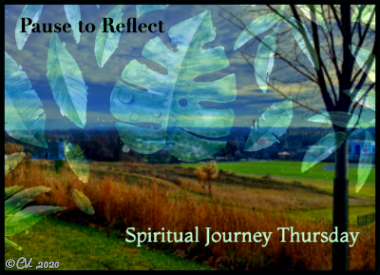
Graphic design by Carol Varsalona. She is also hosting today at Beyond Literacy Link.
Living on the bayou gives me a daily view of seasonal changes. We have a huge cypress tree that drops its needles all over the back deck when the days grow shorter. They burst out in bright neon green as the days grow long.
While cypress respond to daylight, other plants respond to temperature changes. On my morning walk, I’ve been watching a Japanese magnolia bursting into bloom. Maybe it’s just me, but I think it blooms earlier and earlier each year. The beauty is striking. I used the tree as a subject for my Poetry Friday offering for tomorrow.
One way I pay attention to seasonal changes is to write poems. I am writing every day with #100daysofnotebooking and with Laura Shovan’s February poetry challenge. When I commit to a social media group, I have accountability, so I get it done.
On Saturday, I wrote a quick notebook draft responding to the quote by Robert Louis Stevenson “There is no music like a river’s”
Listen to the cry of mother wood duck, clicks of red-headed woodpecker on the old oak. Hear the train whistle in the distance, and the peaceful ringing of wind chimes.
The bayou wakes up slowly on this winter Saturday playing its music for the clouds welcoming first sun, first light, new day.
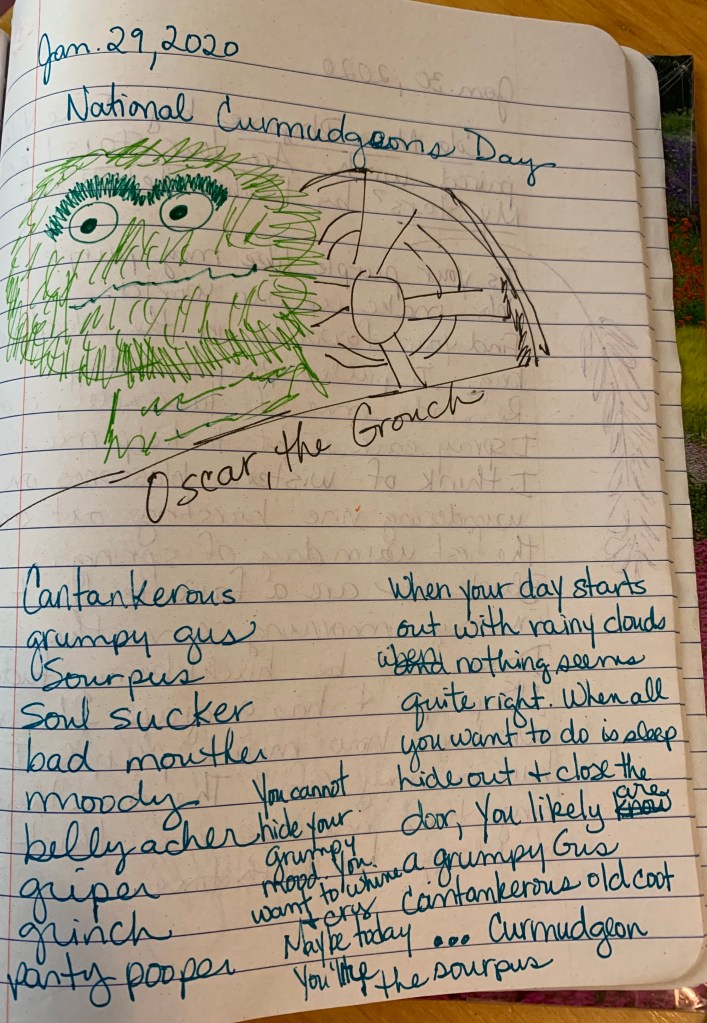
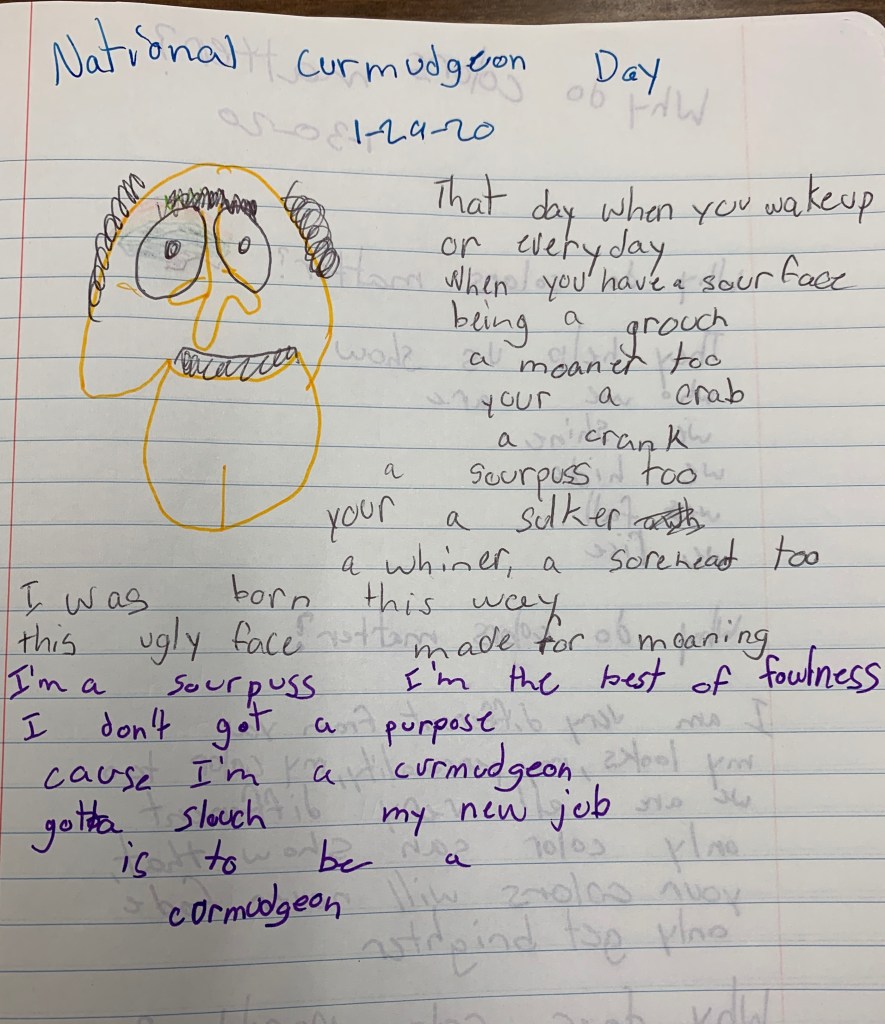
Did you know that Wednesday, Jan. 29th was National Curmudgeons Day in honor of W.C. Fields’ birthday? I didn’t either until I got an email from Jen Laffin’s blog Teach Write. Jen listed some great writing prompts to use with your students.
My students loved this. I loved giving them a word they didn’t already know, which is a challenge when teaching gifted kids. In their notebooks, they wrote poems and character sketches as well as drew pictures of Grumpy Cat, Oscar the Grouch, and the two old men from the Muppets.
I reminded them of the poem form, definito, which was created by my friend and fellow poetry swagger, Heidi Mordhorst. A definito is a poem of 8-12 lines that defines a word and ends with the defined word.
I worked on this poem playing with a rhyme scheme. Writing this poem cheered me up, out of curmudgeonliness.
National Curmudgeons Day Definito
When your day starts out in slush and mud, When nothing seems quite right, When your cat scratches drawing blood, When you’ve already lost the fight, When all you want to do is rest or hide, just slam the door, You can’t suppress your grumpiness; Your mom says you’re a boar. Your face turns green and grouchy, shoulders glum and slouchy. It may be better to stay in as you are a curmudgeon.
Margaret Simon lives on the Bayou Teche in New Iberia, Louisiana. She is a retired elementary gifted teacher who writes poetry and children's books. Welcome to a space of peace, poetry, and personal reflection. Walk in kindness.