See more posts at Two Writing Teachers Slice of Life
Photo by Kay McGriff: “This photo is from one of our favorite activities twice each year–the Friends of the Muscatatuck River Society River Clean up.”
I have been writing a lot of poems lately with my students as we respond daily in our notebooks and with a Facebook group for Laura Shovan’s February Poetry Project.
The picture above was shared by Kay McGriff. She and her family participate in a twice-a-year river clean-up. I haven’t done this yet, but living near the bayou, we see all sorts of things drift by. This picture inspired me to look into this project.
Armed with an article, I decided to create a Bop poem. I was introduced to this form by my friend and critique partner, Linda Mitchell. Here’s a link to the form: https://poets.org/glossary/bop
People are messy. Rivers are easy to access. Everything can be found– shoes, tires, buckets, balls– whatever falls in sinks to a watery grave.
“You wouldn’t believe the stuff we find.”
Someone found a car, an old boat motor, ten feet of rope. It’s all trash pollution and doesn’t belong here buried in our drinking water. Imagine what the fish are thinking. People are crazy! Let’s get out there and clean it up!
“You wouldn’t believe the stuff we find.”
So share in the fun of the Annual Spring River Cleanup. There’s something for everyone to do. Volunteers will collect whatever they find walking the bank or paddling a canoe. Together we can save the river.
Poetry Friday round-up is with Laura at Writing the World for Kids.
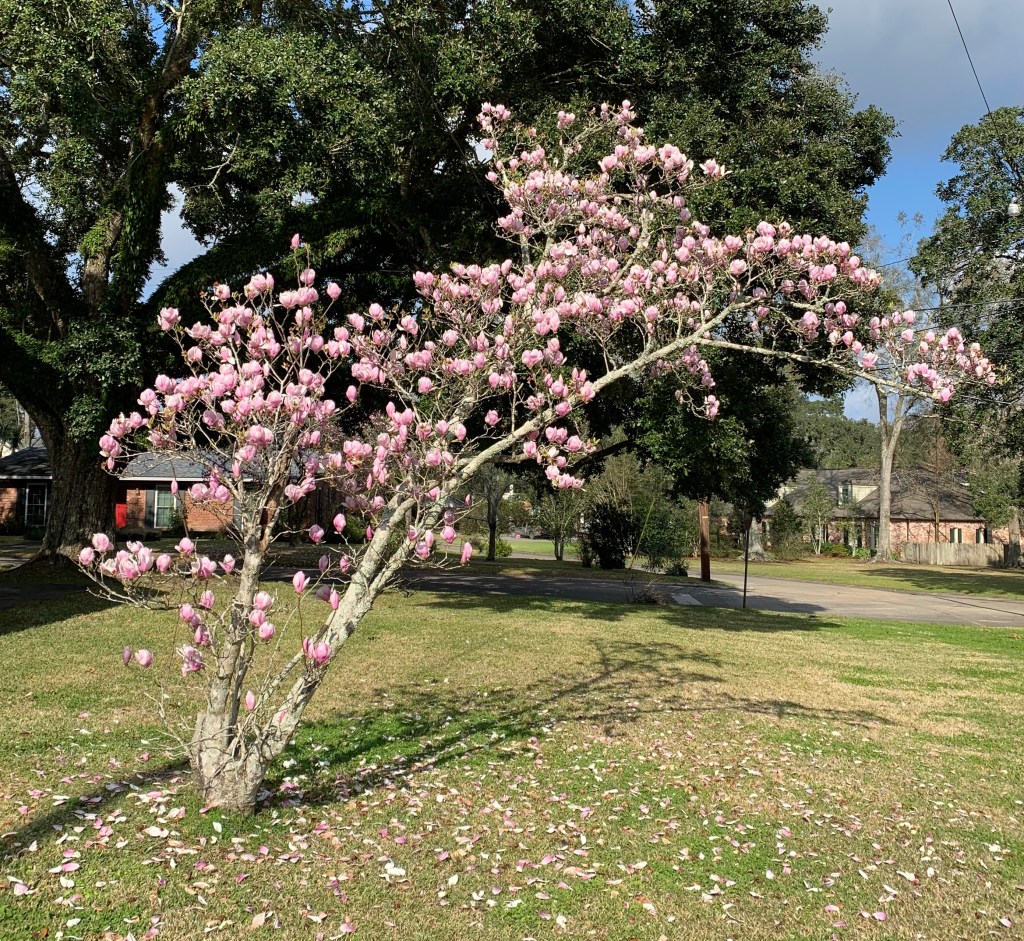
Take a walk with me on this chilly day. The temperature dropped during the day yesterday from a rainy 55 degrees to a frigid 35 degrees with winds close to 20 mph. Bundle up in your winter coat and gloves. Did you bring your wool socks? As we walk past the bayou and along the road, we come to an open field. Watch your step because the ground is uneven here, and you may step in a puddle.
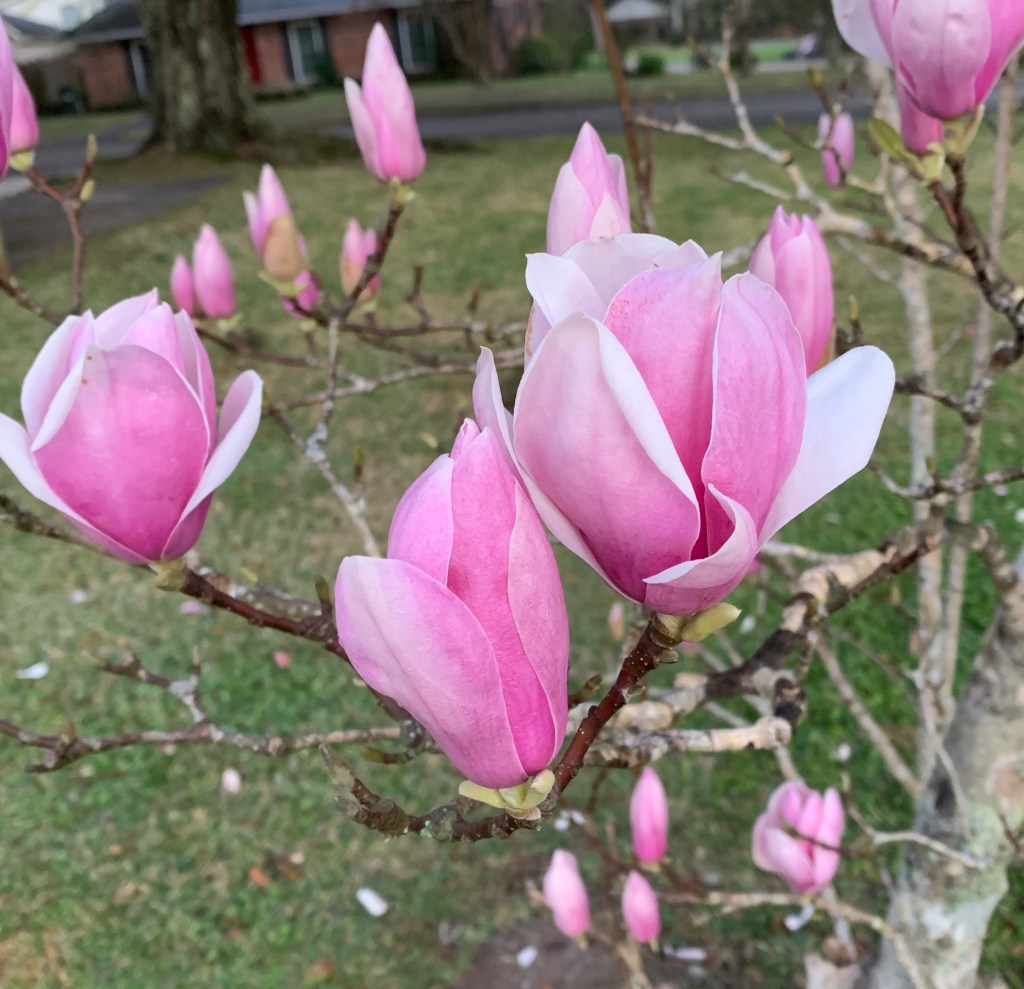
There near the neighboring house is a tree that looks like it may have been struck by lightning. It’s leaning slightly, but oh! It’s bright with pink blossoms. Flowers in winter? I think Japanese magnolia likes to be the first to show off her new spring dress.
My poetry swaggers group had a difficult challenge this month, given by Catherine Flynn. Terza Rima, she suggested, a form none of us had ever tried. But it’s from Dante, she delighted, not knowing yet that we are no Dantes.
Nevertheless, I gave it a shot. The first results lacked greatly. After a few rounds with my writing buddies, they helped me patch it up to present today. A terza rima is not going into my book of forms. This was a tough code to crack. Here’s a link to some confusing helpful guidelines.
A Japanese magnolia takes a chance on blooming ‘fore the risk of frost is gone with warming trends alive inside its branch.
Perhaps a passing storm had left it torn in this winter field alone and gray, when leaves of life from limbs are yet unborn.
Bold flowers burst bright pink and lift away a fog; flamboyant beauty flirts for view when wind blows chill across my path today.
A Japanese magnolia takes a chance.
Margaret Simon, draft #5
Visit the Poetry Swaggers Sites for more (and better, if you ask me) Terza Rima poems.
Graphic design by Carol Varsalona. She is also hosting today at Beyond Literacy Link.
Living on the bayou gives me a daily view of seasonal changes. We have a huge cypress tree that drops its needles all over the back deck when the days grow shorter. They burst out in bright neon green as the days grow long.
While cypress respond to daylight, other plants respond to temperature changes. On my morning walk, I’ve been watching a Japanese magnolia bursting into bloom. Maybe it’s just me, but I think it blooms earlier and earlier each year. The beauty is striking. I used the tree as a subject for my Poetry Friday offering for tomorrow.
One way I pay attention to seasonal changes is to write poems. I am writing every day with #100daysofnotebooking and with Laura Shovan’s February poetry challenge. When I commit to a social media group, I have accountability, so I get it done.
On Saturday, I wrote a quick notebook draft responding to the quote by Robert Louis Stevenson “There is no music like a river’s”
Listen to the cry of mother wood duck, clicks of red-headed woodpecker on the old oak. Hear the train whistle in the distance, and the peaceful ringing of wind chimes.
The bayou wakes up slowly on this winter Saturday playing its music for the clouds welcoming first sun, first light, new day.
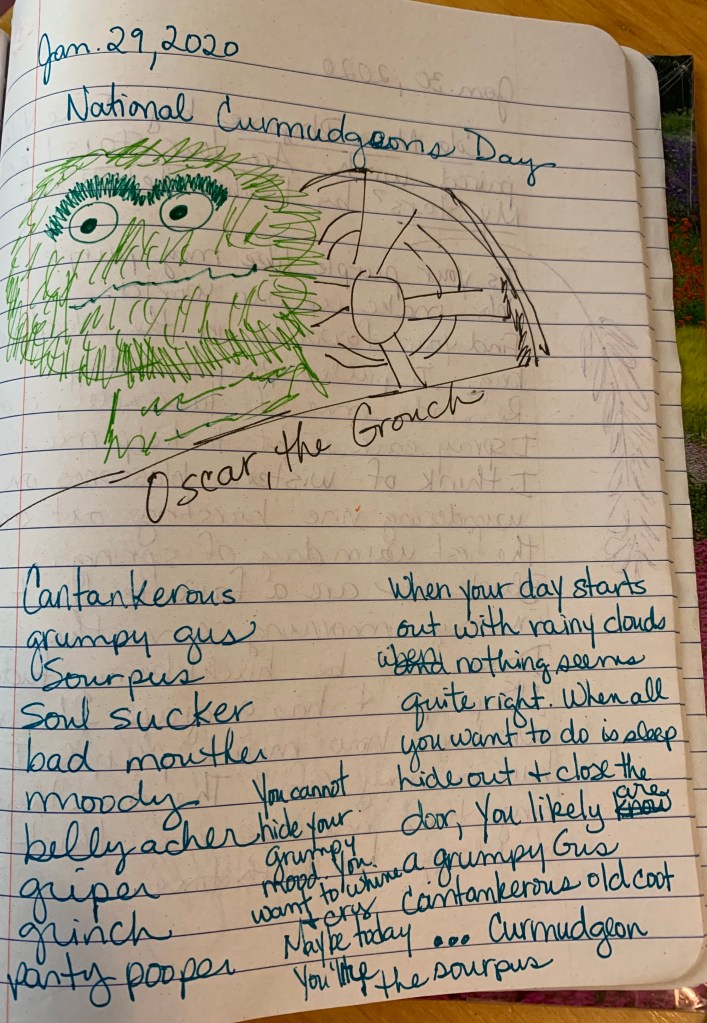
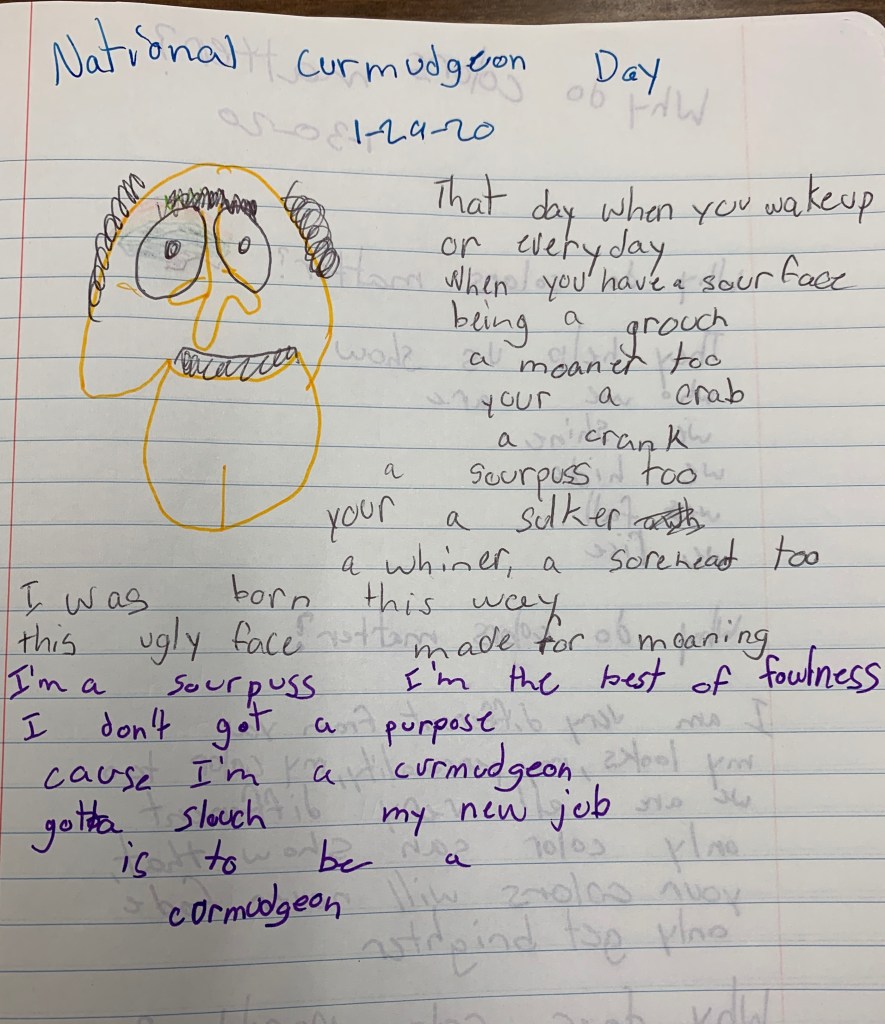
Did you know that Wednesday, Jan. 29th was National Curmudgeons Day in honor of W.C. Fields’ birthday? I didn’t either until I got an email from Jen Laffin’s blog Teach Write. Jen listed some great writing prompts to use with your students.
My students loved this. I loved giving them a word they didn’t already know, which is a challenge when teaching gifted kids. In their notebooks, they wrote poems and character sketches as well as drew pictures of Grumpy Cat, Oscar the Grouch, and the two old men from the Muppets.
I reminded them of the poem form, definito, which was created by my friend and fellow poetry swagger, Heidi Mordhorst. A definito is a poem of 8-12 lines that defines a word and ends with the defined word.
I worked on this poem playing with a rhyme scheme. Writing this poem cheered me up, out of curmudgeonliness.
National Curmudgeons Day Definito
When your day starts out in slush and mud, When nothing seems quite right, When your cat scratches drawing blood, When you’ve already lost the fight, When all you want to do is rest or hide, just slam the door, You can’t suppress your grumpiness; Your mom says you’re a boar. Your face turns green and grouchy, shoulders glum and slouchy. It may be better to stay in as you are a curmudgeon.
See more posts at Two Writing Teachers Slice of Life
Over the weekend news traveled quickly of Kobe Bryant’s untimely death and the heart-wrenching revelation that his 13 year old daughter died with him. I’m not a huge basketball fan, but I knew my students would come Monday talking about this tragedy. So when I saw Sara Ahmed’s tweet, I took notice.
This is the piece of writing that got me hooked on the @PlayersTribune
This is the piece of writing I would share with students on Monday to remember #KobeBryant
I copied Kobe’s poem Dear Basketball. We talked about Kobe, about the accident, and read aloud the poem. Later in the day, I saw a Facebook post of this video, so my last class watched the video as well.
As a writing prompt, I told my students they could write a letter to something they love or write a letter to Kobe from his basketball. This prompt worked especially well with my boys. I want to share three of my students’ poems.
Dear Kobe
From the first time you made me from a ball of socks and threw me into a hoop,
I knew that you would become one of the greatest. I knew that you dreamt of being one of the greatest, by how you put your heart and soul into me, day and night, never resting. You put your blood, sweat, and tears into me.
You worked day and night, making shot after shot after shot after shot, until you were finally able to put on that Lakers jersey with me in your hand, doing the thing you love the most.
I am grateful for all the years we spent together, but as you grow older, your body isn’t into running up and down the court, throwing the ball into the hoop, but I know your heart will always be with me forever and ever.
Poetry Friday round-up is with Kathryn down under at her website.
When I started #100DaysofNotebooking with my students, I couldn’t imagine that we would be reading and writing poetry every day. But poetry is where my radar goes, and a good poetry prompt for me is also good for my kiddos.
Thanks to Ethical ELA, I had many ways to lead my students into writing this week. The prompts are still up on the website, and I highly recommend them. Writing together day by day helps me and my students to be vulnerable together. From this prompt, we wrote poems about loved ones who have passed away. My students touched me with their honesty. They had to bear with me choking up when I shared this poem about my dear friend Amy:
Amy Who inspired by Abuelito Who by Sandra Cisneros
Amy who looked like Sandra Bullock but better, whose smile glowed a mile away, who wore a crown with grace when she threw beads to the crowd, whom you may call a social butterfly, but her conversations were real; she didn’t stray from the tough stuff, and laughed aloud at funny happenstance, who held my grandbaby the last time I saw her, tears in her eyes as she said, “I will never have this.” Who faced cancer with wisdom, never giving up while knowing all the while her body was, who left us all missing her, whose joy lives on, and her smile.
Margaret Simon, draft 2020
This photo of Amy from the first Berry Queen Ball in 2008 stays on my my refrigerator.
A prompt from Teach this Poem led me to a video of “Imagine” by John Lennon. Sadly, most of my students didn’t even know who he was, much less the song. But this freshness caused them to be open and creative in their writing.
The world breaking into countries some people can only imagine while others can do something. We would want our world to be like clouds in the sky staying together to make a huge crowd shouting and singing. They contain heaven where everyone lives in peace not separating their clouds. We don’t want our world to turn into nothing
Jaden, 4th grade
Photo from PIxabay
No reason, to kill or die for. Imagine, I might be called a dreamer, but there are others who think the same. I hope some day… you’ll join us, a brotherhood of man… No need for greed or hunger. Imagine us all living and loving,
See more posts at Two Writing Teachers Slice of Life
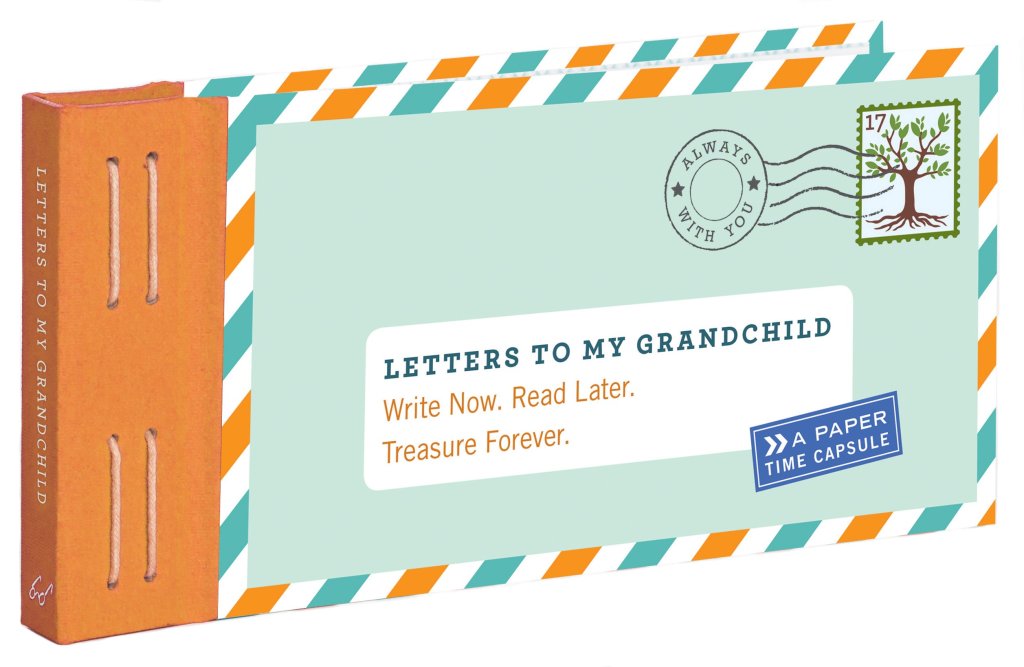
Warning: This is another shameless Grandmother post. I received a wonderful gift from a friend, “Letters to My Grandchild”. It’s a little book with envelopes to tuck letters into. I love this idea because those books that you write in intimidate me. What if I mess up? This little book is just envelopes, so I can do multiple drafts before I place them into the book. Thanks, Dani!
I’ve been reading Ordinary Hazards by Nikki Grimes. This book will tug at your heartstrings as Nikki overcame a terrible childhood bouncing around in foster homes and facing her mother’s alcoholism and schizophrenia. The memoir is constructed with poems and notebook entries. Each poem is a poem in and of itself. Because of this, I can share poems from the book with my students without having to read the whole book to them. The content can be too tough for my young students.
On Thursday last week, I shared the poem “The Mystery of Memory #3”.
Think food, and nourishment comes to mind, but we all know it’s so much more. One bite of pineapple, and my tongue sticks to the roof of memory, gluing me to the last moment I savored a slice of pineapple upside-down cake at my grandmother’s kitchen table.
To read the complete poem, read Ordinary Hazards by Nikki Grimes.
One of my poems came out as another grandmother joy poem.
Think baby, and crying comes to mind, that piercing sound first heard as life. But we all know it’s so much more. So many firsts– first bath first smile first step first word.
When you send me a picture or video text, my heart swells with joy. Something new, something yours, now mine. A tiny finger wraps around my finger tingling with love.
Margaret Simon, after Nikki Grimes
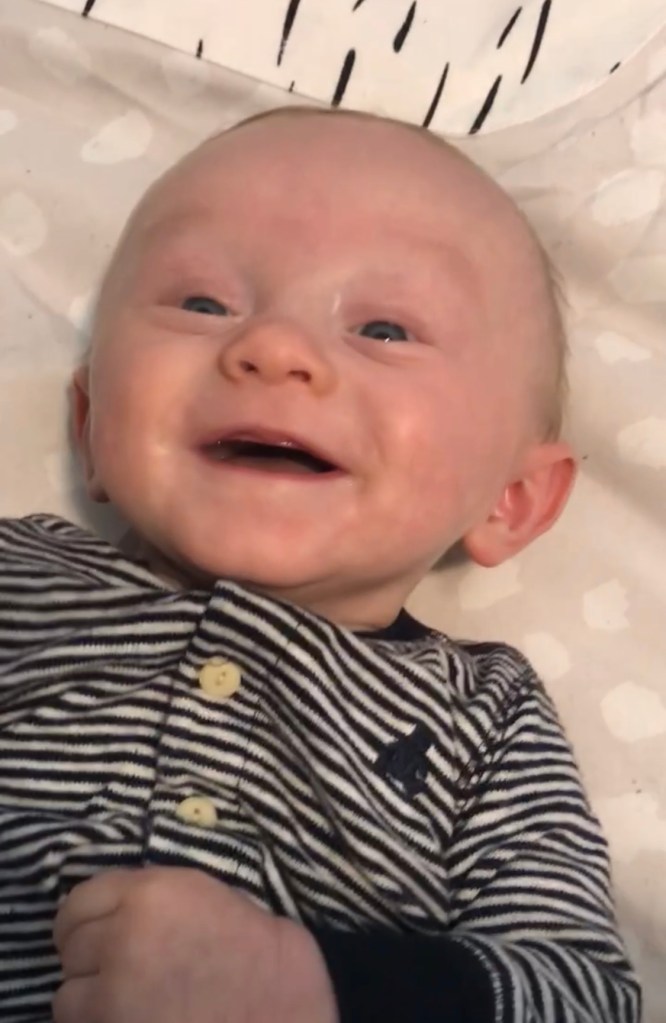
A gummy Thomas smile to warm your heart.
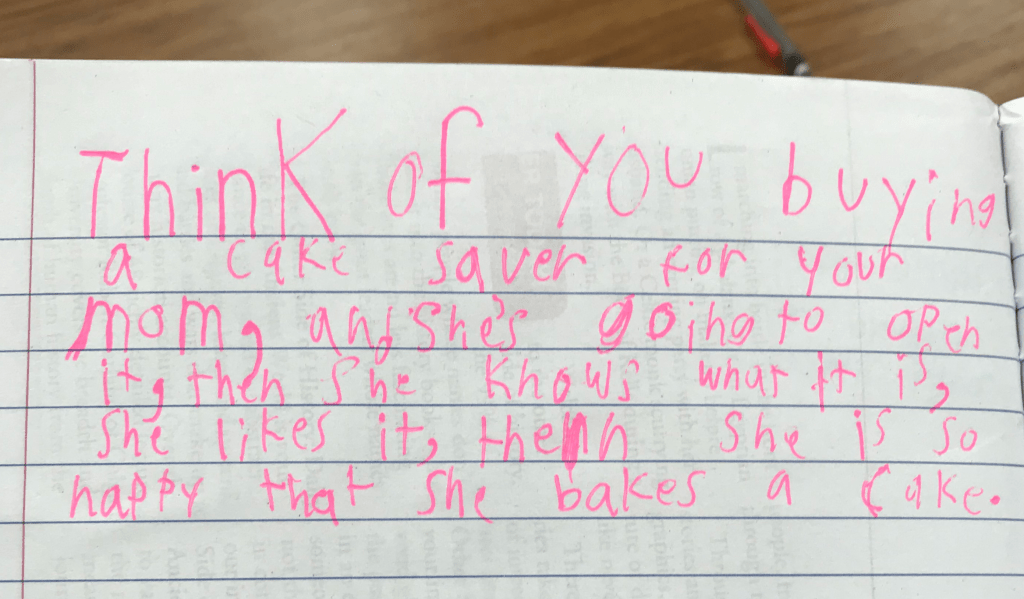
My second grader Rylee is not yet worried about line breaks, but she heard the rhythm and sentiment of Nikki’s poem and wrote this (hands off from me) in her notebook.
by Rylee, 2nd grade
With line breaks by me:
Think of you buying a cake saver for your mom, and she’s going to open it, then she knows what it is. She likes it, then she is so happy that she bakes a cake.
Joining the link up for It’s Monday, What are you Reading? At Teach Mentor Texts.
I’m a member of our local (as well as national) SCBWI (Society of Children’s Book Writers and Illustrators). In this organization, I am able to meet some wonderful authors. A few years ago I met Leslie Helakoski at ALA or NCTE, not sure which, and found out that her mother lives in our area, and she dances to Cajun and Zydeco music. Turns out, I know her mother from our dancing circle. Small world.
Leslie was involved with the SCBWI in her home state of Michigan. Well, lucky us, she is now splitting her time between the two states, Michigan and Louisiana. She has taught a few picture book workshops in our area, and I greatly admire her talent. Not to mention, she is a very nice person, too.
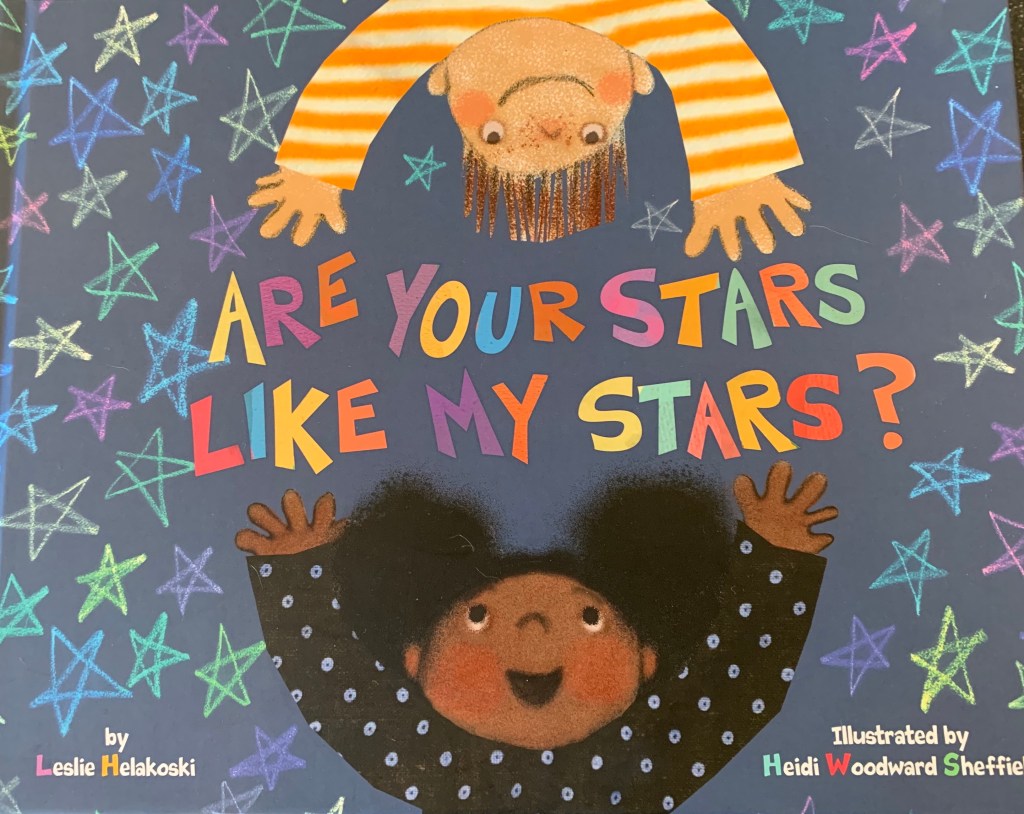
Leslie’s latest release is as sweet a story as she is. Are Your Stars Like My Stars? is a picture book about colors. No, it’s a book about friendship. No, it’s a book about diversity. All in one, Leslie’s rhyming verse asks the question, “Is your blue like my blue?” Leading us to see through the eyes of a child that we can all see things differently, and that is the best thing of all.
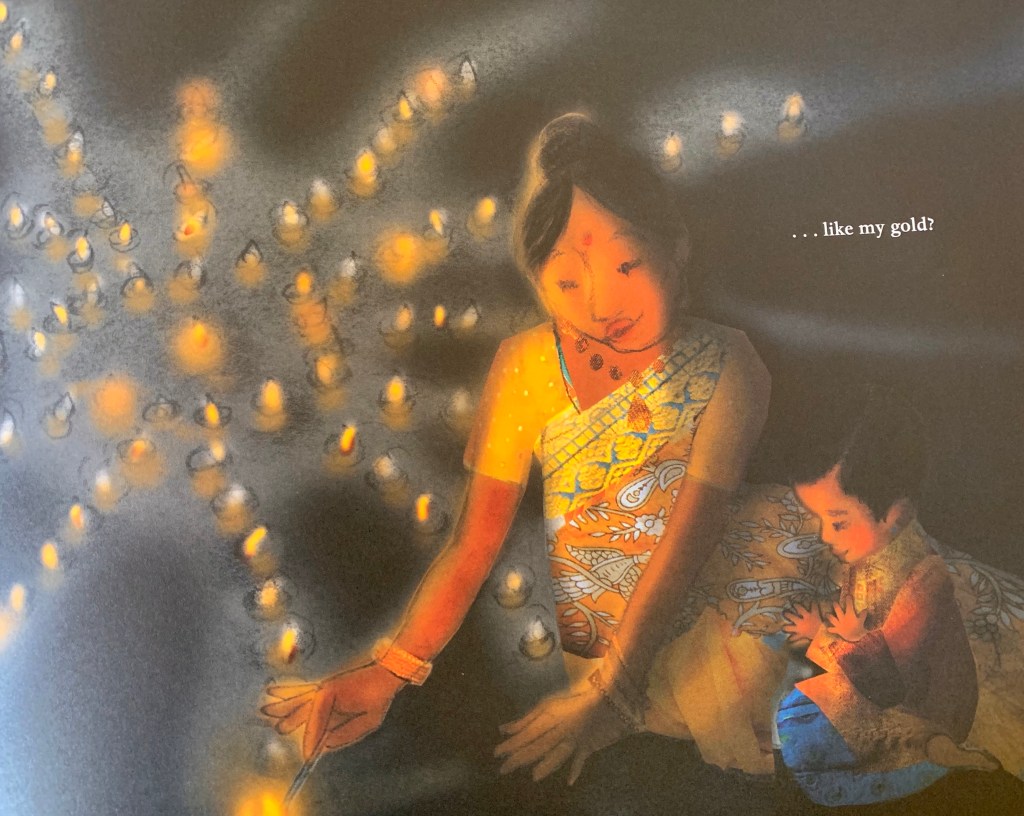
With engaging art from Heidi Woodward Sheffield, any child will be entranced by the coloring book collage style.
Do you splash in a puddle when the world is washed clean? Are the leaves fresh and bright?
Is your green… … like my green?
Leslie Helakoski
You can find out more about Leslie’s books here. Follow her on Facebook and Instagram, @helakoskibooks. If you are in Lafayette, LA on Saturday, January 25th, come by Barnes and Noble and get a personal signed copy.
Poetry Friday round-up is with my friend and critique partner, Catherine Flynn.
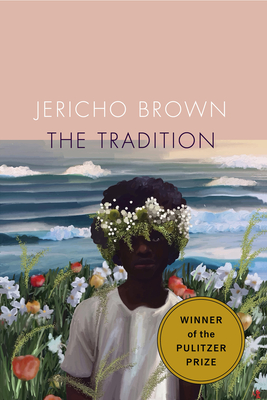
In my school email inbox, I get a weekly poetry lesson from Poets.org. called Teach this Poem. I don’t do these every week because the intended audience is middle and high school, and my students are elementary. But this week the author’s bio drew my attention. Jericho Brown is from Shreveport, Louisiana, a native to our state.
In the lesson, students were to identify a picture from the Library of Congress of the March on Washington. Enough of my students know about MLK, Jr. that they understood what they were seeing. Relating the poem to the march was a stretch for them, however.
Nevertheless, we wrote after Jericho Brown.
The water is one thing, and one thing for miles. The water is one thing, making this bridge Built over the water another. Walk it Early, walk it back when the day goes dim, everyone Rising just to find a way toward rest again.
We have crossed the line, that imaginary space between you and me, a wall covered in vines. Tearing at the weeds, I find a flower– morning glory. Help us, Jericho, to see the flower in the weeds, the flame inside a rainbow, crossing over barriers to a place where we can all leap together.
See more posts at Two Writing Teachers Slice of Life
I saw the tweets, Facebook posts, and blog posts from Michelle Haseltine, and I said, “No!” I don’t need another group to join, another challenge to conquer, anything else to do! Just. Say. No.
That “no” lasted a few days, but the more posts I saw, the more I realized that this was the perfect thing to rejuvenate writing in my life and in my classroom.
Last year at NCTE 2018, I attended a notebooking workshop (wrote about it here) with Michelle and others. I came home inspired to make a commitment to notebooking in my classroom. At the end of the year on a field trip bus, I overheard one of my students talk to another one from a different school. She said, “I love notebook writing. Do you?”
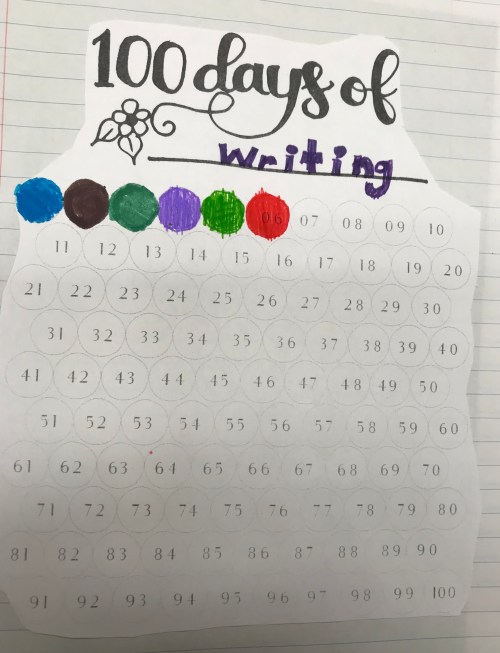
Somehow things got in the way this school year. So the #100daysofnotebooking was just the thing I needed to bring out the notebooks again. We wrote every day last week.
I printed out this page, so we could keep a count of the days.
The notebook writing takes about 20 minutes in each of my three classes. I begin with some sort of prompt. We write to the Insight Timer set to 7 minutes. Then we share. Some of my students post their writing on our class blog, but this is not required.
Watching the Facebook page is inspiring (or daunting, depending on your point of view as some posts are very creative), but there is room for every type of notebooker. I’m enjoying trying out collage, writing to poetry, and word collecting.
As we continue, I’ll know more about how my students are growing their writing skills. Right now the routine of it is working. They look forward to the time to write, the time to draw, and the time to be themselves on the page.
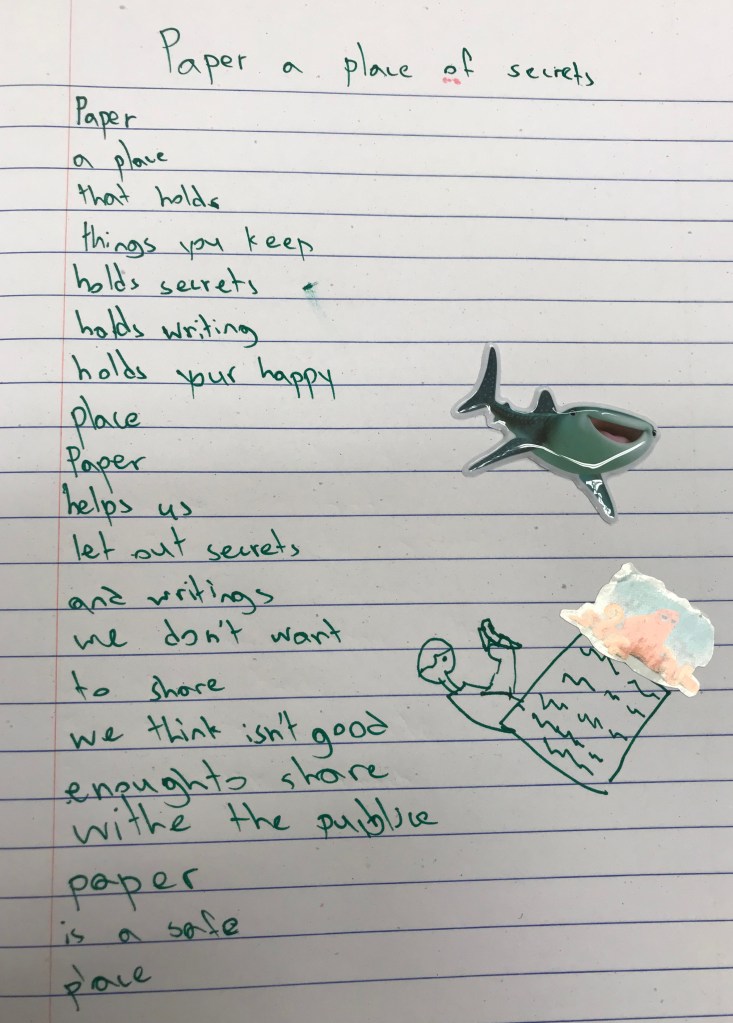
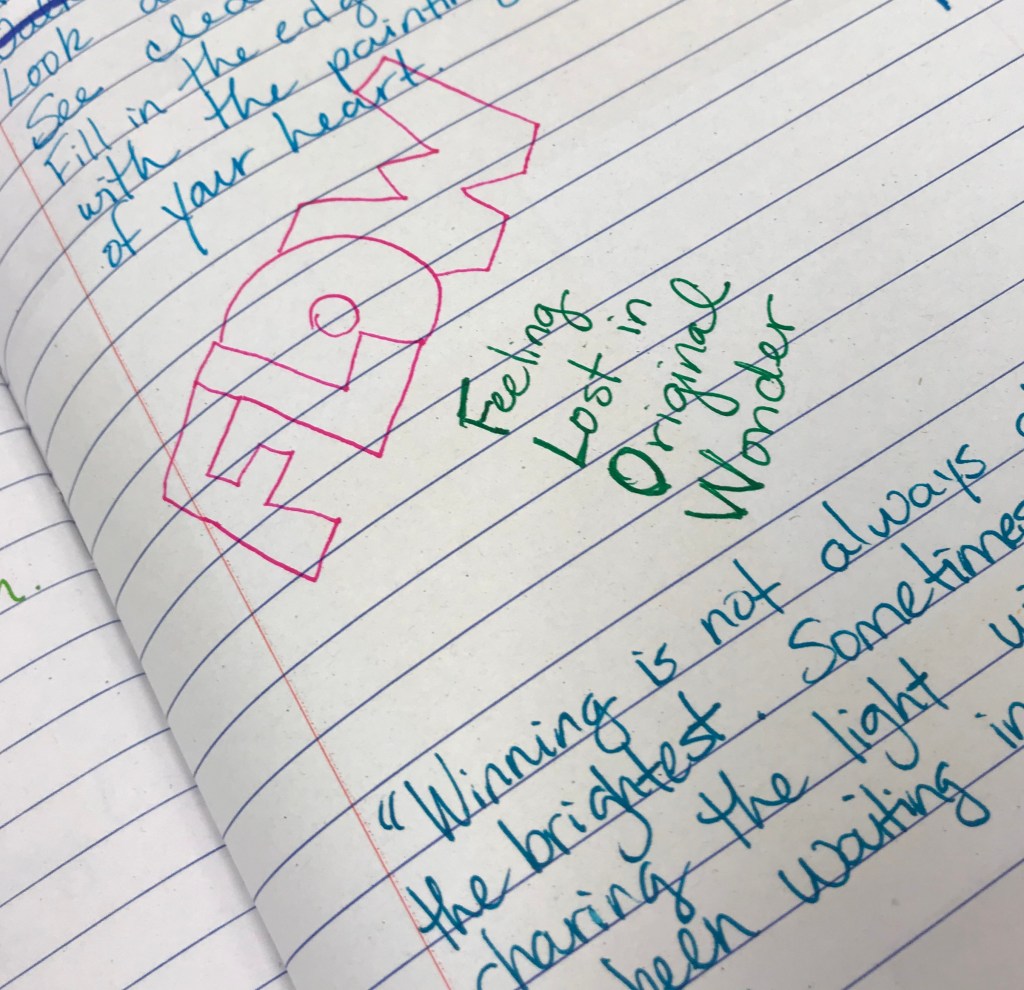
Here’s a gallery walk of some of our pages:
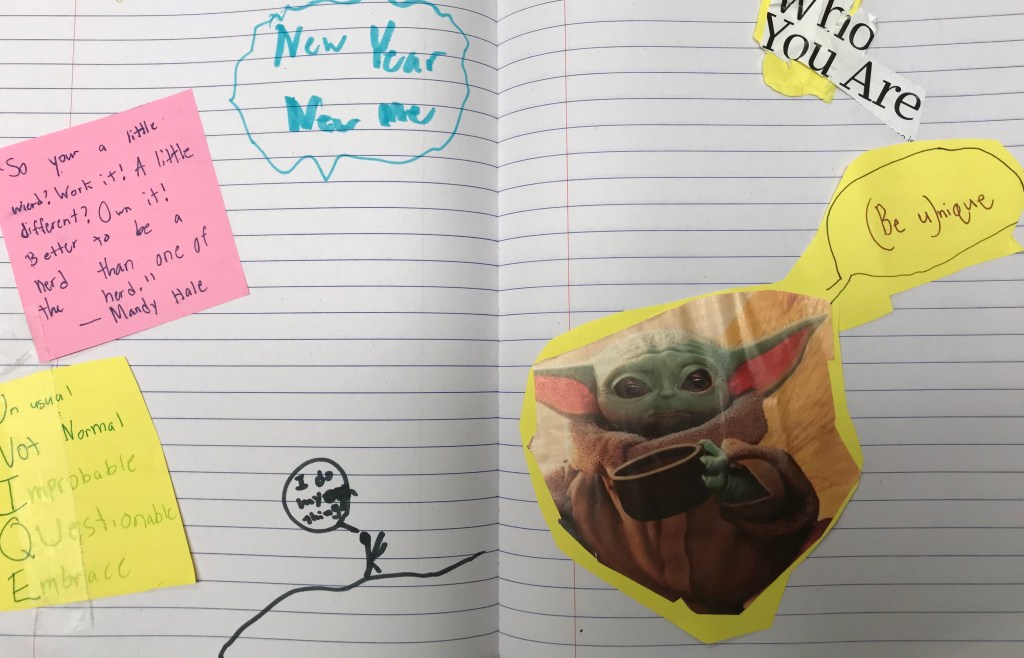
Jaden was inspired by a poem by Nikki Grimes, Journey from Ordinary Hazards.
Notebook time leads to Flow, the concept that time disappears while we are immersed in a creative activity.
Karson’s One Little Word notebook page.
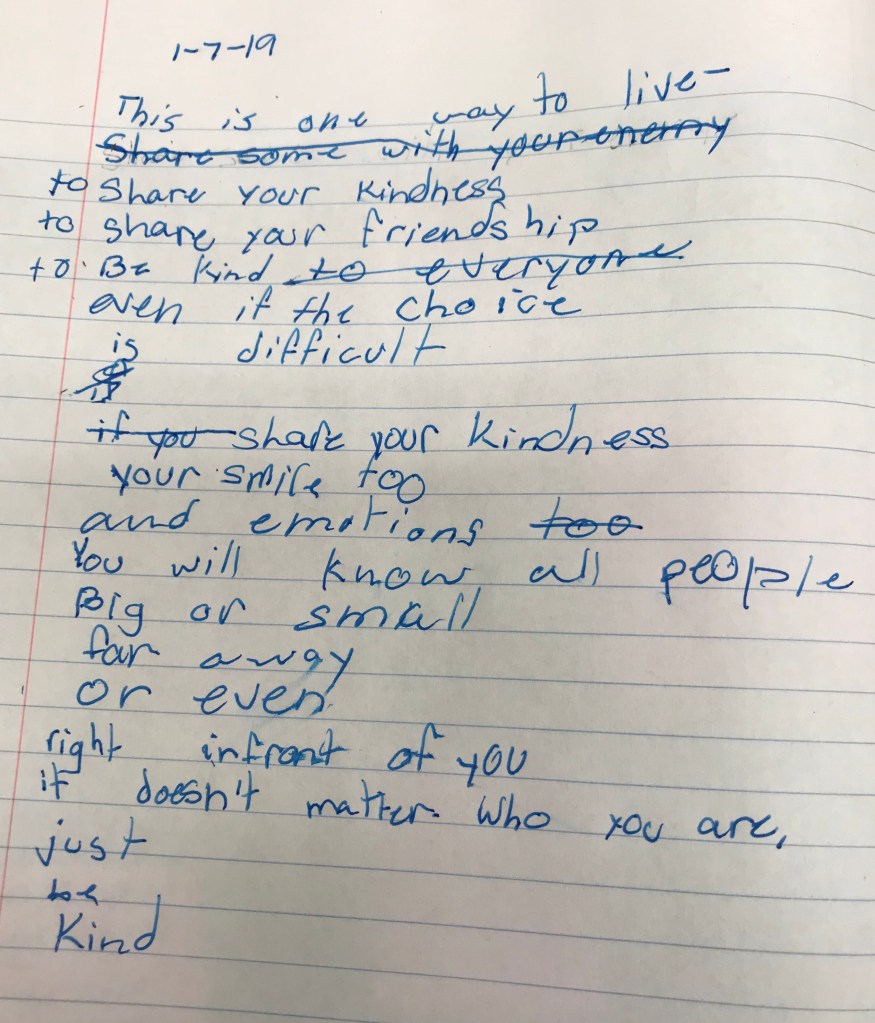
Breighlynn’s poem in response to Amy Ludwig VanDerwater’s poem The Pie of Kindness.
Margaret Simon lives on the Bayou Teche in New Iberia, Louisiana. She is a retired elementary gifted teacher who writes poetry and children's books. Welcome to a space of peace, poetry, and personal reflection. Walk in kindness.









 Reflections on the Teche