July came in with a poem from Grateful Living. A poem I know and love. One I’ve carried in my pocket often for Poem in your Pocket Day. It’s likely one that you know as well, Kindness by Naomi Shihab Nye. In my notebook I wrote a riff on the line “You must know sorrow as the other deepest thing.”
You Must Know
Sorrow buries itself in the marrow of your bones, zaps your energy so all you can do is stop, rest, breathe slow and steady.
Then you emerge, shedding a former skin to feel Love as the deepest thing, how sorrow lights on a fence post to show you what is true. All a part of you.
July is a popular travel month. Heidi challenged the Inklings to write a postcard poem for this first Friday. “Write a short postcard poem with choice details of your vacation/holiday/getaway/escape location and activities. Conclude with “Wish you were here” or some variation!”
Unfortunately, we had to cancel a Europe trip due to my husband’s injury. I have been perusing social media and pondering the travel of my friends. This is not a healthy situation. I’m having bouts of travel envy.
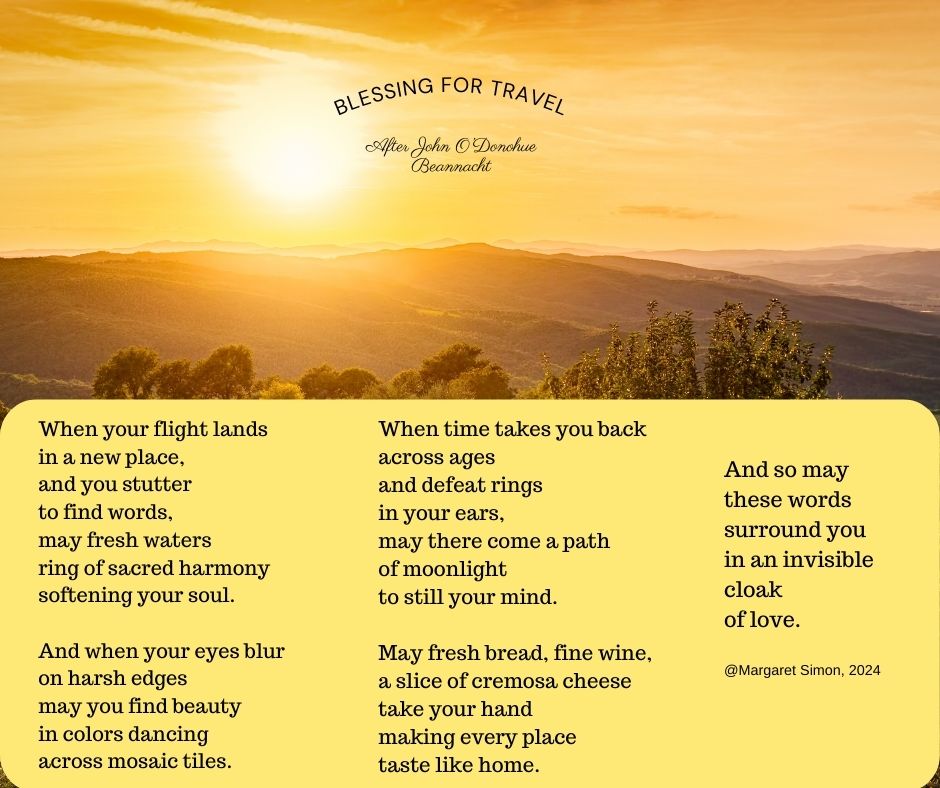
A friend recommended John O’Donohue’s interview on the On Being podcast. O’Donohue died young in 2008. His interview with Krista Tippett was inspiring. I was especially attracted to his poem “Beannacht” found in his final book: To Bless the Space Between Us: A Book of Blessings and used it as a mentor poem for my poem “Blessing for Travel”
The annual Summer Poetry Swap is coordinated by Tabatha Yeatts.
This week I received my first poetry swap poem from Rose Cappelli. Rose sent a dreamy note tablet, a Mary Oliver poem, and a cascade poem about peonies. As Rose explained, in a cascade poem, each line from the first stanza repeats as the final line of each subsequent stanza. Rose does this seamlessly.
Thank you, Rose, for the lovely cascade poem.
My mind has been on the flowers, prompted by Mary Oliver, Rose, and Maggie Smith. I subscribe to Maggie Smith’s Substack newsletter. This week she wrote about naming things.
“I love when I can accurately identify things when I see (or hear) them: a bird, a tree, a flower, a constellation, a kind of nest. (As the poet Pattiann Rogers once said in an interview, ‘naming is a form of honoring something.’)”
Maggie also writes about not knowing the name of something and how that can lead to wonder and discovery. I found a flower in my mother-in-law’s collection of pots that she nor I could identify. We could tell it was a type of hibiscus. I began by writing a list of metaphors. I am still playing with how to insert the not knowing, but wanted to share the small poem that I wrote in my notebook.
Hibiscus Moment
You are Love’s red lace, blooming beet-red bow on a woman’s flowing gown.
You open only for a day flirting like a spool of yarn to a kitten, taunting us
to feel unhinged with marvel. So much bravery in your fleeting face. (Margaret Simon, draft)
I have fallen out of a daily writing practice. I don’t have my students to keep me honest. Summer break has seeped into my psyche and everything feels like a pause. Good news I feel rested. I’m sleeping better, and my daily exercise has leveled up. But I feel guilty about the writing. I really thought I would do more of it.
Ethical ELA helped me out this week with daily prompts for June’s Open Write. On Saturday, Sarah Donovan started us out with a prompt from June Jordan’s poem “These Poems.”
These poems after June Jordan
These poems they are sated with sweet wine.
These lips open for words whispered to wind.
These wishes wander in warm sun hoping to find your heart to hold.
I follow these strokes stem by stem scribbles of ink seeking recognition.
Do you see me?
On Sunday, I led the prompt about writing a duplex poem after Kay Ulanday Barrett who wrote after Jericho Brown. The poem I wrote came to me after my husband’s recent dog bite injury. Everyone we talked to wanted to know all the details. He is doing better, but he is wearing a wound vac that is a gismo that continually pumps the bad stuff out of his wound. We are hoping this method works toward faster healing. (Thanks for all of your thoughts and prayers.)
the poem what it wants me to hear today. What thread runs through the details?
Everyone wants to know the details. What happened at the corner lot?
What happened at the corner turned his life, his legs inside out.
Turned his life, his legs inside out, details that thread the woven story.
They tell details to thread the woven story. Shout for justice for the finish line.
Say justice is truth; shatters the plan, pulls the thread on the whole thing.
Pull a thread, the whole thing changes to what the poem wants me to know.
Monday’s prompt was from Susan Ahlbrand. She shared clips from Gilmore Girls to prompt us to write about graduation day. I took a quote from Lorelei who said, “I’m not crying.”
On the final day, I was taking care of two of my grandchildren, so I put together a quick book spine poem, prompted by Jessica, from my daughter’s son’s shelf. This week revived my soul and hopefully put me back on a path of daily writing.
Poetry Friday is hosted today by Tracey Kiff-Judson at Tangles & Tails.
Here we are again with a monthly Inkling challenge. This month Molly challenged us with a prompt from Pádraig Ó Tuama who said “A poem is a word-event going in many directions at once. Sometimes the “you” of a poem is a specific person, at other times it’s the poet, or a general audience, and at times there’s no you at all so the poem addresses itself to the world.”
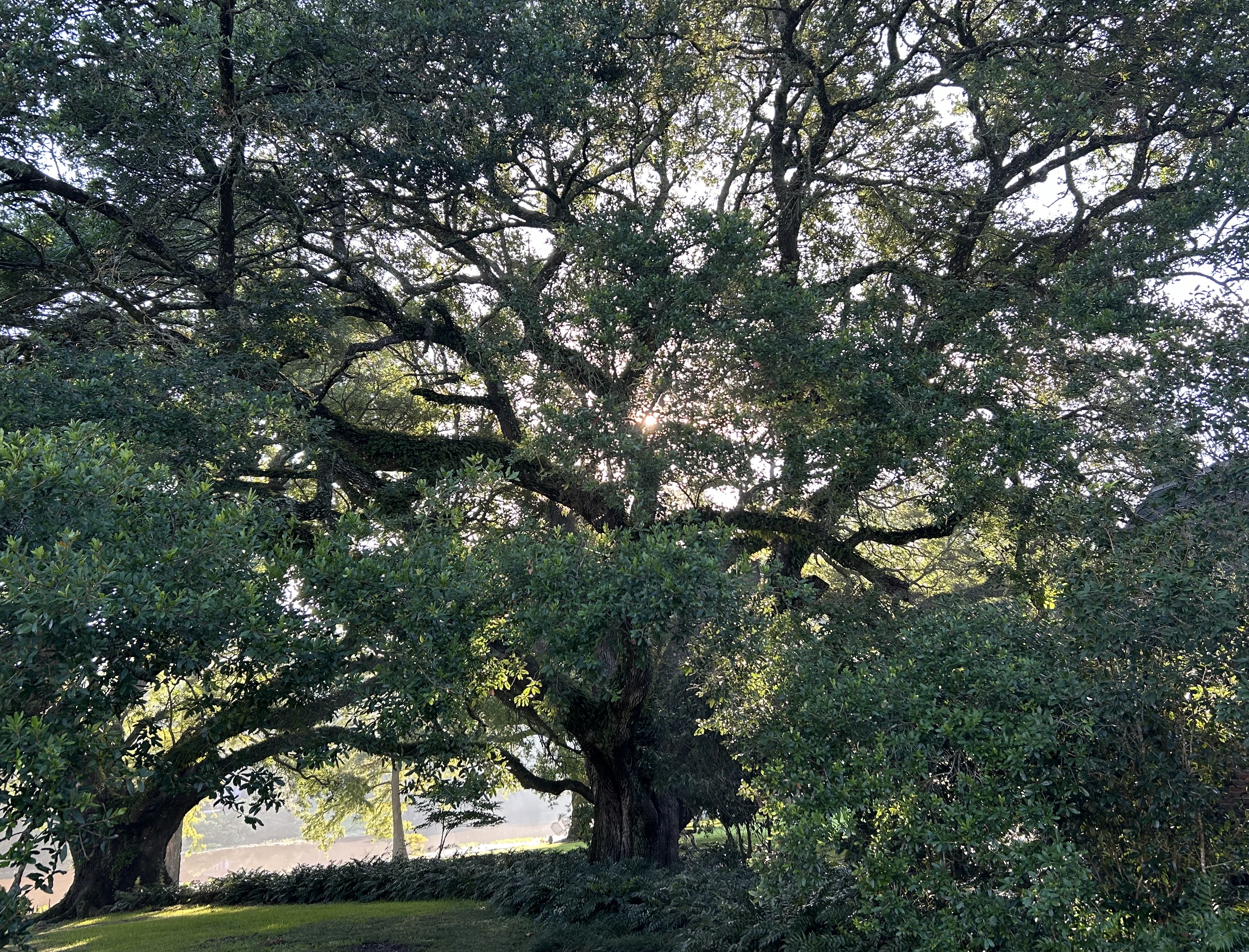
Molly asked us to write a narrative poem that includes observations about the world and explores the craft of address, the you of a poem. On a recent morning walk, I spoke two observations into my notes app. I felt invaded upon when a truck high up on oversized wheels revved its engine at me as it passed. The other observation was not connected at all. I saw oak tree arms leaning on electric wires. We’ve had a number of sudden storms this summer, and each one is frightening. That’s all to say that poetry is a place where I can vent; I can let steam rise and fall. I address this poem to the you of a random monster truck.
Grandmother Oak Sunrise June 6, 2024
You disturb my peace.
You! with your hot wheels rumbling down the road, motor revving, disrupt this peace of mind I’m in writing a poem in my head about birds singing.
Birds sing as you pass, your rolled-up windows beat-boxing, shaking a rhythm
of my walking, heart pumping brow sweating. I’m in this groove you move your hard edge against.
My poem wants to be kind, but I cannot wash away your harsh sound that erases the wind heaving a heavy sigh
like the old oak arms leaning on electric wires holding heavy vibration– a lightning bolt I cry
to be saved from.
Margaret Simon, draft
Take a look at how my Inkling friends approached this challenge:
I take inspiration for writing from many sources, but one of my favorites is Pádraig Ó Tuama’s Poetry Unbound. A few weeks ago, he featured sections of a poem by Joy Harjo. I listened, then read the whole poem. I was reminded of a conversation I had with my husband when we passed road construction on the way to visit the doctor.
Two weeks ago, my husband was mauled by a German shepherd. He’s going to be okay, but his calves were pretty torn up and he’s had two surgeries so far for repair and debridement. This is the kind of thing that turns your world on its edge, just checking in to see if you’re paying attention.
When I am thrown into a deep hole, I make my way out by writing poetry. Joy Harjo inspired this one. It may help to know that Jeff is a real estate attorney.
Road Construction
As we pass the road construction, he told me the owners agreed to the sale if they saved the tree.
The tree is gone; one hundred years of life gone for a road.
We don’t know how long we have. How long until a dog escapes its fence and takes you down to the bone.
This land does not belong to us to give. The house on the corner did not own the tree; it was not theirs to give, but there’s the empty space filled with mulch, the former bark of a tree giving up its life for a road.
Linda Mitchell is gathering posts with another fun clunker exchange.
A friend of mine suggested I listen to a podcast with Jane Hirshfield. It was a lovely hour. Even though I split it between multiple shorter listens, I want to go back and listen straight through. You can find it on Spotify on the Ezra Klein Show.
I write a poem-a-day, but honestly, I don’t always write a good, shareable poem each day. This week the only one I somewhat like is an acrostic to a Jane Hirshfield quote. One of my students found a Mary Englebright quote “It’s just a bad day. Not a bad life.” I’m applying that to my poetry writing. “It’s just a bad poem. Not a bad poet.” I like Linda’s idea of exchanging clunkers. Maybe some of my starts and fits will bloom on another page. For today, it’s Anything.
Happy May! In many ways, I’m sad that it’s May. I looked over the school calendars, and I have fewer than 10 days left with my students. May’s calendars are worse than December. They are full of “Fun Days”, field trips, and “Awards Day”… Where are the time-with-my-students days?
Of course, there are some wonderful days on the same calendar: Teacher Appreciation Week, Mother’s Day, Memorial Day, Sleep-in-it’s-summer days.
Today is Inklings Challenge of the Month Day. Linda Mitchell hit us with an interesting challenge to exchange poems and “Fiddle with, play with, tinker, tear-apart, be inspired or stumped by” the poem you were given. I chose to find a nestling ( à la Irene Latham). On this Canva design, you can see the poem Linda sent and my nestling.
Full poem “Star Says” by Linda Mitchell Nestling “Star” by Margaret Simon
Links to other Inklings. Molly had my poem to fiddle with. I can’t wait to see what she did with it.
If you followed the Progressive Poem, you can find the poem as a whole at this link: 2024 Kidlit Progressive Poem: Border Crossing This year felt different, a higher stakes dramatic story evolved. Thanks to everyone who participated.
I will be participating in a poetry reading event on Saturday night. It’s been a while since I have read for an audience. Wish me luck.
This week is state testing week, so I did not pull my gifted students out from their regular classrooms. I’m on stand-by to help if needed. But I do get to see my youngest ones. William, first grade, was only recently placed in gifted services. His gifted brain is so full of ideas that he can barely settle on one thing. I asked him to work with me on a haiku about a rainbow. We talked about how a haiku form captures a single moment in time, usually about nature, and has 3 lines, short, long, short. We played around with word order and placement of his ideas. Then he came out with the word “surprise.” Ah yes, that’s it!
Reflex (relects) in the warter (water). a rainbow comes out of clouds. surprise in the sky
William’s first haiku, 1st grade
Carson in 2nd grade has been working with me all year long. He’s more independent in his writing, but still needs reassurance. I showed him a video from Mystery Science about how the rain becomes a prism to refract the white light into a colorful rainbow.
Rainbows are still a mystery to me even though I have this knowledge. When I see an actual rainbow in the sky, I often take a picture. My husband knows to stop for rainbows. If you are drawn to them, to Molly’s amazing photo, and want to add your writing to the collection, go back to this post on Wednesday.
Sunlight prism in the water makes rainbows arch of colors
Carson, 2nd grade
While I was checking my Fanschool post, I realized that even though Adelyn was not coming to class, she checked on our weekly “This Photo Wants to be a Poem” post and wrote. She is crazy about all things mythological. Can you tell?
The great color arc, stretching above us. As water vapor shimmers bright in shining light, Iris glows.
Adelyn, 5th grade
After a skipped day on Thursday (no worries, just busy life), Karin introduces a new character.
For Poem in Your Pocket Day, I invited Marcie Flinchum Atkins to join my students by Zoom. We were able to get a small 30 minute window of time while she could visit. What a treat!
Marcie is a master at haiku, and no wonder, she writes one every day. She usually writes in a small notebook to photos that she has taken. Beautiful photos!
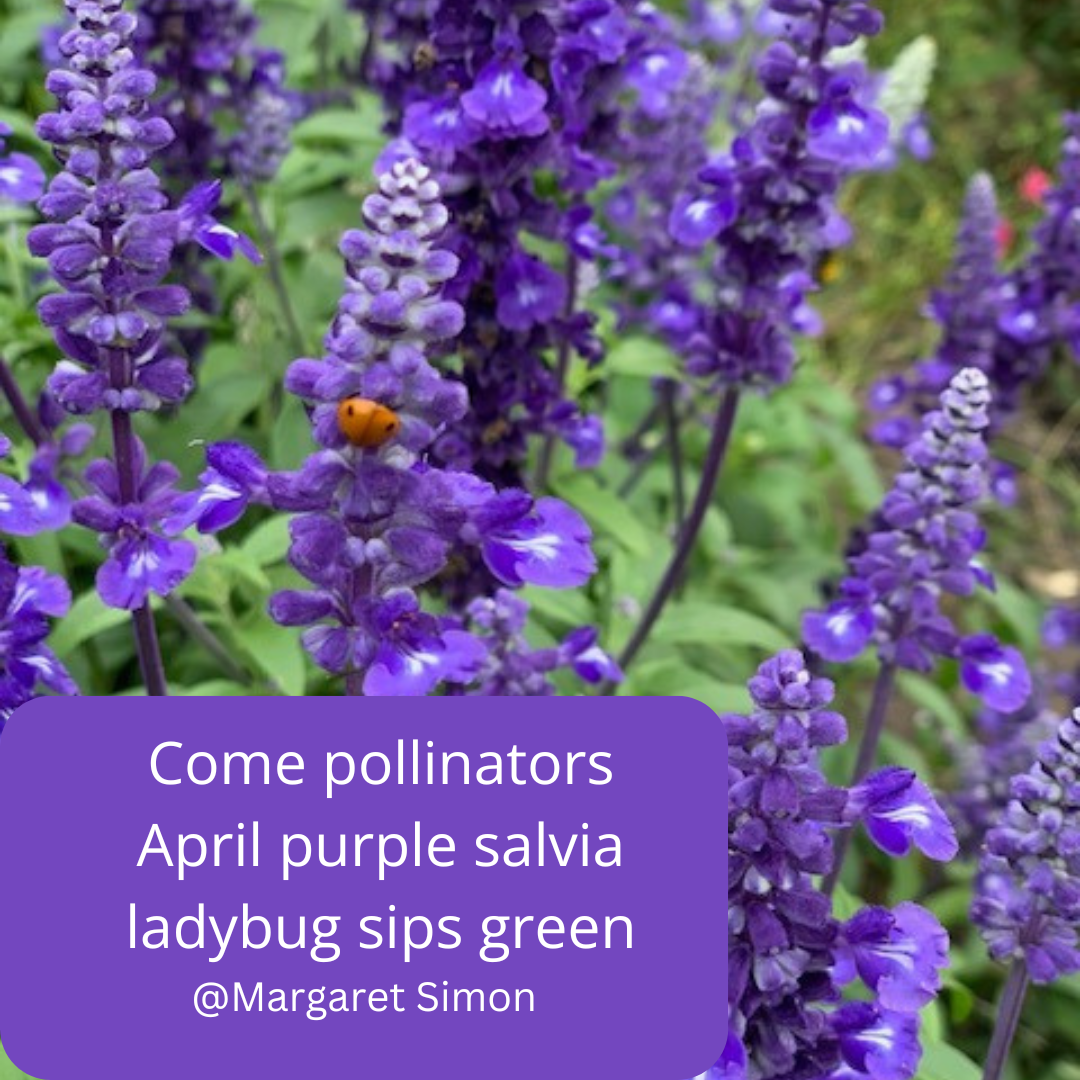
Her easy-going way led to a comfortable, safe environment for writing. My students wrote. I wrote. Like Marcie, I wanted to use a photo and Canva to design my haiku for publication. Maybe one day I’ll send them out on postcards.
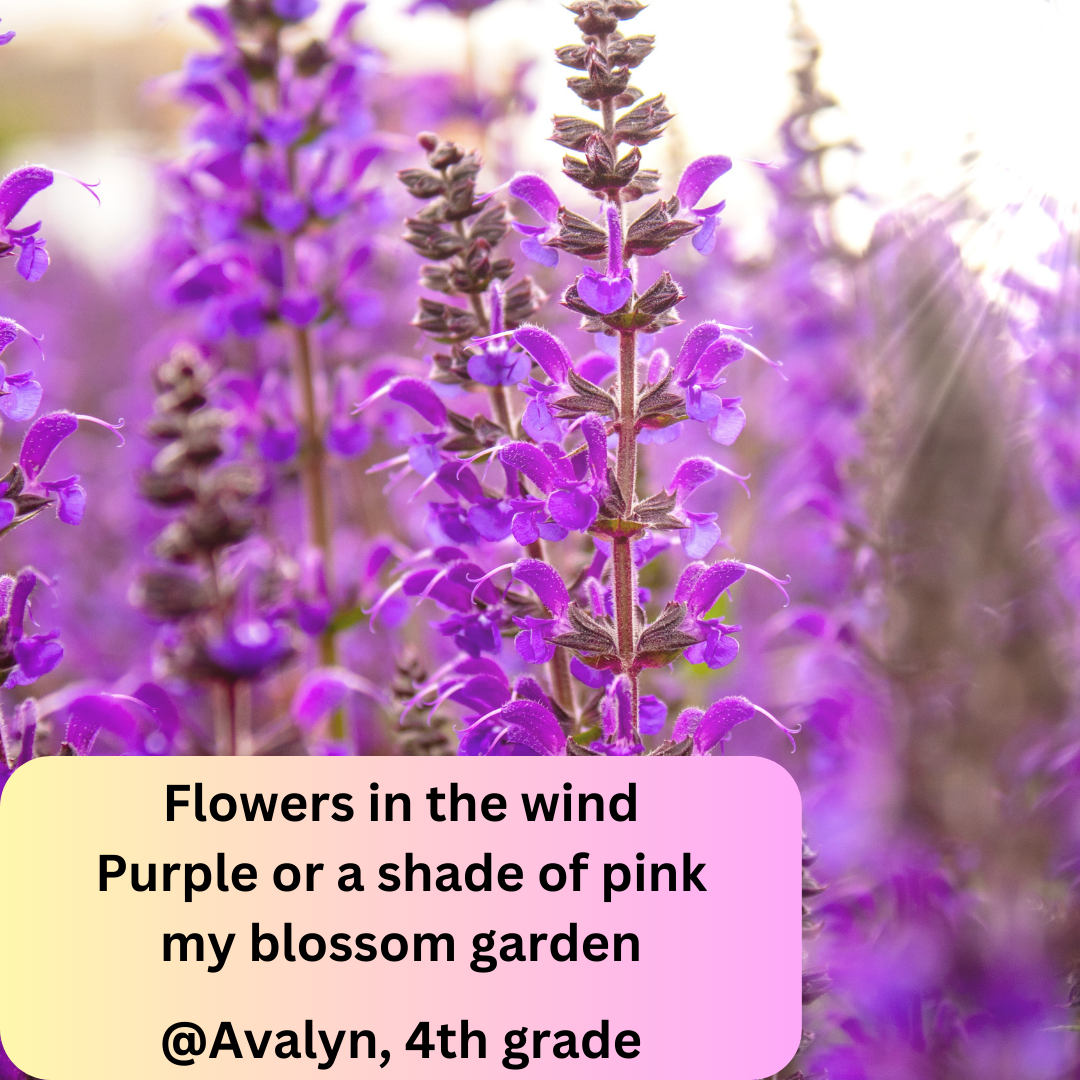
At one of my schools, we are rejuvenating the butterfly garden. The purple salvia has come back after winter and is thick and covered with blossoms. We’ve been spending recess time there among these flowers, tilling and planting new feeding plants. Avalyn, my garden partner, wrote a haiku and asked me to put it on Canva like mine.
The Kidlit Progressive Poem is with Catherine Flynn today. Check on our little immigrant hero.
Margaret Simon lives on the Bayou Teche in New Iberia, Louisiana. She is a retired elementary gifted teacher who writes poetry and children's books. Welcome to a space of peace, poetry, and personal reflection. Walk in kindness.










 Reflections on the Teche