Thank you to Two Writing Teachers for creating an amazing community of writers and a safe, welcoming space to write and share.
Before leaving my students for the year, I offered an assignment from Scholastic Magazines, the My History Project. We spent a Google Meet session looking at Animoto for creating interesting videos.
I knew this project would be a difficult endeavor without me overseeing and coaching the process. I honestly didn’t think any of them would take the time to pursue it.
You are a part of history. You are living through an important and unique time in history—the COVID-19 pandemic. Years from now, historians will learn from the experiences of people who went through it—people like you and your family.
Lauren Tarshis, Scholastic
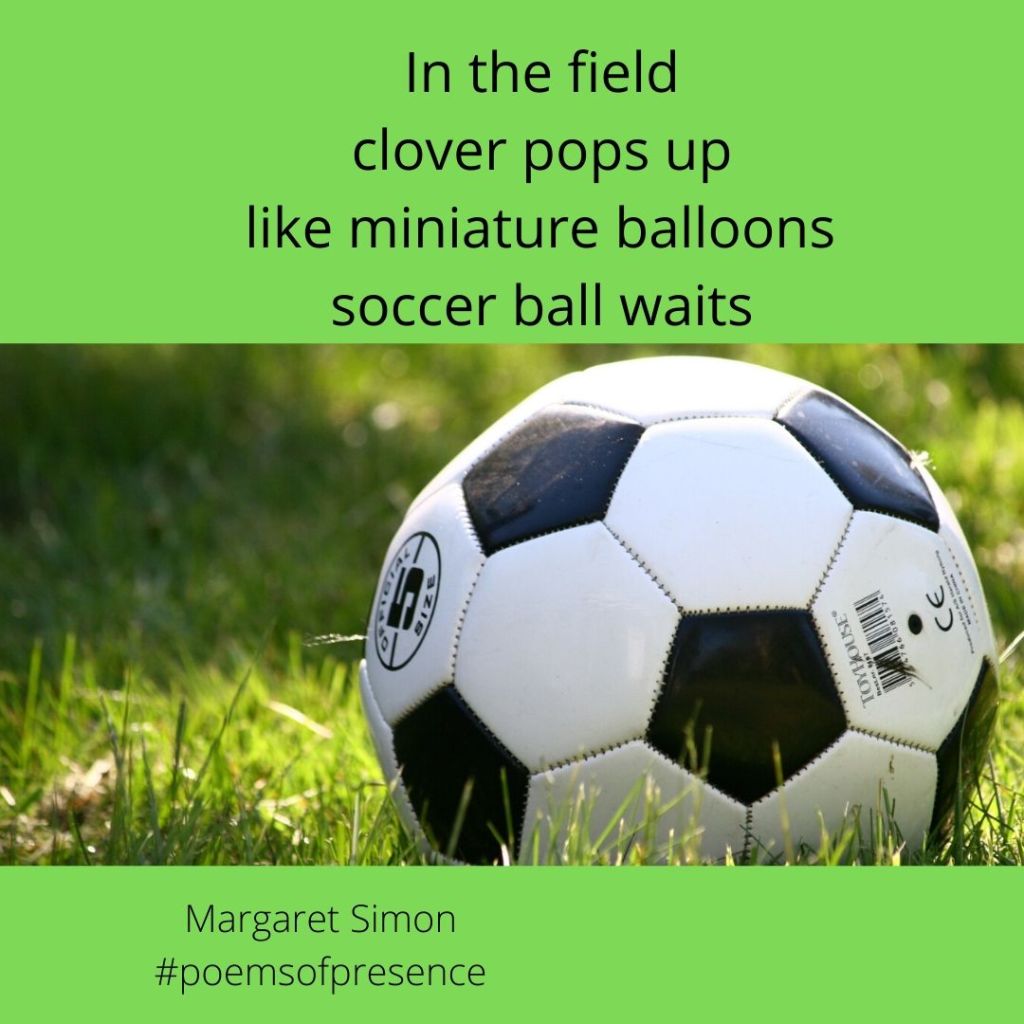
The projects were due to Scholastic by July 1st. I was pleasantly surprised when I got an email from Chloe’s mom with a link to her completed video. I’m excited to share it with you. I love how Chloe used equations “Laura Purdie Salas-style” to communicate a lot with few words. Please share comments to Chloe here, and I will pass them on to her.
Thank you to Two Writing Teachers for creating an amazing community of writers and a safe, welcoming space to write and share.
My milkweed/monarch journey began a little more than a year ago in a school garden. There I met Meadow. (Yes, Meadow is the name of a naturalist in our area.) She taught me about capturing monarch caterpillars and caring for them through emergence to a butterfly. (Slice of Life post here.)
I wanted some host plants of my own, so I took cuttings from the garden and planted them in a flower bed. This spring while sheltering at home, I was able to nurture caterpillars on my screen porch.
In May, I was visiting a friend, safely distanced in her backyard, and she gave me a few milkweed seed pods. I had no idea how to cultivate them, but I planted them in two pots of potting soil and kept them watered.
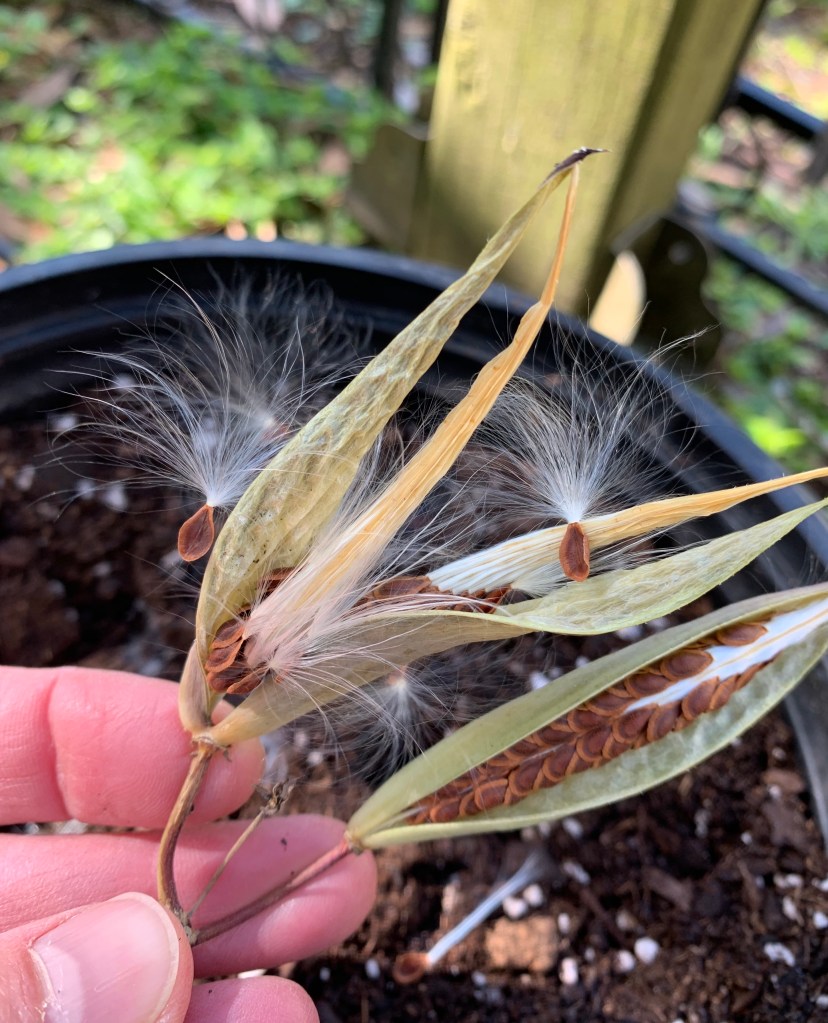
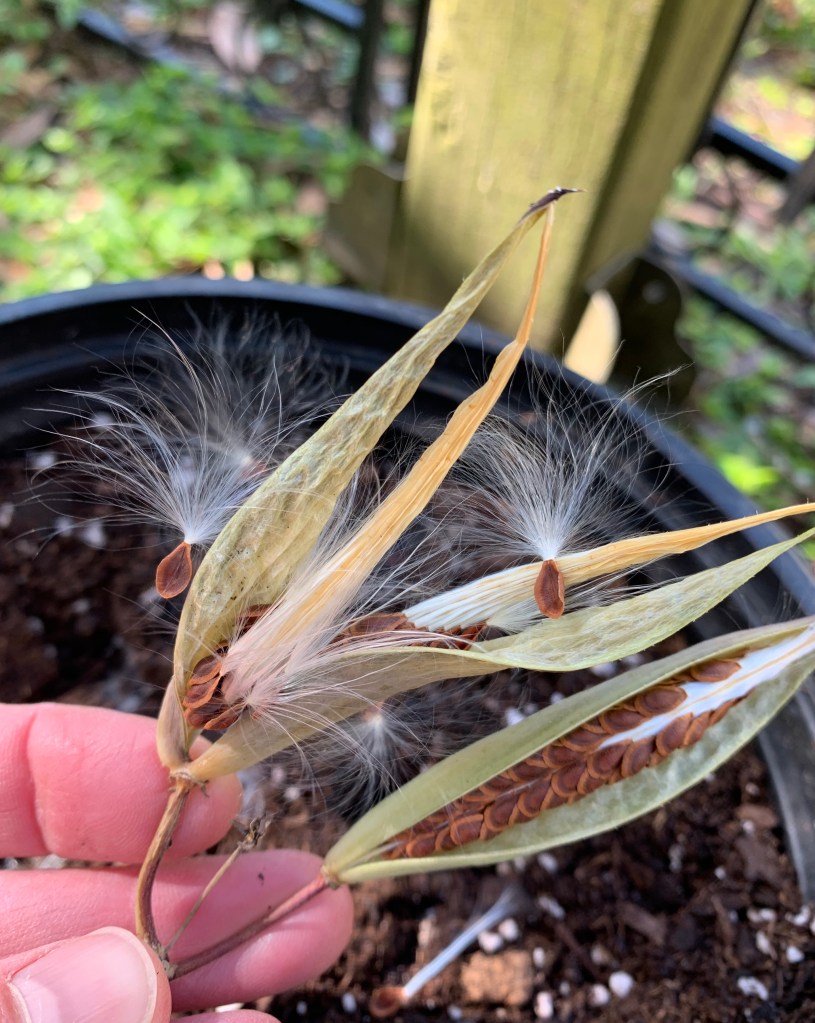
Milkweed seed pods
A miracle of Mother Nature, the seeds sprouted. I had 42 little seedlings about 3 inches high. I could have taken a few and planted them in my flower bed, but what about all the others? I couldn’t bear the thought of letting them die.
I ordered some cheap plastic pots on Amazon, and planted each little sprout. Putting out a call on Facebook, I had some takers. The surprising part for me was how excited the receivers were. And how welcomed the visits!
On Sunday, Sisters Sarah and Emily came by to “rescue” some seedlings. I taught Emily in elementary school. She is now headed to 10th grade, so it was great to see her. (Oh, how I just wanted to hug her!)
Mary and Brittany arrived at the same time, donning masks and staying distanced. We had a wonderful time getting to know each other in a more intimate way than Facebook allows.
On Monday, I delivered seedlings to some friends and took a walk through a beautiful backyard and met a new grandbaby.
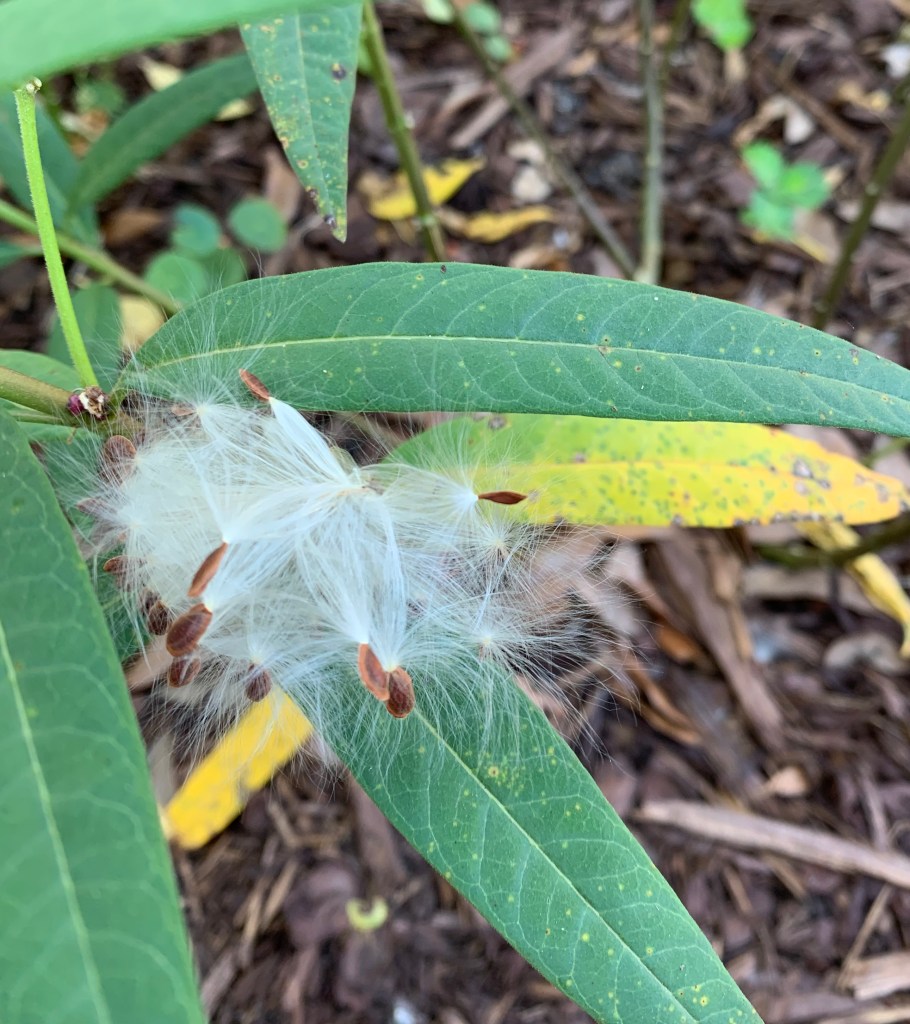
This morning, I noticed an opened seed pod on one of my milkweed plants. The cycle continues…
Milkweed seed pod
Milkweed seeds provide life for the butterfly and hope for this lonely planet, as well as Joy to this lonely planter.
Thank you to Two Writing Teachers for creating an amazing community of writers and a safe, welcoming space to write and share.
There’s a part of me that is afraid to write. I’m afraid to get it wrong. But writing nothing doesn’t feel right, either. So, when I read the daily email from the New York Times, I found a poem of voices from the protestors.
In every city, there’s a George Floyd– my father, my brother, my cousin, my friend– I speak for everybody beaten up. If we don’t fight for change, we’re not going to get it. I took six rubber bullets, but no one kneeled on my neck. I came out peacefully to show my support, Yeah, it’s really like that.
Margaret Simon, found poem from New York Times June 2, 2020
Thank you to Two Writing Teachers for creating an amazing community of writers and a safe, welcoming space to write and share.
Taking a morning walk every day seems a mundane task. It’s exercise, yes, but so much more. Walking is my daily therapy.
This last week, I’ve been walking with a stroller. My daughter is home with her 8 month old while her husband works off-shore. She needs help with the baby while she works from home. We love having them here.
While walking, I stop to chat with neighbors. People are in less of a hurry, and it shows in the way we linger in the shade and talk about the weather, the baby’s eyes, or how we are faring in the pandemic.
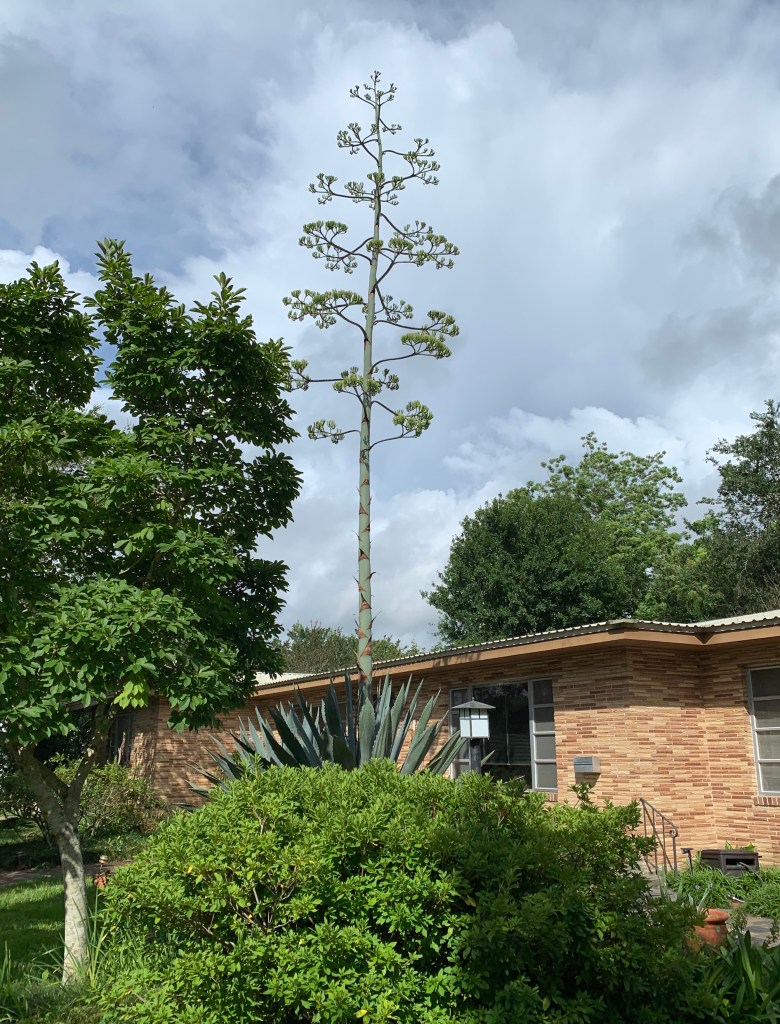
While walking, I stop to check on my neighbor’s century plant, now in full bloom. This plant has been in the process of blooming for ten weeks. It has been a source of wonder and hope for all who have seen it. These plants bloom once in their lifetime. After blooming, it dies. I posted it in April for “This Photo wants to be a Poem.”
Century plant in full bloom.
While walking, I discover Sesame Street songs. When Thomas gets fussy, the best antidote is Elmo. I didn’t know how many popular musicians have done songs with Elmo, Dave Marshall, Beyonce, Ed Sheeran, Adam Sandler, and many more. Even after he’s asleep, I keep listening. The songs are uplifting and catchy.
While walking, I may catch a poem of presence.
Morning walk with stroller Elmo’s song La la la la’s him to sleep.
Margaret Simon, draft
There are some wonderful #poemsofpresence on Twitter. Consider joining us. What mundane task is keeping you going these days?
Thank you to Two Writing Teachers for creating an amazing community of writers and a safe, welcoming space to write and share.
My feelings are all over the place. Starting the day later because I can sleep longer wakes me rested, ready. A walk outside on a perfect spring morning energizes. But then the weight of all that is different, all that is not happening, not normal comes with cleaning out a classroom or picking up items at the store or watching the news.
Poetry helps me cope. In my email inbox, on my Instagram feed, or on the bedside table, I can find a poem that soothes, comforts, or inspires me.
On Twitter this month, a group of us teacher-poets are writing #Poemsof Presence. These poems capture a single moment in time. They honor the present without regard or worry over the future or past. I can find connection and hope in this task. If you are a poem dabbler, join us.
This poem by ADA LIMÓN has come across my path a few times. Today from Gratefulness.org. I love how the title Instructions on Not Giving Up tells me what she wants me to learn from nature. And the poem fills me with a beautiful image.
More than the fuchsia funnels breaking out of the crabapple tree, more than the neighbor’s almost obscene display of cherry limbs shoving their cotton candy-colored blossoms to the slate sky of Spring rains, it’s the greening of the trees that really gets to me.
Thank you to Two Writing Teachers for creating an amazing community of writers and a safe, welcoming space to write and share.
On Friday, Michelle Heindrich Barnes lovingly posted an interview with me over at Today’s Little Ditty. With her Reader’s Spotlights, she asks us to prompt a writing challenge. I wrote this challenge:
The practice of writing poetry is an exercise in mindfulness. To be open to the universe of words and to put them down on a page is nothing short of a miracle. Mary Oliver said, “There is no nothingness—With these little atoms that run around too little for us to see. But, put together, they make something. And that to me is a miracle. Where it came from, I don’t know. But it’s a miracle, and I think it’s enough to keep a person afloat.”
Write a mindful poem about the present moment.
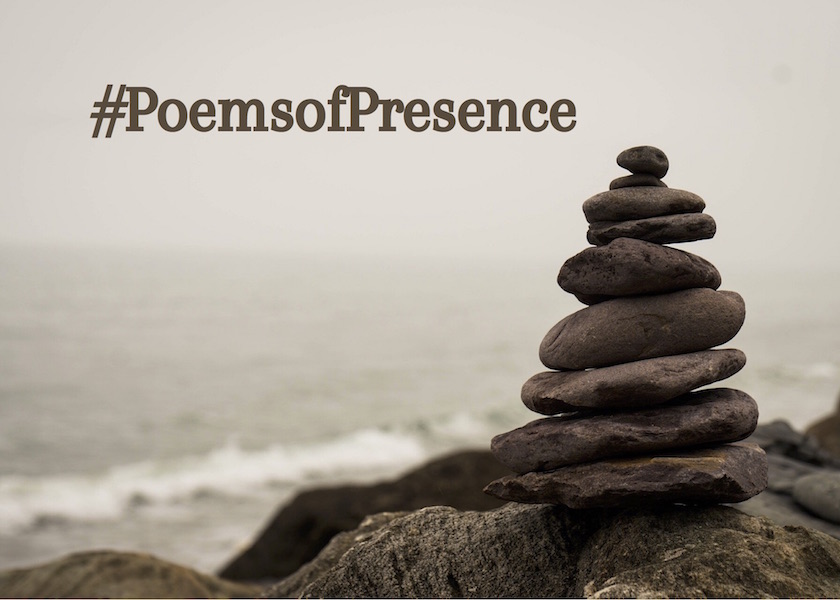
To my pleasant surprise, Heidi Mordhorst and Mary Lee Hahn created a Twitter hashtag #PoemsofPresence to invite poets to write a small poem every day in May. The idea has gathered some following. Michelle created a graphic.
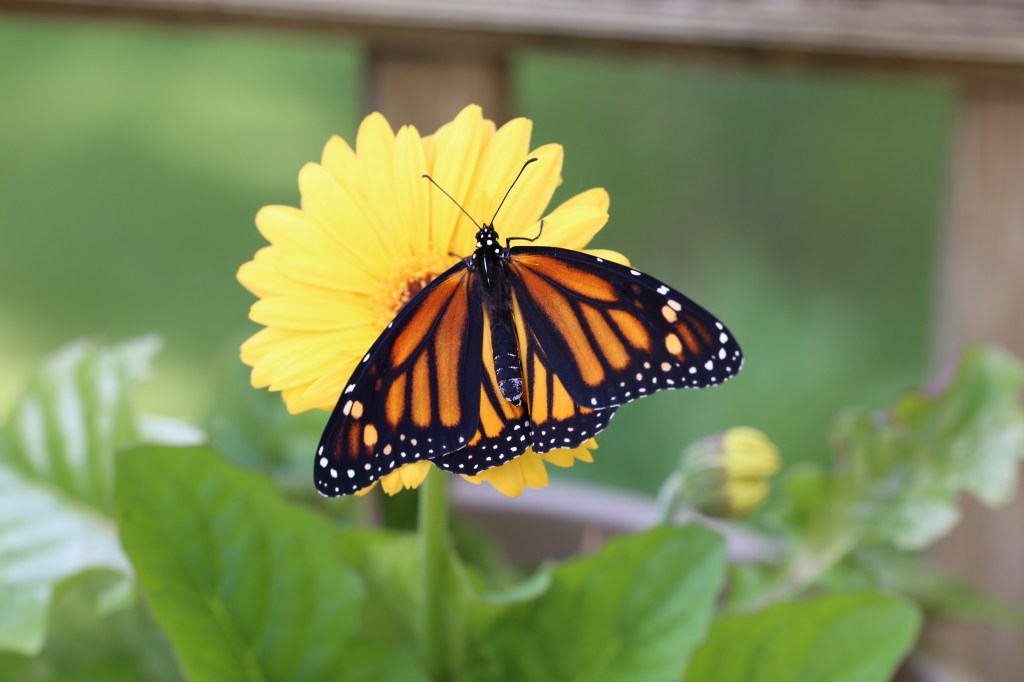
The last of my monarch chrysalises emerged. Last week, I successfully released 7 new monarchs into the sky. My friend and neighbor, who is also a teacher and a photographer, asked to come over to photograph a release. Here’s one of her amazing photos.
Photo by Lory Landry
Monarch Release
Fly, friend, fly! while I walk and walk watching your wings glow like the sunset.
Thank you to Two Writing Teachers for creating an amazing community of writers and a safe, welcoming space to write and share.
Even before we were sheltering in our homes, I enjoyed making connections over cyberspace. Teacher-poet-writer Fran Haley is one of those connections. We read each other. Yesterday she wrote a beautiful blog post “Ode to the Wind.” In that post she wrote about a tweet from Robert MacFarlane with the word of the day: susurrate.
Word of the day: “susurrate”—to whisper, murmur, esp. of noise produced by numerous individual sources of sound (bees humming, leaves rustling, etc.) Compare to “psithurism,” its similarly sibilant sense-sibling, meaning the whispering of wind in trees (from Ancient Greek).
Susurrate was a new word to me when I read MacFarlane’s most amazing, beautiful book the lost words: A Spell Book. A friend who knows I love words and poetry loaned it to me. I presented the first few poems to my students. The last stanza of the second poem “adder” reads:
Rustle of grass, sudden susurrus, what the eye misses: For adder is as adder hisses.
Robert MacFarlane, the lost words
Reading Fran’s post, I remembered that I had written a definito to the word. The definito is a form created by my friend, teacher-poet Heidi Mordhorst. “The definito is a free verse poem of 8-12 lines that highlights wordplay as it demonstrates the meaning of a less common, often abstract word, which always ends the poem.“
I love this form for working with the meaning of a new word in a way that helps someone else understand the word.
As murmur is to whisper a mutter to a babble When grumbles turn to mumbles and a purr softens sound As whisper is to wind a sigh of the weather As a hum is to a hummingbird flying quickly to a flower You may hear something close to silence…susurration.
This poetry month I didn’t commit to write a certain type of poem every day like many other poets I am following. I decided I would write to the muse. Wherever she lead, I would follow.
Among my weekly teacher-poet emails, I get Teach this Poem from Poets.org. This week the poem to teach was “Earth. Your Dancing Place” by May Swenson. One line (“Take earth for your own large room”) jumped out at me and wanted to be a golden shovel. After messing with it in my journal, I created this draft.
Earth’s Heartbeat
If you take
a moment with earth,
touch her for
her soothing spirit, place your
hand on her beating heart, your own
heart will open a door to a large
living room
Margaret Simon, draft 2020
I was also inspired by Catherine Flynn’s post that included the NASA Earth Day poster. The artist, Jenny Motter, used the idea of listening to the pulse of a tree to create this amazing image. There is much more imagery used in the artwork that you can read about at the NASA site.
Traditions can be a comfort when life is not as it should be. The tradition of a Kidlit Progressive Poem started in 2012 by Irene Latham. Last year sometime she decided to pass it on. I said yes to coordinating this year, and so far, it’s been an easy job. The Progressive Poem is such a well-oiled machine that it just works. Each poet takes their turn. I haven’t had to remind anyone…yet.
This year Donna Smith started us off with a choose-your-own-adventure style by giving a choice of two lines. Subsequently, each poet has done the same. Choose a line. Compose two lines. Move on.
The first stanza wasn’t following a strict rhyme scheme. However, stanzas 2 and 3 unfolded in rhyming couplets.
Leave it to Kat Apel to stir things up a bit. From across the globe in Australia, she introduced some suspense. I’m good with that, but the two end words were snaps and glimpse. Try a search for rhymes, and you get impossible words like claps and wimps. When I left a comment for “katswhiskers”, she responded, “I confess, I wasn’t thinking ahead to any rhymes when I wrote my line. But now that you say that… I think a disruption of flow (and rhyme) is a good thing in a turning point. #permissiontobreakrules”
Sweet violets shimmy, daffodils sway along the wiregrass path to the lake. I carry a rucksack of tasty cakes and a banjo passed down from my gram.
I follow the tracks of deer and raccoon and echo the call of a wandering loon. A whispering breeze joins in our song, and night melts into a rose gold dawn.
Deep into nature’s embrace, I fold. Promise of spring helps shake the cold. Hints of sun lightly dapple the trees, calling out the sleepy bees.
Leaf-litter crackles…I pause. Twig snaps.
As I pass this pleasant romp to the lake on to Leigh Anne, I decided to go the way of near rhyme. Will our hero fall? Or will they handle the pressure with mindfulness? You choose…
Option 1: I stumble, reach out… there’s nothing to grasp.
Option 2: I gasp! Shudder! Breathe out. Relax…
You can follow the Progressive Poem using the links on my sidebar. Thanks for stopping by.
Margaret Simon lives on the Bayou Teche in New Iberia, Louisiana. She is a retired elementary gifted teacher who writes poetry and children's books. Welcome to a space of peace, poetry, and personal reflection. Walk in kindness.