Linda Mitchell is gathering posts with another fun clunker exchange.
A friend of mine suggested I listen to a podcast with Jane Hirshfield. It was a lovely hour. Even though I split it between multiple shorter listens, I want to go back and listen straight through. You can find it on Spotify on the Ezra Klein Show.
I write a poem-a-day, but honestly, I don’t always write a good, shareable poem each day. This week the only one I somewhat like is an acrostic to a Jane Hirshfield quote. One of my students found a Mary Englebright quote “It’s just a bad day. Not a bad life.” I’m applying that to my poetry writing. “It’s just a bad poem. Not a bad poet.” I like Linda’s idea of exchanging clunkers. Maybe some of my starts and fits will bloom on another page. For today, it’s Anything.
Happy May! In many ways, I’m sad that it’s May. I looked over the school calendars, and I have fewer than 10 days left with my students. May’s calendars are worse than December. They are full of “Fun Days”, field trips, and “Awards Day”… Where are the time-with-my-students days?
Of course, there are some wonderful days on the same calendar: Teacher Appreciation Week, Mother’s Day, Memorial Day, Sleep-in-it’s-summer days.
Today is Inklings Challenge of the Month Day. Linda Mitchell hit us with an interesting challenge to exchange poems and “Fiddle with, play with, tinker, tear-apart, be inspired or stumped by” the poem you were given. I chose to find a nestling ( à la Irene Latham). On this Canva design, you can see the poem Linda sent and my nestling.
Full poem “Star Says” by Linda Mitchell Nestling “Star” by Margaret Simon
Links to other Inklings. Molly had my poem to fiddle with. I can’t wait to see what she did with it.
If you followed the Progressive Poem, you can find the poem as a whole at this link: 2024 Kidlit Progressive Poem: Border Crossing This year felt different, a higher stakes dramatic story evolved. Thanks to everyone who participated.
I will be participating in a poetry reading event on Saturday night. It’s been a while since I have read for an audience. Wish me luck.
This week is state testing week, so I did not pull my gifted students out from their regular classrooms. I’m on stand-by to help if needed. But I do get to see my youngest ones. William, first grade, was only recently placed in gifted services. His gifted brain is so full of ideas that he can barely settle on one thing. I asked him to work with me on a haiku about a rainbow. We talked about how a haiku form captures a single moment in time, usually about nature, and has 3 lines, short, long, short. We played around with word order and placement of his ideas. Then he came out with the word “surprise.” Ah yes, that’s it!
Reflex (relects) in the warter (water). a rainbow comes out of clouds. surprise in the sky
William’s first haiku, 1st grade
Carson in 2nd grade has been working with me all year long. He’s more independent in his writing, but still needs reassurance. I showed him a video from Mystery Science about how the rain becomes a prism to refract the white light into a colorful rainbow.
Rainbows are still a mystery to me even though I have this knowledge. When I see an actual rainbow in the sky, I often take a picture. My husband knows to stop for rainbows. If you are drawn to them, to Molly’s amazing photo, and want to add your writing to the collection, go back to this post on Wednesday.
Sunlight prism in the water makes rainbows arch of colors
Carson, 2nd grade
While I was checking my Fanschool post, I realized that even though Adelyn was not coming to class, she checked on our weekly “This Photo Wants to be a Poem” post and wrote. She is crazy about all things mythological. Can you tell?
The great color arc, stretching above us. As water vapor shimmers bright in shining light, Iris glows.
Adelyn, 5th grade
After a skipped day on Thursday (no worries, just busy life), Karin introduces a new character.
For Poem in Your Pocket Day, I invited Marcie Flinchum Atkins to join my students by Zoom. We were able to get a small 30 minute window of time while she could visit. What a treat!
Marcie is a master at haiku, and no wonder, she writes one every day. She usually writes in a small notebook to photos that she has taken. Beautiful photos!
Her easy-going way led to a comfortable, safe environment for writing. My students wrote. I wrote. Like Marcie, I wanted to use a photo and Canva to design my haiku for publication. Maybe one day I’ll send them out on postcards.
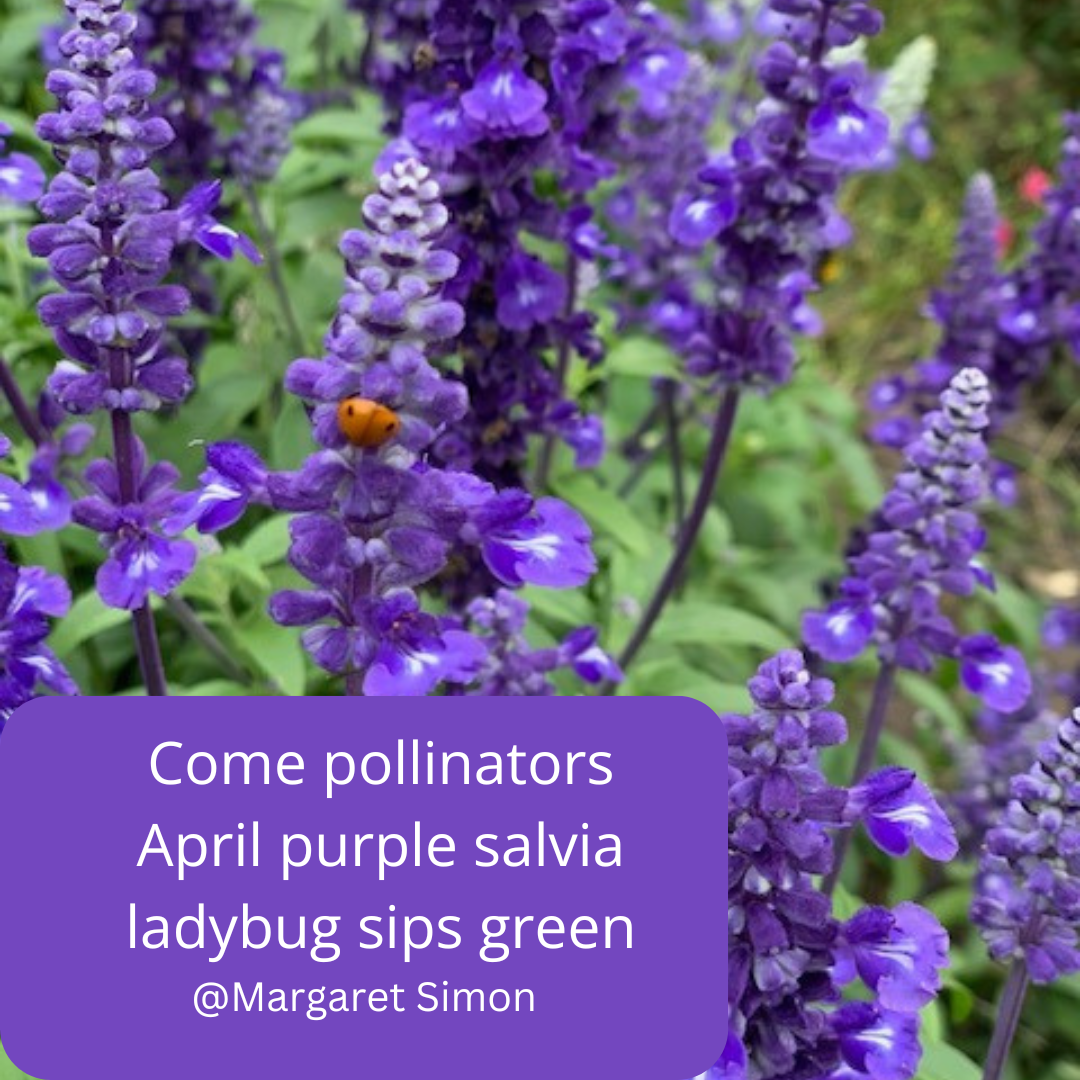
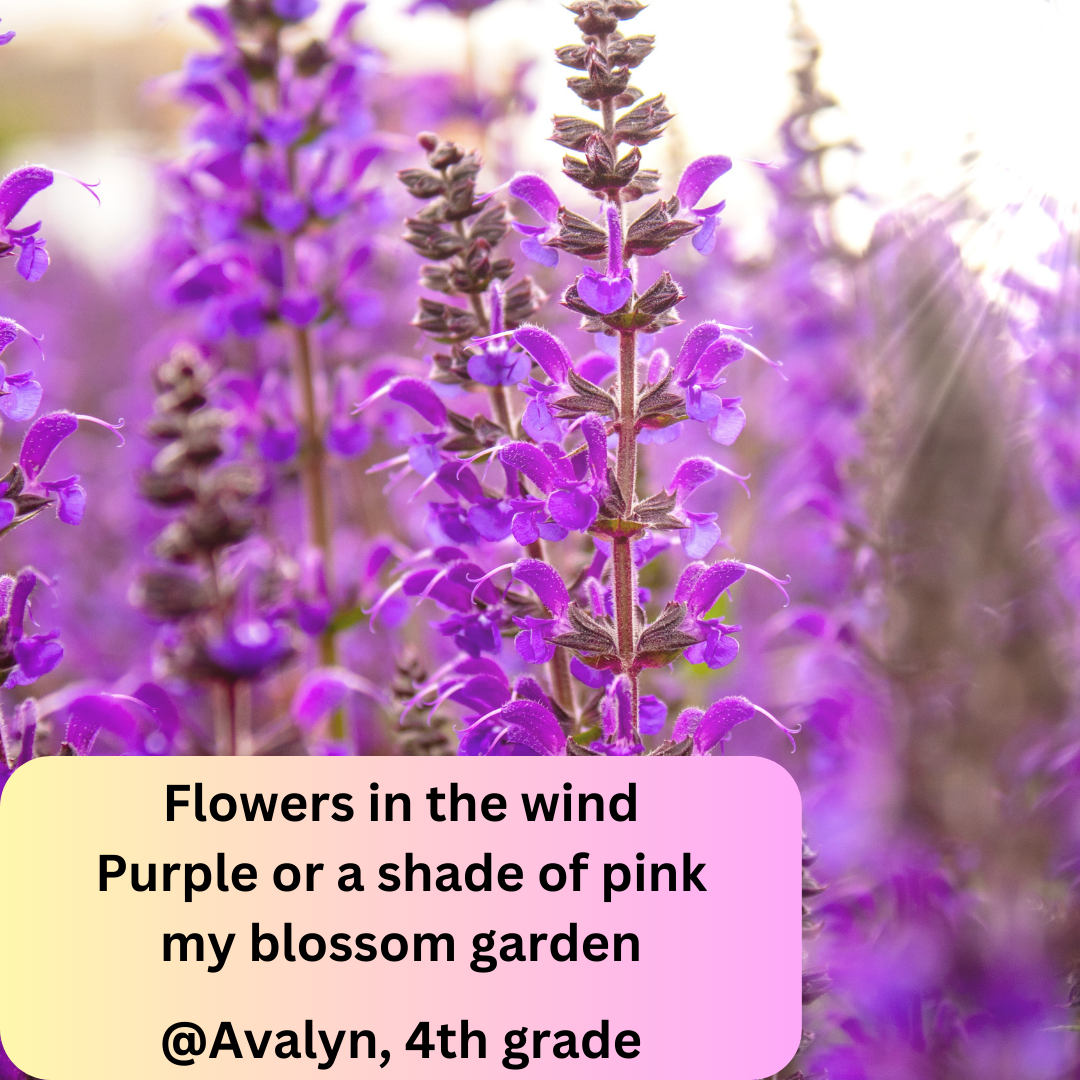
At one of my schools, we are rejuvenating the butterfly garden. The purple salvia has come back after winter and is thick and covered with blossoms. We’ve been spending recess time there among these flowers, tilling and planting new feeding plants. Avalyn, my garden partner, wrote a haiku and asked me to put it on Canva like mine.
The Kidlit Progressive Poem is with Catherine Flynn today. Check on our little immigrant hero.
Kidlit Progressive Poem is moving along with apprehension and worry for our two refugees. See the latest line at Opposite of Indifference with Tabatha Yeats.
Being a part of the Poetry Friday community has given me much to be grateful for. We are writing together a wonderful Progressive Poem. Today’s line is with Denise Krebs and yesterday was Linda Mitchell. I’ve met these poets along with many others through our weekly postings. These posts have led to collaboration on other projects. Linda is a writing group partner and Denise and I are a part of Ethical ELA and a book we are collaborating on. (More on that later.) I would never have met them in real life. The gathering of a like-minded community of writers has all occurred right here with my blog.
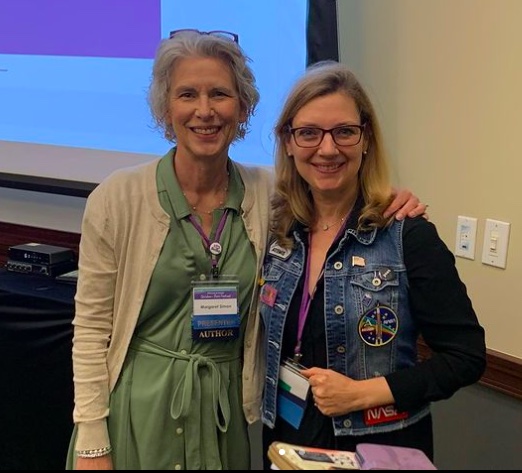
This week I attended the Fay B. Kaigler Children’s Book Festival and had the privilege of presenting with Irene Latham. Irene and I met through Poetry Friday and in person years ago at the Louisiana Book Festival. We’ve presented together before at NCTE.
Irene is such a humble leader. She turns every eye away from herself toward you. She makes everyone in the room feel like confident poets. What joy! You can see our slideshow here.
Margaret and Irene presenting at Fay B Kaigler Children’s Book Festival: “Poetry as a Time Machine”
Next year, you should consider attending the festival in person. They invite the most inspiring speakers. This year I heard keynotes from Lesa Cline-Ransome as well as her talented husband, James Ransome, Cynthia Leitich Smith (Southern Miss Medallion), and Juana Martinez-Neal who won the Coleen Salley Storytelling Award. Jason Chin, deGrummond Children’s Literature Lecturer, impressed me with his curiosity about the world and how that curiosity has led him to illustrating. He won a Caledecott Medal for Watercress. The book that impressed me the most was The Universe in You: A Microscopic Journey (Caldecott and Sibert Honoree). As you can see, the Fay B Kaigler invites some of the best authors and illustrators in the children’s literature realm.
And now for a poem. Following Ethical ELA VerseLove has kept me writing a poem each day. Yesterday’s prompt was an ode to the unworthy. I’ve lived in Louisiana and Mississippi all my life, so I’ve had many hurricane experiences. I wrote an Ode to the Hurricane.
Ode to the Hurricane
As the wild winds swirl together above the Gulf, you become a massive creation threatening a nation.
No matter how we prepare– buy bread, water, flashlights, charge up Sparky, the generator, your fierce presence is feared.
They give you gentle names: Katrina, Ida, Andrew, Camille. Names that will live in history. Names that define an era.
After you pass through, an eerie calm descends upon a community. We band together to feed each other, to clean up destruction you left behind.
Oh, hurricane, you are the hint of end times. Behold your survivors–we tell your story.
This first Friday of National Poetry Month, we have an Inklings challenge brought to us by Mary Lee Hahn. Mary Lee asked us to write a haiku sequence about poetry without using the word poetry.
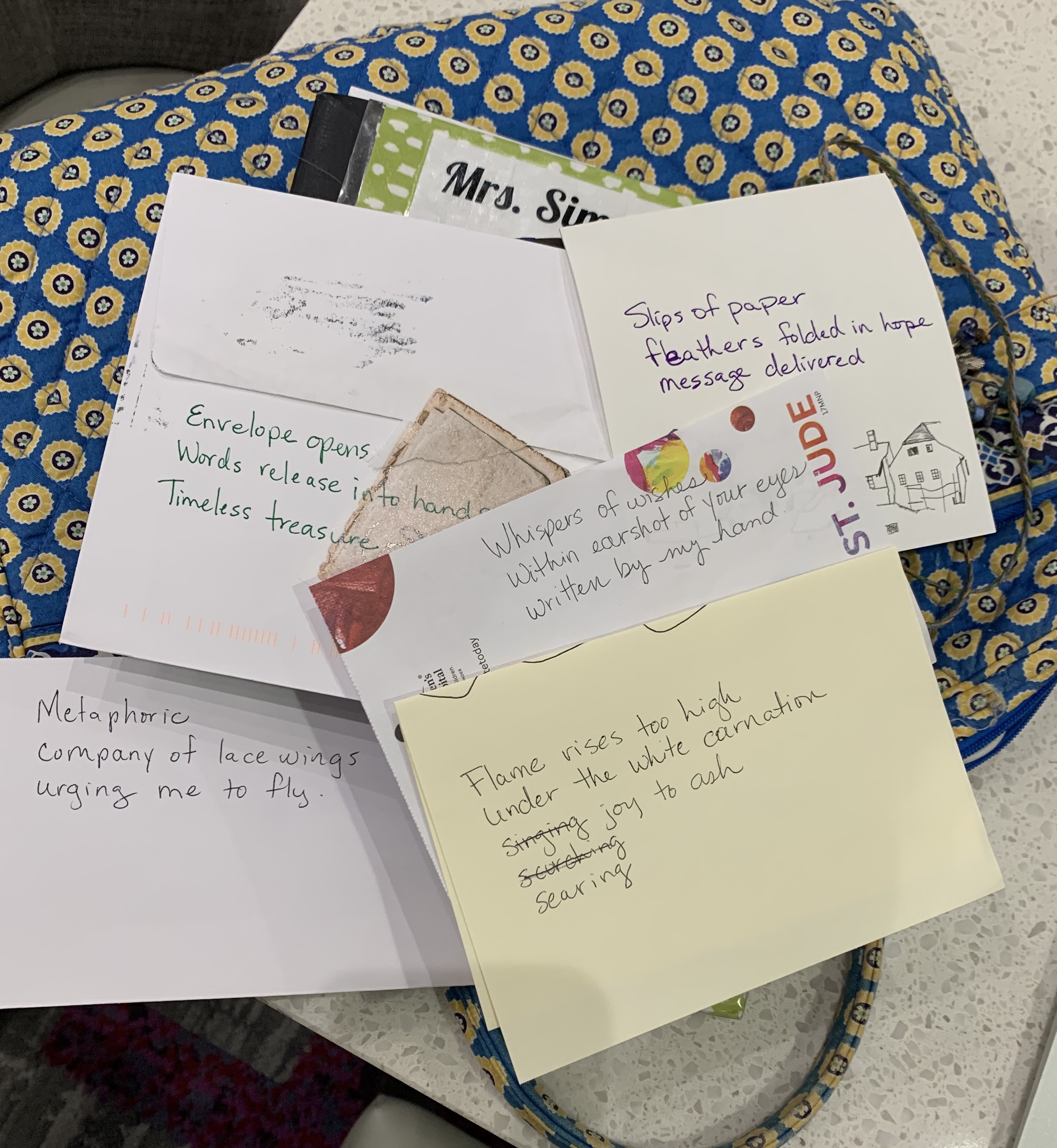
I’ve been on an Emily Dickinson kick watching the surreal series “Dickinson” on Apple TV and reading through a dog-eared collection of her poems. When I read Mary Lee’s challenge, I decided to write individual haiku on slips of paper from the pile on the kitchen counter. That way I could arrange them in a logical/ illogical/ artistic/creative way.
random collection of haiku
I played with the order and this is what I have, for now. One of the best parts of writing poetry is revising, so I am open to rearranging and rewording or throwing it all into the flame.
Envelope opens words release into hands timeless treasure
2. Flame rises too high under the white carnation searing joy to ash
3. Whispers of wishes within earshot of your eyes written by my hand
4. Slips of paper feathers folded in hope message delivered
5. Metaphoric company of lacewings urging me to fly
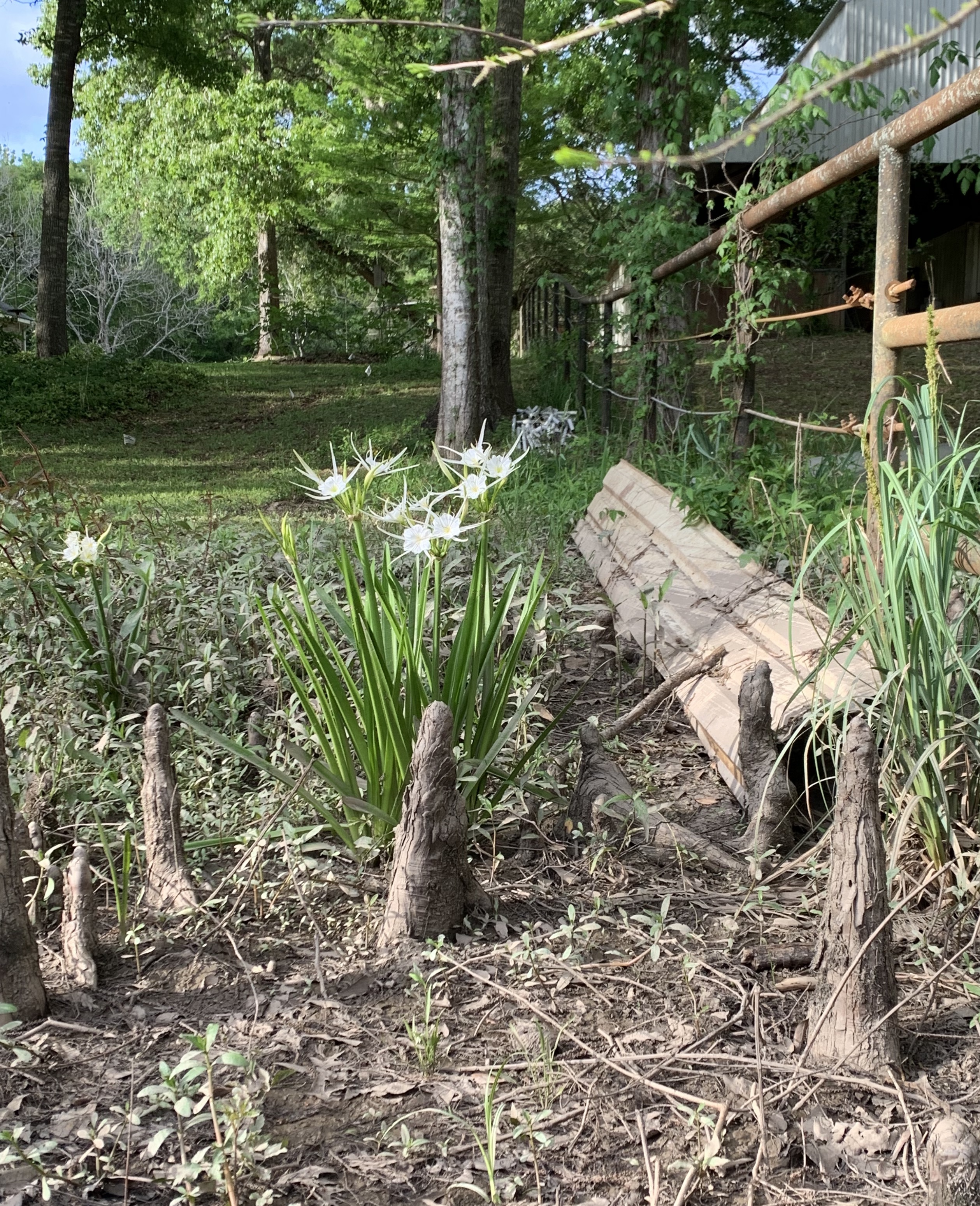
Spider Lily among cypress knees on Bayou Teche, Louisiana
I wanted this swamp lily to be a star lily, but research is telling me it’s a variety of spider lily. On Ethical ELA, the prompt by Wendy Everard asks us to explore the place of a favorite poet. I chose Mary Oliver and a striking line from her poem Fall: “what is spring all that tender/ green stuff”
I’m not sure what heaven is but amazement like spring when all green that was hiding in tender seed fills green bridal bouquets blossoming beautiful stuff.
Margaret Simon, draft
I’m also writing a word poem each day. Today’s word is vernal which means of, in, or appropriate to spring. Today’s form is an acrostic.
Variety of colors eagerly popping- resurrection- nature’s recital. April, I Love you.
To begin our National Poetry Month adventure, start here with the Kidlit Progressive Poem. Today’s first line is with Patricia Franz at Reverie.
At Ethical ELA, Kim Johnson invites us to introduce ourselves using a hashtag acrostic. I was challenged by the repeated letters of my name. Like the spelling of Mississippi, I’ve always enjoyed the way my name repeats when spelled out: M-a-r-g-a-r-e-t.
#Margaret
#Mother of three strong women #Ask me to dance #Romantic hopelessly #Grandmother of four potential difference-makers #Artist of poetry #Reserved until I trust you #Early riser #Teacher of gifted children
I love a good form for poetry and one I’ve played with often is Heidi Mordhorst’s definito. It is a poem of 8-12 lines appealing to children that defines a word. The defined word ends the poem.
Feline flexibility, a natural mystery. That deliciously pink belly bouncing when she runs can’t hide a surplus of fat designed to save her, but try as you might to touch this soft spot, Watch out! She will bite. Don’t touch a cat’s tum-tum… primordial pouch.
I was inspired by Michelle Kogan who wrote a pantoum for a hippo. I recalled the hippos of my Africa tour in 2016. I’ve been reading Margarita Engle’s verse novel Singing with Elephants. I collected lines from the verse and went to work on the pantoum form. This form is like a puzzle. Michelle fit hers together with rhyme. I didn’t use rhyme. When I googled pantoum, there doesn’t seem to be a rule about rhyme or line length. The rules show that each stanza is four lines with this pattern: (1,2,3,4) (2,5,4,6) (5,7,6,8) (7,3,8,1)
The Poetry Sisters respond to a challenge on the last Friday of the month. This month they are writing animal pantoums. Our host Tricia has more about the form and links to other Poetry Sisters posts.
The beauty of an elephant’s hum-hug, a language as common as buzzing bees, simple as spending time with kindness. Elephants embrace us with their music.
With a language as common as buzzing bees, I can catch good luck as it passes. Simple as spending time with kindness, these animals move like magical mountains.
I catch good luck as it passes: Photo from Africa is a touchstone of memory. These animals move like magical mountains with a touch of heavy gentleness.
My photo from Africa is a touchstone of memory, as simple as spending time with kindness– A touch of heavy gentleness– the beauty of an elephant’s hum-hug.
Margaret Simon, with thanks to Margarita Engle and PÁDRAIG Ó TUAMA.
Margaret Simon lives on the Bayou Teche in New Iberia, Louisiana. She is a retired elementary gifted teacher who writes poetry and children's books. Welcome to a space of peace, poetry, and personal reflection. Walk in kindness.









 Reflections on the Teche